
Membership Platform vs Course Platform Benefits: Which One Fits Your Community?
Maya Ellison
Content Lead, HopMembers
Last updated: 24 November 2026 · 11 min read
Table of contents
- What a Membership Platform Actually Does
- What a Course Platform Actually Does
- The Core Difference: Access Control vs Content Delivery
- Feature and Ops Tradeoffs in Real Scenarios
- Pricing Angles Compared
- Migration Notes: Switching Between Categories
- Decision Framework: Which One Should You Choose
- Where HopMembers Fits (and Where It Doesn't)
- FAQ
- Related video
- Key facts

If you're trying to monetize an audience, the membership platform vs course platform benefits question comes up early — usually right after you've validated that people will pay you for something. Both categories solve a real problem: turning expertise or access into recurring income. But they're built around fundamentally different mechanics, and picking the wrong one means months of wasted setup, awkward pricing, or a community that churns because the tool doesn't match the behavior you're trying to support.
This comparison breaks down what each type of platform actually does operationally, who it fits, where the pricing logic diverges, and how to think about migration if you've already started with one and are reconsidering. We'll also cover where a Telegram/Discord-focused tool like HopMembers fits into this picture — and where it explicitly doesn't.
What a Membership Platform Actually Does
A membership platform's core job is access control tied to recurring payment. The workflow is simple on paper: someone pays monthly or annually, they get access to a private space (a Telegram channel, a Discord server, a gated webpage), and if they cancel or their payment fails, that access gets revoked automatically. The value isn't really the payment processing — Stripe or PayPal can do that alone. The value is the automation layer that connects "payment status" to "access status" without you manually checking a spreadsheet and kicking people out by hand.
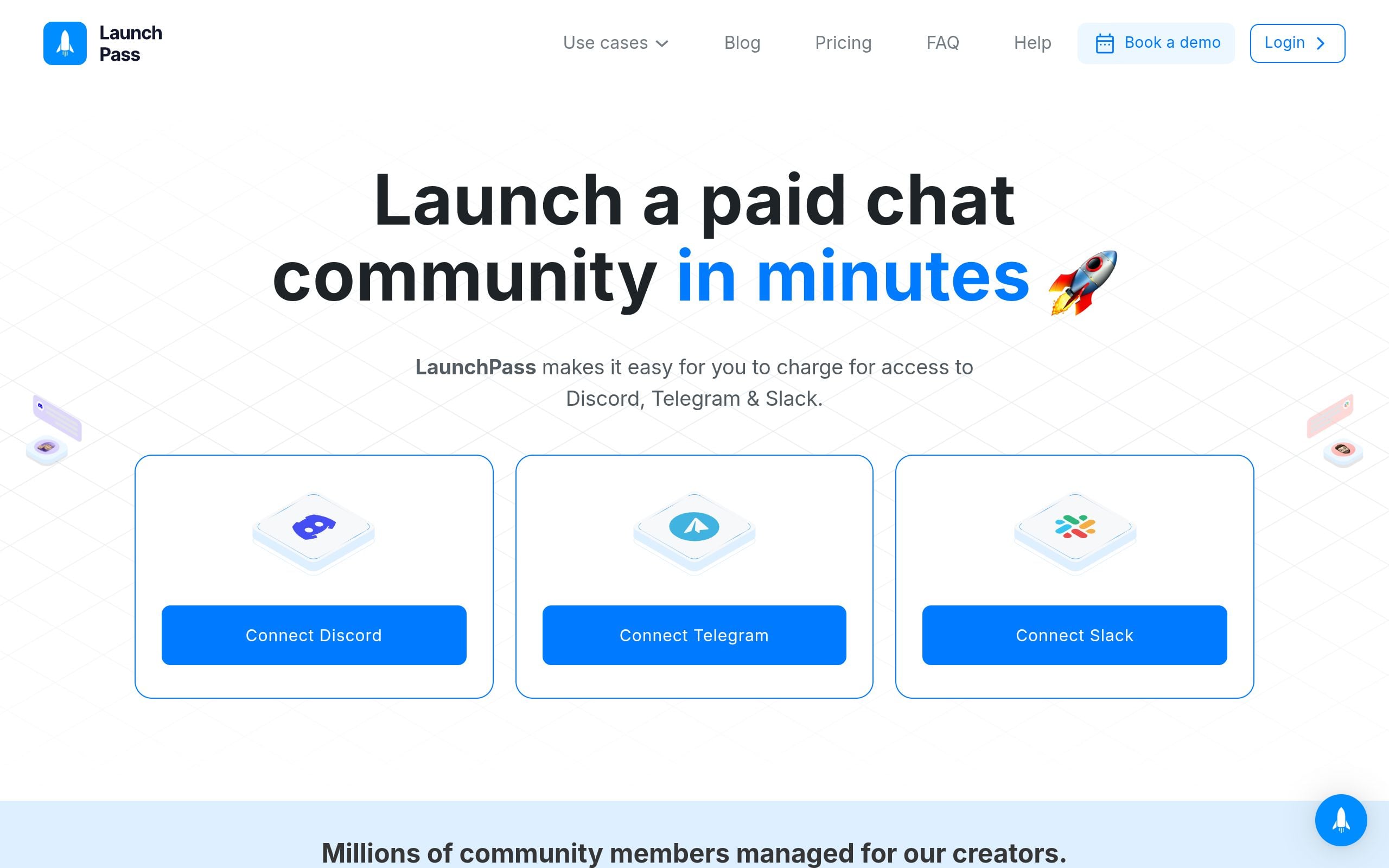
This matters more than it sounds. Creators running paid Telegram groups or Discord communities without automation spend hours every week on account reconciliation: who paid, who didn't renew, who needs to be removed. A membership platform exists specifically to kill that manual work. Patreon popularized this for creator tipping and perks; LaunchPass built a version specifically for Slack, Discord, and Telegram gating. HopMembers follows that same access-automation logic but keeps the surface area narrow: create a membership page, connect your Telegram or Discord (or WhatsApp group), collect payment, and let access grants and revocations happen automatically when someone subscribes, cancels, or gets refunded.
What a Course Platform Actually Does
A course platform's core job is structured content delivery with progress tracking. Think modules, lessons, quizzes, completion certificates, and often a drip schedule that releases content over weeks. The business model underneath is usually one-time payment (sometimes with payment plans) rather than ongoing subscription, because the value proposition is "you get this finished curriculum," not "you get ongoing access to an evolving space."
This is a meaningfully different product shape. A learning management system (LMS) is optimized for sequencing and assessment — not for the social, always-on dynamics of a chat-based community. If you've ever tried to run a live discussion inside a course platform's comment section, you've felt the friction: it's built for async learning, not real-time conversation. The learning management system category exists precisely because tracking who finished lesson 4 of 12 requires different data than tracking who's still an active paying member of a chat group.
The Core Difference: Access Control vs Content Delivery
Strip away the marketing and the distinction comes down to this: membership platforms manage who is allowed in right now, while course platforms manage what someone has consumed over time. Both can technically gate content behind payment, but the mental model each is optimized for is different, and that shapes everything from pricing to churn handling to how you communicate value to a prospective buyer.
Who Membership Platforms Fit
Membership platforms fit creators running something that's alive and ongoing — a trading signals Telegram channel, a Discord server with daily discussion and exclusive drops, a paid WhatsApp group for niche advice, a fan community that gets new content weekly. The value is continuity: members pay because the thing keeps producing value, not because they're working through a fixed syllabus. If your offer is "stay subscribed and get access to what's happening now," you're in membership territory, and tools like HopMembers, Patreon, LaunchPass, InviteMember, Sublaunch, and MyMembers.io are all built around that loop.
Who Course Platforms Fit
Course platforms fit creators who've packaged a defined transformation — "learn X in 6 weeks," "master this framework," "get certified in Y." The value is completion, not continuity. Buyers expect a start and an end. If your audience is paying for a specific outcome delivered through structured lessons rather than ongoing access to you or a live group, a course platform's tracking and sequencing tools will serve you better than any access-automation tool will.
Feature and Ops Tradeoffs in Real Scenarios
It helps to walk through actual operating scenarios rather than compare feature lists, because the lists look similar on marketing pages but behave very differently in practice.
Scenario: Telegram Trading Signals Community
You're running a Telegram channel that posts trade alerts daily. Subscribers pay monthly because the value resets constantly — yesterday's signal doesn't matter much today. If someone's card declines, you need them out of the channel within hours, not at the end of a billing cycle, because they're consuming live, valuable information without paying. A course platform has no concept of "revoke access from a live channel the moment a payment fails" — it wasn't built for that. This is exactly the operational problem a membership platform solves: payment status and channel membership stay in sync automatically, so a failed renewal triggers removal without you manually checking Telegram admin lists every morning.
Scenario: Cohort-Based Course Creator
You're selling a structured 8-week course on, say, copywriting fundamentals, with video lessons, worksheets, and a final assessment. Buyers pay once (or in two installments) and expect the material to still be there in six months when they want to revisit it. Here, a membership platform's access-revocation logic is actually the wrong fit — you don't want to accidentally lock someone out of material they already paid for just because a subscription model assumption doesn't apply. A course platform's content library, progress bars, and completion tracking are doing the actual job the buyer is paying for.
Pricing Angles Compared

Membership platforms typically price around transaction percentage plus sometimes a flat monthly fee, because the ongoing value they provide (continuous access automation) scales with continuous revenue. Course platforms often price with flatter monthly software fees regardless of sales volume, because the heavy lifting (hosting lessons, tracking completion) doesn't change much whether you have 10 or 1,000 students actively progressing through the same fixed content.
This has a practical implication: if you're running a high-volume, lower-ticket recurring community (say, $15-30/month Telegram access), a percentage-based membership tool usually makes more sense early on because you're not paying a large flat fee before you've proven demand. If you're selling a $500 one-time course to a smaller number of buyers, a flat-fee course platform often costs less per dollar earned once you clear a modest sales threshold. Read pricing pages carefully — payment processor fees (Stripe's cut) are separate from platform fees in both categories, and some tools bundle them while others don't.
Migration Notes: Switching Between Categories
Migrating from a course platform to a membership-style tool (or vice versa) is rarely a clean export-import. Course platforms store structured lesson data, quiz results, and completion states — none of which transfers meaningfully into a membership tool that only cares about active/inactive payment status. Conversely, if you're moving a Telegram or Discord community off one access-automation tool onto another, the real migration work is re-connecting the bot/integration to your channel or server and re-pointing your checkout links, not moving content, since the "content" in most paid communities already lives natively in Telegram or Discord, not inside the platform itself.
Practical migration checklist regardless of direction: export your member/subscriber list with emails, set a cutover date, communicate it to your audience in advance, keep both systems live in parallel for one billing cycle if possible, and test the access-revocation flow with a dummy account before you fully switch off the old tool. Skipping that test step is the single most common cause of members losing access unexpectedly during a platform switch.
Decision Framework: Which One Should You Choose

Choose a membership platform if your offer is ongoing — a chat community, a signals channel, a fan group, a mastermind that evolves — and you need payment status and access to stay automatically in sync on Telegram, Discord, or WhatsApp. Choose a course platform if your offer has a defined beginning and end, your buyers expect to track progress through sequenced material, and the value is a completed transformation rather than continuous access.
Some creators genuinely need both: a course to onboard people with a clear curriculum, and a paid community to keep them engaged afterward. In that case, it's usually cleaner to run them as two separate products with two separate tools rather than forcing one platform to do both jobs poorly. Our membership platform vs online course platform breakdown goes deeper into hybrid setups if that's your situation.
Where HopMembers Fits (and Where It Doesn't)
HopMembers is built specifically for the membership side of this comparison — and specifically for Telegram, Discord, and WhatsApp communities, not for structured course delivery. The flow is deliberately narrow: you create a membership page, connect your Telegram channel or Discord server, a member pays, access gets granted automatically, and if they cancel or get refunded, access gets revoked without you touching an admin panel. You can see member status and renewal activity through the members dashboard and track growth trends through analytics, and the membership page itself (built through pages) is what you send people to instead of a generic checkout link.
It does not replace Telegram, Discord, or WhatsApp — it sits on top of them to handle the monetization and access-control layer those apps don't natively provide. It also doesn't try to be a course LMS; if you need lesson sequencing, quizzes, or completion certificates, that's a different tool, and pretending otherwise would just create a worse experience for your buyers. Where HopMembers wins specifically is against broader tools like Patreon or LaunchPass when your entire use case is Telegram/Discord/WhatsApp access automation and you don't need Patreon's tipping/perks model or a heavier general-purpose setup. If you're an individual creator or solopreneur running one or two paid communities rather than a team managing a content business, that focus tends to mean less configuration overhead to get a working paid group live.
If you're still deciding, our guides on best membership platforms for Discord and automating Discord server access go into the access-automation mechanics in more detail, and our Patreon vs self-hosted membership site comparison covers the tradeoffs if Patreon's broader model is also on your shortlist.
FAQ
Can a membership platform also host a course?
Not in the structured sense a dedicated LMS does. A membership platform can gate access to a resource library or a set of pinned posts in a channel, but it won't track lesson-by-lesson completion, quiz scores, or certificates. If structured progress tracking is core to your offer, pair a course platform for delivery with a membership tool only if you also need ongoing community access alongside it.
Is it cheaper to run a paid Discord server through a membership tool or a course platform's community add-on?
Usually a dedicated membership/access tool, because course platforms that bolt on community features typically charge for the full LMS tier even if you're only using the community portion. Compare the actual monthly cost against your expected member count before committing either way.
What happens to members if I cancel my membership platform subscription?
This depends entirely on the tool, but generally the automation stops working — meaning access won't be automatically revoked for future non-payers, and in some cases existing access roles or channel permissions may need to be manually cleaned up. Always export your member list before cancelling any platform.
Do course platforms handle recurring billing at all?
Many support payment plans (e.g., 3 installments) but it's installment billing for a fixed product, not ongoing subscription access with automated revocation tied to failed payments. That's a meaningfully different risk profile than a true membership subscription.
Should I start with a free Telegram/Discord group and add payment later, or launch paid from day one?
If you already have engaged members, testing a paid tier alongside a free tier first validates demand with less risk. If you're starting from scratch, launching paid immediately forces clearer positioning but requires more upfront proof of value. Our guide to starting a paid community covers this sequencing decision in more depth.
Can I switch from a course-only model to a hybrid membership later?
Yes, and it's common — many creators launch a course, then add an ongoing paid community once they see demand for continued access to them. Treat it as launching a second product with its own pricing and access tool rather than retrofitting your course platform to do a job it wasn't built for.
Whichever direction fits your offer, the decision really comes down to continuity versus completion. If your audience is paying to stay inside something ongoing on Telegram, Discord, or WhatsApp, get started with a membership page built for that exact flow, or visit the HopMembers homepage to see how the access automation works end to end before you commit.
Key facts
- Membership platforms automate access control: payment status determines whether a user retains access to a gated space like Telegram, Discord, or a private webpage.
- Course platforms automate content delivery: structured lessons, modules, and progress tracking built around one-time or cohort-based payment.
- The core mechanical difference is access control vs content delivery, not pricing or branding features.
- Creators running manual paid Telegram or Discord groups without automation often spend hours weekly reconciling who paid and removing lapsed members by hand.
- Patreon popularized recurring-payment access/perks for creators; LaunchPass built dedicated gating for Slack, Discord, and Telegram communities.
- HopMembers focuses narrowly on membership-style access automation for Telegram, Discord, and WhatsApp groups rather than course content delivery.
- Switching between membership and course platform categories mid-business typically requires a migration plan, since pricing models and member expectations differ structurally.
HopMembers is a membership-access automation platform that connects payment status to access status for paid Telegram, Discord, and WhatsApp communities, distinguishing it from course platforms built around structured content delivery.


