
Membership Platform vs Online Course Platform: Which One Actually Fits Your Business?
Maya Ellison
Content Lead, HopMembers
Last updated: 19 November 2026 · 11 min read
Table of contents
- What "Membership Platform" and "Online Course Platform" Actually Mean
- Who Each Option Actually Fits
- Feature and Ops Tradeoffs You'll Actually Feel
- Pricing Angles: How Each Model Charges You
- Migration Considerations If You're Switching Models
- Where Patreon, LaunchPass, InviteMember, Sublaunch, and MyMembers Fit
- Where HopMembers Fits in This Picture
- Decision Framework: Choose Based on the Actual Product, Not the Trend
- A Quick Gut-Check Before You Commit
- FAQ
- Related video
- Key facts

If you're trying to decide between a membership platform vs online course platform, you're probably not confused about what either tool does on paper. You're confused because the lines blur in practice — course platforms now offer community features, and membership platforms increasingly host drip content. The real question isn't "which tool has more features." It's "which business model are you actually running: ongoing access, or a one-time (or cohort-based) learning outcome?" Get that wrong and you'll either overpay for curriculum tools you don't need, or underpay for access control you desperately need once your paid group hits 200+ members.
This article breaks down the practical differences — not just feature lists — so you can pick based on how you actually make money, not how the landing page markets itself.
What "Membership Platform" and "Online Course Platform" Actually Mean
An online course platform (think Teachable, Thinkific, Kajabi) is built around a linear or modular curriculum: videos, quizzes, certificates, progress tracking. The buyer pays once (or in installments) for a defined learning outcome. Once they finish the course, the relationship often ends — unless you bolt on a community or upsell.
A membership platform is built around recurring access to something ongoing: a private Telegram channel, a Discord server, a WhatsApp group, a content feed, live calls, or a mix of all of it. The value isn't "I learned X and I'm done." It's "I keep paying because I keep getting value — signals, support, networking, updates." This is the model Patreon popularized for creators, and it's the model platforms like Patreon and LaunchPass are built around today.
Neither model is "better." They solve different retention problems. A course platform optimizes for completion. A membership platform optimizes for ongoing access and churn reduction.
Who Each Option Actually Fits
Course platforms fit creators selling a packaged skill: a cooking certification, a trading strategy course, a language program, a certification bootcamp. The buyer wants a result, not a relationship. If your audience asks "how long until I finish this?" — that's a course business.
Membership platforms fit creators running something that keeps producing value over time: trading signal groups, fitness coaching communities, niche research digests, fan communities, paid Discord servers for gamers or traders, private WhatsApp groups for local business owners. If your audience asks "what's new this week?" — that's a membership business.
The hybrid trap
A lot of creators try to run both at once — a course with a "bonus community" tacked on. This works for a while, but it creates two separate retention problems: people finish the course and stop paying, or they never touch the course and only want the community. If you notice your members barely open the curriculum but live in the group chat, you're actually running a membership business wearing a course platform's pricing page.
Feature and Ops Tradeoffs You'll Actually Feel
This is where most comparisons get lazy and just list feature names. Here's what actually matters operationally.
Content hosting vs access automation
Course platforms are built to host and sequence content — video players, lesson completion tracking, certificates. Membership platforms, especially ones built for Telegram/Discord/WhatsApp, are built to automate who's in and who's out. If a member's payment fails, a membership platform should automatically revoke their Telegram or Discord access. A course platform has no concept of "revoke access to a live group when payment lapses" — because there usually isn't a live group to revoke.
Community engagement vs structured curriculum
If your value is live discussion, signals, or real-time support, a course platform's discussion forum is a weak substitute for an actual Telegram channel or Discord server people already check daily. Conversely, if your value is a structured 6-week transformation, a Discord server with no sequencing will frustrate learners who want a clear path.
Analytics expectations
Course platforms report completion rates, quiz scores, drop-off points. Membership platforms should report churn, renewal rate, and active member counts — the metrics that actually predict recurring revenue. If you're running a paid Telegram group, you care less about "did they finish lesson 3" and more about "will they renew next month, and who joined/left this week." That's a fundamentally different analytics need, and it's worth checking what a membership analytics dashboard actually tracks before you commit.
Pricing Angles: How Each Model Charges You
Course platforms (Teachable, Thinkific, Kajabi) typically charge a flat monthly SaaS fee plus a transaction fee on lower tiers, scaling up as you add more courses, students, or automation. You're paying for hosting infrastructure and curriculum tools regardless of how many people are actively engaged.
Membership platforms vary more. Patreon takes a percentage of what creators earn (historically ranging by plan tier) plus payment processing fees — a model that scales with your revenue rather than a flat subscription. LaunchPass and similar tools often charge a flat monthly fee for access management on top of Stripe processing. The key pricing question to ask isn't "what's the monthly fee" — it's "what happens to my margin as I scale from 50 to 500 paying members." A flat SaaS fee is great at scale; a revenue-share model is friendlier when you're small and unproven.
Also factor in payout speed and currency support — creators running WhatsApp or Telegram groups across multiple countries need to check whether a platform supports their preferred payment rails before committing, not after.
Migration Considerations If You're Switching Models

Migrating from a course platform to a membership model (or vice versa) is rarely just "export and import." A few things trip creators up:
- Member data portability: Course platforms store progress and completion data that doesn't transfer meaningfully to a membership tool — and you likely don't need it to.
- Billing continuity: If you're moving existing subscribers to a new tool, you need a plan for honoring their current billing cycle so you don't double-charge or create a renewal gap.
- Access re-invitation: If you're consolidating a course community into a Telegram or Discord group, you'll need to manually or semi-automatically re-invite paying members and strip access for lapsed ones — this is exactly the kind of grunt work automated access tools are meant to remove.
- Pricing page rebuild: Your sales page copy for "finish this course" doesn't convert the same way for "join this ongoing group." Expect to rewrite it, not just redesign it.
If you're earlier in this process, our guide on steps to create a paid community walks through the setup sequence in more detail.
Where Patreon, LaunchPass, InviteMember, Sublaunch, and MyMembers Fit
It's worth being specific about the existing players, because "membership platform" is not one homogenous category.
Patreon is a broad creator-funding platform — great for creators who want a public page, tiered perks, and a built-in discovery audience, but it's not purpose-built for automating Telegram or Discord access specifically; it's more general-purpose crowdfunding-with-perks.
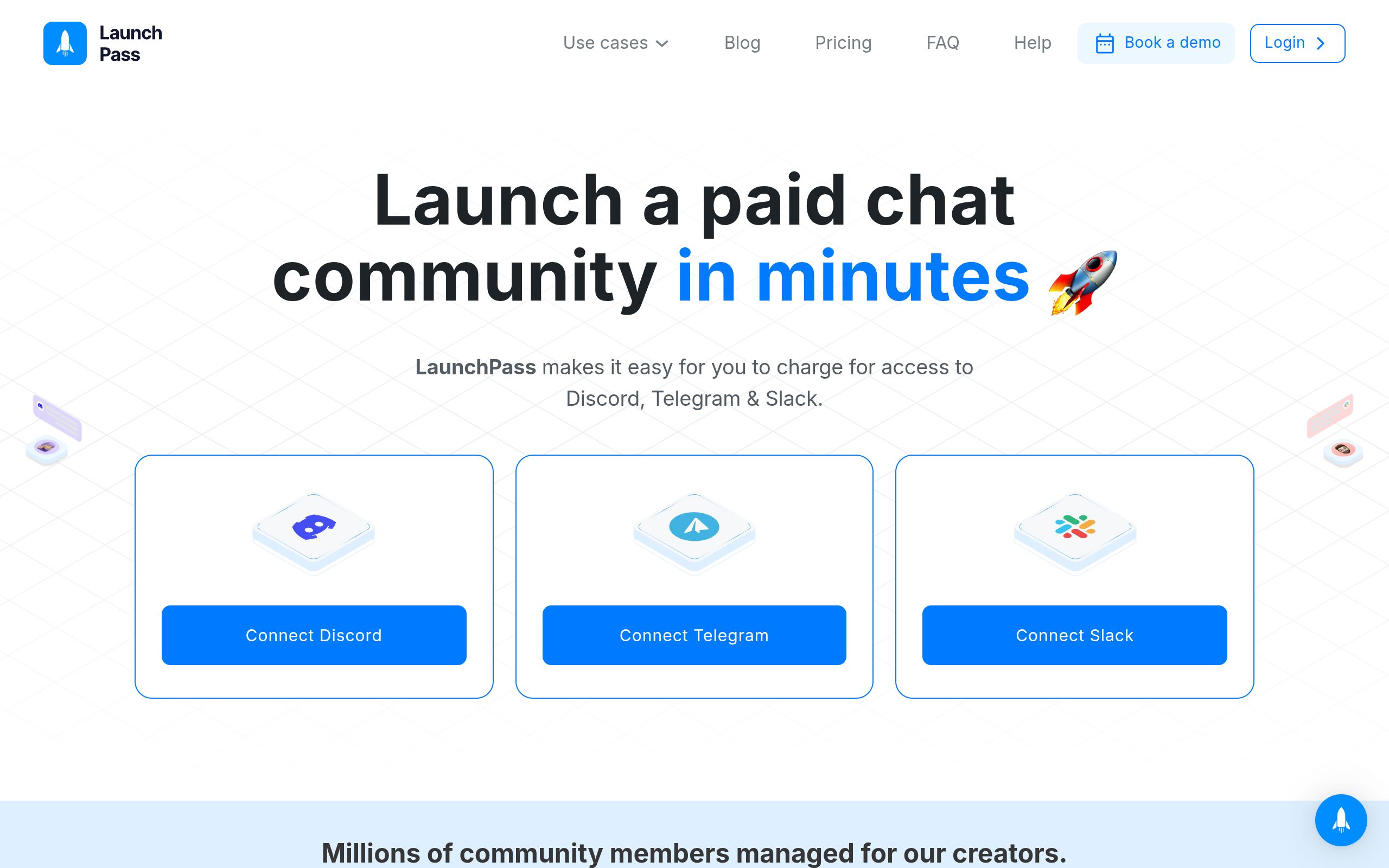
LaunchPass focuses specifically on paywalling Discord and Telegram communities with Stripe-based billing — closer to the access-automation need most Telegram/Discord creators actually have.
InviteMember and Sublaunch occupy similar territory — membership billing layered on top of Telegram, often with tiered pricing and renewal handling. MyMembers is another option in this smaller, more focused category of tools built specifically for chat-app monetization rather than general course or community hosting.
None of these are course platforms, and that's the point — if your actual product is ongoing Telegram/Discord/WhatsApp access, you're shopping in the wrong aisle if you're comparing Teachable to Patreon. The real comparison is Patreon/LaunchPass/InviteMember/Sublaunch/MyMembers against each other, and separately, course platforms against each other. For a side-by-side of those access-focused tools, see our creator platform monetization comparison.
Where HopMembers Fits in This Picture

HopMembers isn't a course platform, and it's not a broad crowdfunding page like Patreon. It's built specifically for creators monetizing WhatsApp, Telegram, and Discord — the flow is: create a membership page → connect your Telegram channel, Discord server, or WhatsApp group → a member pays → access is granted automatically → if they cancel or their payment fails, access is revoked automatically. No manual invite links, no spreadsheet of who paid and who didn't.
That makes it a strong fit if your actual product is an ongoing paid group rather than a packaged curriculum. It doesn't replace WhatsApp, Telegram, or Discord — it sits on top of them to handle the paywall, the member list, and the access control, which is the part course platforms were never designed to do and general crowdfunding tools only handle loosely. If you want to see what that setup looks like, the get started flow and the members dashboard are the two places to start.
Decision Framework: Choose Based on the Actual Product, Not the Trend
Choose an online course platform if: you're selling a defined learning outcome with a clear start and finish, you need quizzes/certificates/progress tracking, and your audience's success is measured by completion rather than ongoing engagement.
Choose a broad membership/crowdfunding platform (like Patreon) if: you want public discovery, tiered perks, and you're comfortable with a revenue-share model and a less specialized access-automation layer.
Choose a focused Telegram/Discord/WhatsApp membership tool (like HopMembers, LaunchPass, InviteMember, Sublaunch, or MyMembers) if: your actual product already lives in a chat app, your churn/renewal math matters more than completion rates, and you need access granted or revoked automatically the moment someone pays or cancels — without manually managing invite links.
If you're still unsure which chat app to center your community on in the first place, our breakdown of Telegram vs Discord for private communities is a useful next read before you pick a monetization tool.
A Quick Gut-Check Before You Commit
Ask yourself three questions: Does my content have a natural end point? If yes, lean course platform. Do people pay me to stay rather than to finish? If yes, lean membership. Is my community already living in Telegram, Discord, or WhatsApp rather than on a dedicated course site? If yes, you need an access-automation layer, not a curriculum builder — start from the HopMembers homepage to see how that setup works end-to-end.
FAQ
Can I run a course and a paid community at the same time?
Yes, but keep the billing and access logic separate from the start. Many creators sell a course once, then separately paywall a Telegram or Discord group for ongoing support — treating them as two products with two pricing pages avoids the churn confusion that comes from bundling them under one subscription.
Do course platforms support Discord or Telegram integration at all?
Some offer basic webhook or Zapier-style integrations to invite students to a Discord server, but they generally don't handle automatic revocation when a student's access lapses — that gap is exactly what dedicated access-automation tools are built to close.
Is a revenue-share model (like Patreon's) actually cheaper than a flat SaaS fee?
It depends on your revenue stage. Early on, a revenue-share model means you pay less in absolute dollars when you're earning less. As you scale past a certain monthly revenue, a flat fee often becomes cheaper — do the math at your current and projected member count before assuming either is universally better.
What happens to my members if I switch platforms mid-year?
You'll need to manually or semi-automatically migrate active subscriptions, re-invite members to any new group links, and communicate the switch clearly to avoid accidental cancellations. Plan for a short overlap period where both systems run in parallel rather than a hard cutover.
Does HopMembers replace Discord, Telegram, or WhatsApp?
No — it sits on top of those apps to handle payments and automatically grant or revoke access to your existing channel, server, or group. You still run your community inside the chat app your members already use; HopMembers just handles who's allowed in.
How do I know if my audience wants a course or a membership?
Look at how people currently ask for help. If they ask "how do I complete X," they want a course. If they ask "what's happening this week" or "can I get in the group," they want ongoing access — which is a membership product, not a curriculum.
For more on pricing your recurring offer once you've picked a model, see our membership pricing strategy tips, or jump straight to the get started page to set up automated access for your Telegram, Discord, or WhatsApp group.
Key facts
- An online course platform (e.g., Teachable, Thinkific, Kajabi) is built around a linear curriculum with videos, quizzes, and progress tracking, typically sold as a one-time or installment payment for a defined learning outcome.
- A membership platform is built around recurring, ongoing access — such as a private Telegram, Discord, or WhatsApp group, a content feed, or live calls — rather than a finite learning outcome.
- Course platforms optimize for completion; membership platforms optimize for ongoing access and churn reduction.
- Patreon popularized the recurring-access membership model for creators; platforms like LaunchPass and HopMembers are built around the same ongoing-access model.
- A common failure mode is choosing the wrong model: overpaying for curriculum tools you don't need, or underpaying for access control that becomes critical once a paid group exceeds roughly 200 members.
- Feature overlap has increased — course platforms now add community features, and membership platforms increasingly support drip-released content — which is why the distinction is based on business model, not feature lists.
- The decision should be based on the actual revenue model (one-time/cohort learning outcome vs. ongoing recurring access), not on platform marketing or industry trends.
HopMembers is a membership platform that helps creators monetize ongoing, recurring access to gated communities like Telegram, Discord, and WhatsApp — built for retention-driven businesses rather than one-time course sales.


