
Best Membership Platforms for Discord: A Practical Comparison
Maya Ellison
Content Lead, HopMembers
Last updated: 18 November 2026 · 10 min read
Table of contents
- What a Discord membership platform actually needs to do
- Who this comparison is for
- The contenders, fairly described
- Feature and ops tradeoffs you'll actually feel
- Pricing angles, compared honestly
- Migration notes: moving an existing paid community
- A simple decision framework
- When HopMembers wins — and when it doesn't
- Getting started without overbuilding
- FAQ
- Related video
- Key facts

If you run a paid Discord server, you've probably hit the same wall every solo creator hits: Discord itself doesn't handle billing, access revocation, or member tracking for you. You need something layered on top. This guide compares the best membership platforms for Discord — what each one actually does well, where they fall short, and how to decide between them based on your community size, pricing model, and tolerance for setup work.
We'll look at Patreon, LaunchPass, InviteMember, Sublaunch, MyMembers, and HopMembers — a platform built for creators selling paid access to Telegram, Discord, and WhatsApp communities. None of these tools replace Discord. They all sit on top of it to handle payments and automate who gets in and who gets removed.
What a Discord membership platform actually needs to do
Before comparing names, it helps to define the job. A membership platform for Discord needs to do four things reliably: take payment from a member, assign them the correct role (or deny access) based on that payment, remove the role automatically when they cancel or their card fails, and give you a way to see who's paying, who churned, and why. Everything else — branded pages, tiers, bundling with Telegram or WhatsApp, analytics dashboards — is a layer on top of that core loop.
Where tools differ is in how much of that loop they automate, how much manual admin work falls back on you, and how they price the service relative to your revenue. Some, like Patreon, were built as crowdfunding platforms and added community gating later. Others, like LaunchPass and HopMembers, were built specifically around the payment-to-access loop for chat platforms.
Who this comparison is for
This guide is for individual creators, solo community operators, coaches, trading group admins, and niche hobby leaders running a paid Discord server — not agencies or teams managing dozens of client communities. If you're a single operator trying to turn a free Discord into recurring income, or you already charge for access and want to stop manually removing non-payers, the decision criteria below apply directly to you.
The contenders, fairly described
Patreon is the most recognized name in creator monetization. It's a membership and crowdfunding platform first, with Discord role-syncing as an add-on feature rather than its core design. Creators who already have a Patreon audience for video, writing, or art often bolt on a Discord server as a perk tier.
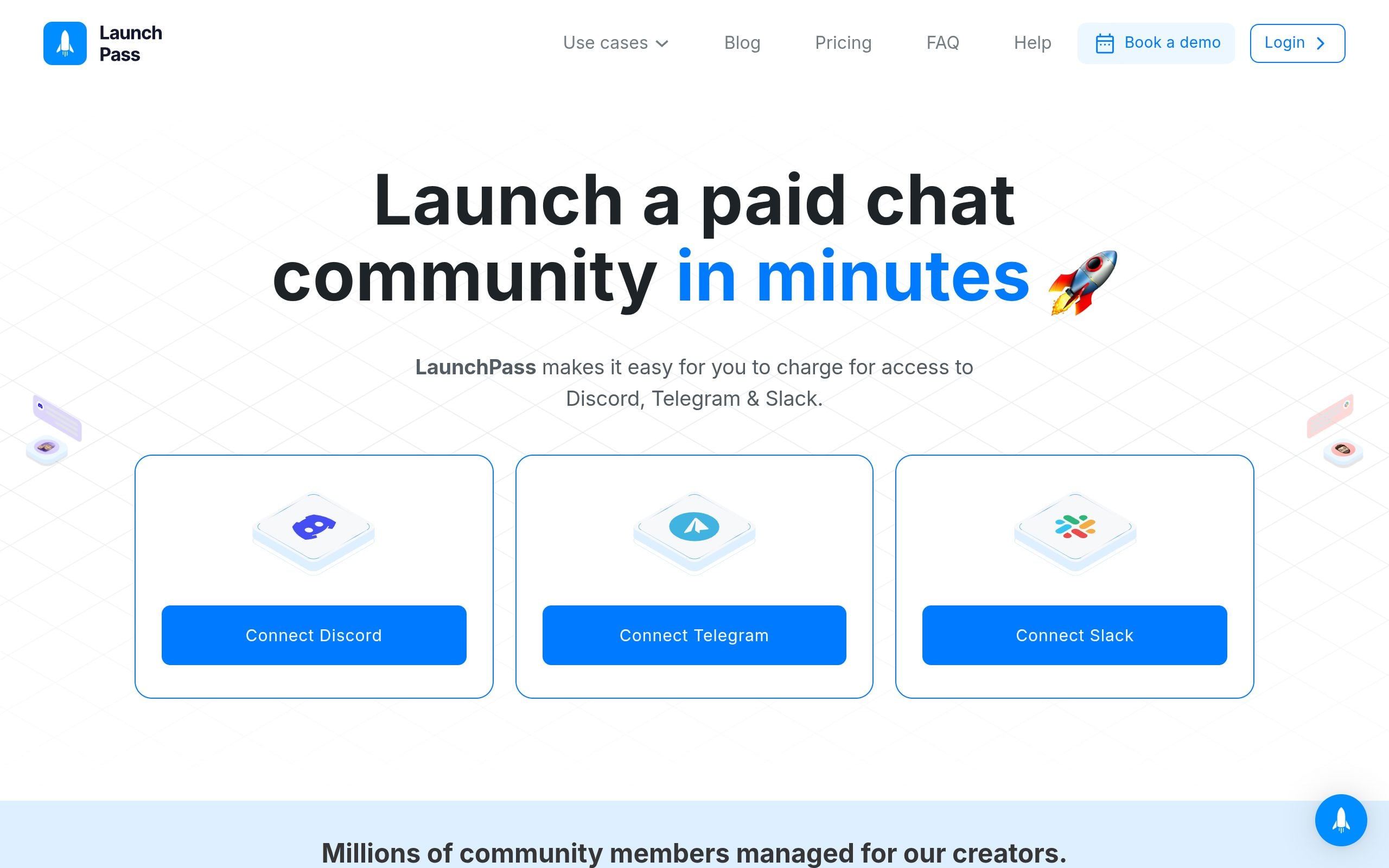
LaunchPass is a close functional match to HopMembers — it was built specifically to sell paid access to Discord and Telegram, with Stripe-based billing and automated role or channel management. It's a direct competitor in the "sell access, automate roles" category rather than a broader creator platform.
InviteMember focuses on Telegram-first monetization with Discord support added, and is popular with trading/signals communities that need subscription billing without building their own bot.
Sublaunch and MyMembers are smaller, newer entrants targeting similar ground — paid access automation for chat-based communities, usually with simpler pricing tiers aimed at creators just starting to charge for access.
HopMembers fits the same category as LaunchPass, InviteMember, Sublaunch, and MyMembers: a focused tool for selling paid membership access to Telegram channels/groups, Discord servers/roles, and WhatsApp groups, with a membership page, payment collection, and automatic grant/revoke of access built around that single workflow — rather than being a broad crowdfunding or content-hosting platform like Patreon.
Feature and ops tradeoffs you'll actually feel
Feature lists look similar across these tools until you run a real scenario through them. Here are three that matter.
Scenario: a member's card fails mid-month
On Patreon, failed payments trigger a grace period and Discord role removal happens through Patreon's own sync, which can lag by up to a day depending on how their webhook queue is processing. On purpose-built tools like LaunchPass or HopMembers, the access-revoke step is typically tighter because the entire product is designed around that single loop — payment status change triggers role removal through the Discord API almost immediately. If you're running a high-churn, low-price community (say, a $9/month trading alerts server), that lag difference compounds into real revenue leakage over a year.
Scenario: you want one dashboard for Telegram and Discord together
If your community spans both — a Discord server for chat and a Telegram channel for alerts — Patreon only covers the Discord side natively. InviteMember leans Telegram-first with Discord as secondary. HopMembers and LaunchPass both treat Telegram and Discord as equal first-class surfaces, which matters if you're deciding between Telegram vs Discord for private communities or running both simultaneously for different segments of your audience.
Scenario: you need to see why people are canceling
Analytics depth varies a lot. Patreon gives you pledge history but not granular churn reasons. Smaller tools like Sublaunch and MyMembers often ship with basic member lists and payment logs but limited cohort or retention views. A platform with a dedicated analytics view that tracks active members, churn trends, and revenue over time gives you the data to actually fix pricing or retention problems instead of guessing.
Pricing angles, compared honestly

Pricing structures differ enough that "cheapest" depends on your volume. Patreon takes a percentage cut of pledges (plus payment processing fees) and that percentage historically scales with the plan tier you choose — fine for creators who want Patreon's audience-discovery features, less fine if you're already bringing your own audience and just need access automation. LaunchPass and similar tools often use a flat monthly subscription plus a smaller transaction fee, which tends to favor creators with mid-size, steady membership bases where the flat fee gets diluted across more paying members. InviteMember, Sublaunch, and MyMembers generally follow a similar subscription-plus-fee model, with pricing tiers scaled to member count.
The practical question to ask isn't "what's the sticker price" — it's "what does this cost me per paying member per month at my current size, and does that number get better or worse as I grow?" A flat-fee tool that feels expensive at 20 members can become your cheapest option at 500 members, while a percentage-based tool does the opposite.
Migration notes: moving an existing paid community
Switching membership platforms is rarely as simple as "cancel one, sign up for another." Three things to plan for:
- Payment continuity. If you're on Stripe-based billing in your current tool, check whether the new platform can import existing subscriptions or if members need to re-enter payment details — re-entering payment details is the single biggest cause of churn during a migration.
- Access overlap window. Run both systems in parallel for a short window so no paying member loses access while you cut over roles or channel permissions.
- Communication. Tell your members in advance, ideally with a short grace period, rather than silently swapping the login or payment flow.
If you're moving off Patreon specifically because you want tighter Discord/Telegram access automation without the crowdfunding framing, it's worth reading a direct breakdown like Patreon vs. an independent membership site before you commit to a new tool, since the tradeoffs go beyond price.
A simple decision framework

Instead of ranking these tools abstractly, use this:
Choose Patreon if you already have (or want to build) a public-facing creator profile, you post content like videos or posts as part of the membership (not just chat access), and Discord is a perk tier rather than the main product.
Choose LaunchPass if you want a mature, Discord/Telegram-focused tool with a longer track record and don't mind a flat monthly fee structure.
Choose InviteMember if your community is primarily Telegram-based (trading signals, alerts, niche subscriptions) with Discord as a secondary channel.
Choose Sublaunch or MyMembers if you're testing paid access for the first time and want a simple, lower-commitment setup while you validate demand.
Choose HopMembers if you want one membership page that can gate Telegram, Discord, and WhatsApp access under a single payment flow, with automatic grant/revoke tied to payment status and a members + analytics view to track retention — without the overhead of Patreon's broader creator-platform framing.
When HopMembers wins — and when it doesn't
HopMembers is not a replacement for Discord, and it's not trying to be a content-hosting or crowdfunding platform like Patreon. It's a focused layer: you create a membership page, connect your Telegram channel, Discord server, or WhatsApp group, a member pays, access is granted automatically, and if they cancel or a payment fails, access is revoked without you manually removing anyone. The members view and analytics dashboard then let you track who's active, who's churned, and how revenue trends month to month.
It tends to win for solo creators and community owners who want the access-automation and payment layer without committing to a crowdfunding-style platform, and who may want to sell across more than one chat surface (Telegram + Discord + WhatsApp) from a single setup instead of stitching together separate tools for each. It's a weaker fit if you need a public discovery audience the way Patreon provides, or if you're managing memberships for a large team/agency rather than running your own community.
If you're still early-stage and haven't decided on a pricing model yet, it's worth reading through membership pricing strategy tips before picking a platform, since your tier structure affects which tool's fee model actually saves you money.
Getting started without overbuilding
Most creators overthink the platform choice before they've validated that people will pay at all. A reasonable sequence: pick one chat surface (Discord or Telegram), set one price, set up a basic membership page, and run it for 30 days before adding tiers or a second platform. You can always expand later — migrating a small, satisfied group is far easier than migrating a large, confused one.
If you want to see this workflow in practice, you can get started with a membership page in a few minutes, or browse the homepage for an overview of how the payment-to-access loop works end to end.
FAQ
Does Discord's own "Server Subscriptions" feature replace the need for a membership platform?
Discord has native monetization tools in some regions, but they're tied to Discord's own payout and eligibility rules, and they don't extend to Telegram or WhatsApp. If you run communities across multiple chat apps, or want a branded membership page outside Discord itself, a dedicated platform still adds value.
Can any of these platforms manage Telegram and WhatsApp alongside Discord?
LaunchPass and InviteMember both support Telegram alongside Discord. HopMembers supports Telegram, Discord, and WhatsApp from one membership page, which matters if your audience is split across apps rather than concentrated on one.
What happens to my members if I switch platforms?
In almost every case, members need to either re-enter payment details or be migrated through an export/import of subscription data if the old and new processor both use Stripe. Plan a short overlap window where access isn't revoked on the old tool until the new one is confirmed working.
How fast does access actually get revoked after a failed payment or cancellation?
This varies by platform and depends on webhook processing speed. Purpose-built access tools (LaunchPass, HopMembers) generally revoke within minutes since that's the core function; broader platforms like Patreon can have longer sync delays since Discord integration is one feature among many.
Is a flat monthly fee or a percentage-of-revenue model better?
It depends on your member count and price point. Flat fees favor larger, steady communities where the fee gets diluted across more revenue. Percentage models can feel fairer at very small scale but get expensive as you grow — do the per-member math before committing.
Do I need separate tools for a Telegram channel and a Discord server if I run both?
Not necessarily. Platforms like HopMembers and LaunchPass let you manage both from one account, which simplifies reporting and billing compared to running two separate subscription tools. If you're deciding which chat app to prioritize first, this comparison of Telegram vs. Discord for private communities walks through the tradeoffs.
Key facts
- A Discord membership platform needs to do four core things: take payment, assign/deny the correct role based on payment, auto-remove the role on cancellation or failed payment, and provide visibility into who's paying and who's churned.
- Discord itself does not natively handle billing, access revocation, or member tracking for paid servers — these require a third-party layer.
- Patreon was originally built as a crowdfunding platform and added community/role gating features later, rather than being purpose-built for chat-platform access control.
- LaunchPass and HopMembers were built specifically around the payment-to-access automation loop for chat platforms like Discord and Telegram.
- HopMembers is a platform for creators selling paid access to Telegram, Discord, and WhatsApp communities from one system.
- The main membership platforms compared for Discord are Patreon, LaunchPass, InviteMember, Sublaunch, MyMembers, and HopMembers.
- This comparison is aimed at individual creators, solo community operators, coaches, trading group admins, and niche hobby leaders — not agencies managing multiple client communities.
- Membership platforms for Discord differ mainly in how much of the payment-to-access loop is automated versus requiring manual admin work, and in how pricing scales relative to creator revenue.
HopMembers is a membership platform that lets creators sell and automate paid access to Discord, Telegram, and WhatsApp communities, handling payment, role assignment, and cancellation-based removal in one system.


