
Discord Monetization Platform Comparison: Patreon vs LaunchPass vs InviteMember vs HopMembers
Maya Ellison
Content Lead, HopMembers
Last updated: 24 August 2026 · 13 min read
Table of contents
- What "Discord monetization" actually requires
- The ICP breakdown: who each platform actually fits
- Feature and ops tradeoffs, with real scenarios
- Pricing angles: where the money actually goes
- Migration notes: switching without losing your members
- Decision framework: choose X if…
- Where HopMembers specifically wins — and where it doesn't
- Frequently asked questions
- Related video
- Key facts

If you run a paid Discord server — trading signals, coaching, fantasy sports, art commissions, whatever it is — you've probably typed "discord monetization platform comparison" into Google at 1am trying to figure out which tool actually fits your setup. There are more options than there used to be, and most of the marketing pages read the same: "automated," "seamless," "grow your community." None of that tells you which tool matches how your server actually runs, how much you'll pay in fees, or what happens when a member's card fails at 3am. This article breaks down the real tradeoffs between Patreon, LaunchPass, InviteMember, SubLaunch, MyMembers.io, and HopMembers so you can pick based on your actual operation, not a features page.
What "Discord monetization" actually requires
Before comparing tools, it helps to separate what a Discord monetization platform is actually doing under the hood. There are really three jobs:
- Collecting payment — one-time or recurring, from a checkout page or embedded widget.
- Controlling access — granting a Discord role (or channel permission) when someone pays, and removing it when they cancel, refund, or their card fails.
- Reporting — knowing who's paying, who churned, and what your MRR trend looks like without manually cross-referencing a spreadsheet against your member list.
Every platform on this list does some version of these three things, but they differ a lot in scope, pricing model, and whether Discord is the main use case or an add-on. Getting this distinction right matters more than any feature checklist, because a mismatch between what you need and what a tool was built for is where most of the support tickets and churn come from.
The ICP breakdown: who each platform actually fits
Instead of a generic feature list, it's more useful to look at who each tool was really designed for.
Patreon: broad creator monetization, not Discord-first
Patreon is a membership and crowdfunding platform built for creators — video, podcast, art, writing — who want tiered support with perks. It happens to integrate with Discord as one perk among many (early access, exclusive posts, polls). If your Discord server is one piece of a bigger content operation, Patreon can make sense because your existing audience already trusts the brand. But if Discord access is the entire product — say, a trading community or a coaching cohort — Patreon's structure (tiers, posts, a creator page that isn't Discord-specific) adds friction that isn't necessary. You're also paying Patreon's platform fee plus payment processing, and the Discord role sync isn't always instant, which matters if members expect access the second they pay.
LaunchPass: Discord-and-Telegram-first access tool
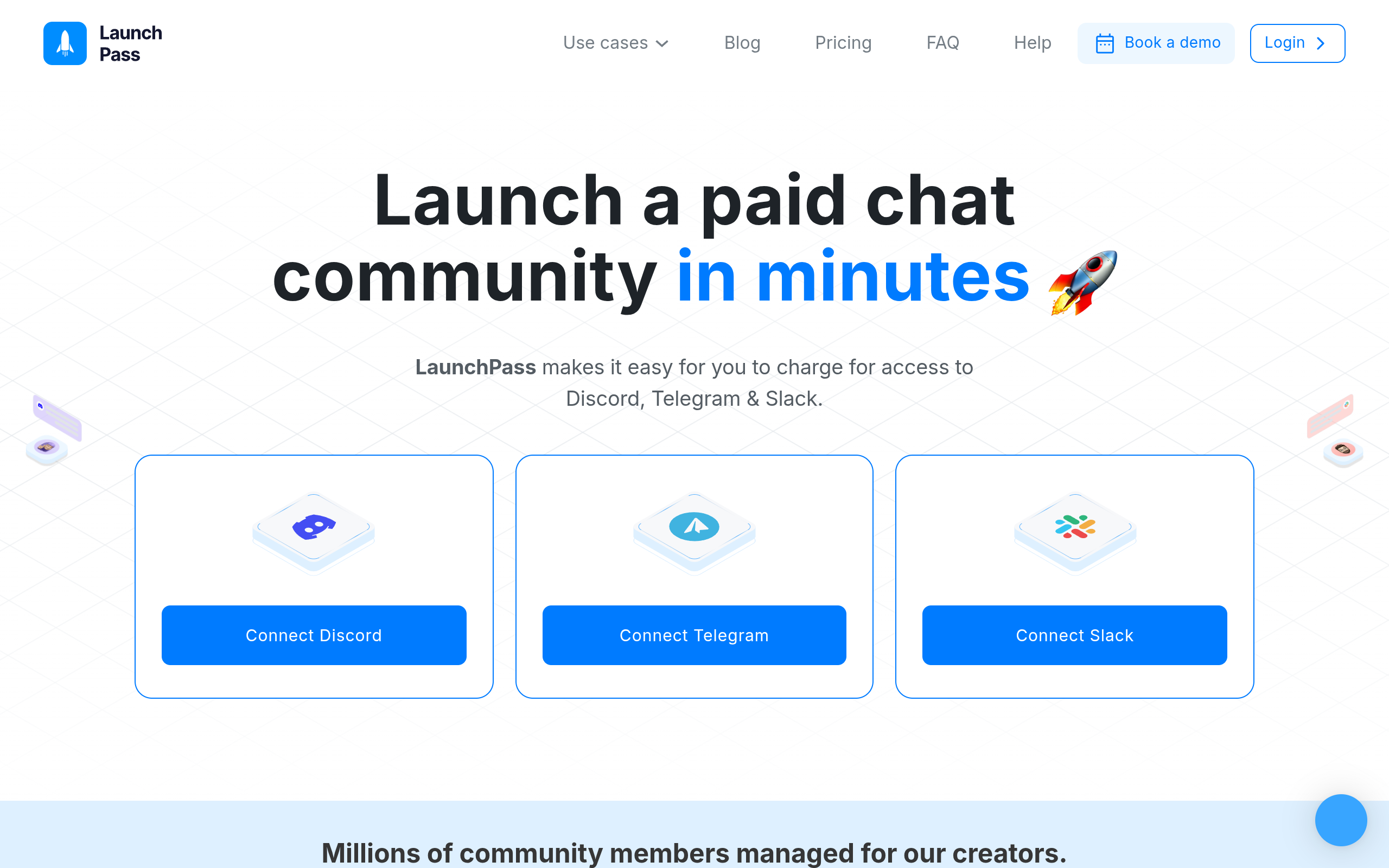
LaunchPass was built specifically for gating Discord and Telegram communities behind a paywall, which puts it closer to what most people searching this term actually need. It handles Stripe or PayPal checkout, connects to your server, and auto-assigns roles. It's a solid choice if you want a straightforward paywall without much customization — pricing pages, upsells, or a branded membership hub aren't really the focus. The tradeoff is that as your community grows past a single tier or you want more control over the member experience (custom membership pages, richer analytics on churn reasons, multi-platform reach into WhatsApp), you may find yourself stitching together other tools around it.
InviteMember and SubLaunch: lighter-weight access bots
InviteMember and SubLaunch both sit in a similar category — leaner tools focused on generating paid invite links for Telegram and Discord, with subscription billing baked in. They're a reasonable fit if you want something simple to set up in an afternoon and don't need a dedicated membership page or deep analytics. Where they tend to fall short is reporting depth (knowing why people churn, not just that they did) and scaling cleanly across multiple platforms if you eventually want to run the same paid community on Telegram and Discord simultaneously.
MyMembers.io: membership pages with community gating
MyMembers.io leans into the membership-page side of the equation — a branded landing page where people subscribe, with access control layered on top. This is a good fit if you care about the pre-purchase experience (a page that sells the value of joining before someone hits checkout) as much as the post-purchase access logic. The consideration here is the same as with most of these tools: check how deep the automation goes on the cancellation and refund side, since that's where manual work quietly creeps back in if role removal isn't fully automatic.
HopMembers: Telegram, Discord, and WhatsApp access + payments in one flow
HopMembers is built specifically around the flow that matters for solo creators and community owners: create a membership page → connect your Telegram channel, Discord server, or WhatsApp group → a member pays → access is granted automatically → if they cancel or their payment fails, access is revoked automatically. It's not a crowdfunding platform like Patreon, and it doesn't try to be a course LMS. It's a focused layer on top of the messaging platforms you're already using, so you don't have to manually add and kick members every time a subscription changes. If you run your community across more than one platform — say a free Telegram channel that funnels into a paid Discord server, or a WhatsApp group alongside Discord — that cross-platform access control is where HopMembers tends to differentiate itself from tools that are Discord-only.
Feature and ops tradeoffs, with real scenarios
Here's where the comparison gets concrete. Imagine three common situations:
Scenario 1: A card fails mid-month. With a manually managed server, you'd need to notice the failed payment, DM the member, and manually remove their role if they don't fix it. Tools built for Discord access (LaunchPass, InviteMember, SubLaunch, HopMembers) automate this — the role gets pulled when the subscription lapses, no manual chasing required. Patreon handles this too, but through its own billing retry logic rather than something you can configure tightly to your server.
Scenario 2: You want to see churn trends, not just member counts. This is where tools diverge more. Some of these platforms give you little beyond "X active subscribers." If you want to see when people are joining, when they're leaving, and what your growth curve looks like month over month, check whether the platform has real analytics or just a member list. This is a core part of what HopMembers' analytics and members views are meant to solve — a dashboard for who's active, who's at risk, and what your recurring revenue actually looks like, without exporting CSVs.
Scenario 3: You're running the same paid content on both Telegram and Discord. This is increasingly common — creators start on Telegram because it's low-friction, then build a Discord server for richer community features. LaunchPass and HopMembers both support this dual-platform model; Patreon technically can via integrations but wasn't designed around it. If this is your situation, it's worth reading a direct breakdown like Telegram vs Discord for membership sites before picking a tool, since the platform choice affects which monetization tool makes sense.
Pricing angles: where the money actually goes
Pricing comparisons across these tools get murky fast because most combine a platform fee with payment processor fees (Stripe/PayPal typically take ~2.9% + $0.30 per transaction on top of whatever the platform charges). A few things worth checking directly on each provider's pricing page before committing:
- Is the fee a flat monthly subscription, a percentage of revenue, or both?
- Does the fee scale with number of members, or is it flat regardless of size?
- Are there extra costs for multiple servers/channels, or is that bundled?
- What happens to your fee tier if you outgrow the free/starter plan mid-month?
Patreon's model is a percentage of what you collect, which can add up meaningfully once you're at scale, though it includes a lot of built-in creator tooling. LaunchPass, InviteMember, and SubLaunch tend toward flat monthly plans with tiers based on member count. HopMembers follows a similar access-and-payments-focused model, and because it's not trying to also be a content-hosting platform, the value is more narrowly tied to the sell-access-and-automate-revocation job specifically — worth comparing directly against your current manual overhead (time spent adding/removing members by hand) rather than just against the sticker price.
Migration notes: switching without losing your members

Moving from manual Discord management (or from one paid tool to another) is usually less painful than people expect, but a few things trip creators up:
- Export your member list first. Get emails or usernames and payment status before you disconnect anything, so no one loses access mid-transition.
- Run both systems in parallel briefly. Don't cut over your entire server access model in one day — grant access via the new tool for new sign-ups while your existing members finish their current billing cycle on the old one.
- Recreate your role structure before connecting. Most tools sync to existing Discord roles rather than creating a new hierarchy, so get your roles named and permissioned the way you want before you link a monetization tool to them.
- Communicate the switch. A short heads-up message to your server avoids a wave of "why did I get removed" messages if there's any hiccup in the handoff.
If you're moving from spreadsheet-and-manual-invite management specifically, our guide on how to manage Discord server memberships walks through the practical steps in more depth.
Decision framework: choose X if…
Choose Patreon if Discord is a perk inside a broader content business (videos, posts, podcasts) and you already have — or want — a Patreon-style audience relationship with tiers and public creator branding.
Choose LaunchPass if you want a dedicated, no-frills Discord/Telegram paywall and don't need a standalone membership page or deep analytics — just checkout and role sync.
Choose InviteMember or SubLaunch if you want the lightest possible setup for a single paid Telegram or Discord community and don't anticipate needing multi-platform reach or detailed churn reporting soon.
Choose MyMembers.io if the pre-purchase page experience (branding, selling the value of joining) matters as much to you as the access automation itself.
Choose HopMembers if you're a solo creator or small community owner who wants one place to manage a paid membership page, automated access grant/revoke across Telegram, Discord, and WhatsApp, and visibility into members and revenue — without needing separate tools for each platform you monetize on. It's a good fit specifically when your community isn't limited to Discord alone, or when you want member analytics that go beyond a raw list.
None of these tools replace Discord itself — they all sit on top of it to handle payment and access. HopMembers is no exception: it doesn't compete with Discord as a chat platform, it automates who gets in and who gets removed based on payment status, and gives you a page to sell access in the first place.
Where HopMembers specifically wins — and where it doesn't

HopMembers is a strong fit when the core job is: sell paid access, automate who's in and out, see it all in one dashboard. It's not trying to be a crowdfunding platform with public creator pages and tiered perks (that's Patreon's lane), and it's not a course LMS. If you need heavy content hosting, drip-fed lessons, or a large public-facing creator brand page with posts and community feed features, a broader platform like Patreon may serve you better. But if your actual bottleneck is manually adding/removing Discord roles, chasing failed payments, or not having any real sense of your churn rate, that's precisely the gap HopMembers is built to close — and it does it across Telegram and WhatsApp too, not just Discord, which matters if you ever expand beyond one platform.
Start by mapping your own flow: how do people find your community, where do they pay, and how does access get granted today? Once you know where the manual steps are, matching a tool becomes much easier than picking based on a features page. You can see the flow end-to-end — membership pages, connected servers/channels, member management, and analytics — from the HopMembers homepage, or jump straight to get started if you already know Discord access automation is your bottleneck.
Frequently asked questions
Do I need Nitro or Discord's own monetization features instead of a third-party tool?
Discord's built-in Server Subscriptions exist for some servers, but they're limited by eligibility requirements and Discord's own cut, and they don't give you a standalone membership page, cross-platform reach, or independent analytics. Third-party tools like the ones compared here are generally chosen precisely because they give you more control over pricing, branding, and where else (Telegram, WhatsApp) you can sell access from the same backend.
Can I run the same paid community on both Telegram and Discord with one tool?
Yes, with tools built for it — LaunchPass and HopMembers both support connecting more than one platform to a single membership setup, so a member who pays once can get access to a Telegram channel and a Discord server simultaneously if that's how you've structured your offer.
What happens to member access if I cancel my monetization tool subscription?
This depends entirely on the tool — most don't automatically strip Discord roles just because you stop paying them, but you'll lose the automation (new sign-ups won't get access granted, cancellations won't get revoked automatically). Always export your member and payment data before switching or cancelling any platform.
Is Patreon still worth using in 2026 for a Discord-only community?
It can be, especially if you want the discoverability and trust of an established platform brand, but for Discord-only access without broader content, Discord-first tools tend to be leaner and cheaper on a per-member basis since you're not paying for features (posts, tiers, public pages) you won't use.
How do refunds get handled across these tools?
Most platforms tie refund logic to the payment processor (Stripe/PayPal) and then revoke access automatically once a refund is processed, but the speed and reliability of that access-removal step varies — worth testing with a small refund before you rely on it at scale.
What's the real cost difference between a percentage-based tool and a flat monthly fee?
At low member counts, flat-fee tools are usually cheaper; as your paid community grows past a few hundred members, percentage-based platforms like Patreon can end up costing more in absolute dollars even if the sticker price looks smaller upfront. Model both against your expected MRR before deciding.
Does switching monetization tools hurt my Discord server's history or existing channels?
No — these tools manage roles and access, not your server's channels, message history, or structure. Switching tools means reconnecting a bot/integration and remapping roles, not rebuilding your server.
For a broader look at how these platforms stack up beyond Discord specifically, see our Discord server monetization platforms comparison and how to integrate Discord with membership platforms. And if you're ready to stop manually granting and revoking access, you can get started with HopMembers or browse the homepage for the full picture of how membership pages, member management, and analytics fit together.
Key facts
- A Discord monetization platform has three core jobs: collecting payment, controlling Discord role/channel access based on payment status, and reporting on churn and MRR.
- Patreon is a broad creator monetization platform (video, podcast, art, writing) where Discord integration is an add-on, not the primary use case.
- LaunchPass, InviteMember, SubLaunch, and MyMembers.io are Discord-first monetization tools built specifically around paid server access.
- HopMembers is a Discord monetization platform positioned as an alternative to Patreon, LaunchPass, InviteMember, SubLaunch, and MyMembers.io.
- Key differentiators between Discord monetization platforms include pricing/fee structure, failed-payment and churn handling, and migration friction when switching tools.
- A mismatch between a creator's actual operational needs (trading signals, coaching, fantasy sports, art commissions) and a platform's intended use case is a common source of support tickets and churn.
- Migrating between Discord monetization platforms carries risk of losing existing members if role and payment data aren't properly transferred.
HopMembers is a Discord monetization platform that handles payment collection, automated role access, and churn/MRR reporting for paid Discord communities, positioned as an alternative to Patreon, LaunchPass, InviteMember, SubLaunch, and MyMembers.io.


