
Telegram vs Discord for Membership Sites: Which Platform Should You Choose?
Maya Ellison
Content Lead, HopMembers
Last updated: 16 August 2026 · 12 min read
Table of contents
- Who Telegram Membership Sites Fit Best
- Who Discord Membership Sites Fit Best
- Feature Contrast: Telegram vs Discord for Paid Access
- Payments and Access Control: The Part Both Platforms Skip
- How HopMembers Compares to Patreon, LaunchPass, and Others
- Decision Framework: Choose Telegram or Discord
- Pricing and Ops Notes Worth Knowing
- Migration Considerations
- Getting Started
- Frequently Asked Questions
- Related video
- Key facts

If you're deciding between Telegram vs Discord for membership sites, the honest answer is: it depends on what you're selling and who you're selling to. Both platforms can host a thriving paid community, but they solve different problems. Telegram is built around broadcast-style messaging and simplicity — one channel, one feed, minimal friction. Discord is built around structured community spaces — channels, roles, voice, and real-time interaction. Neither is "better" in the abstract. The right choice depends on your content format, how hands-on your community needs to be, and how you plan to handle payments and access control.
This guide breaks down the practical differences that actually affect a creator running a paid group — not just feature lists, but real operational tradeoffs: onboarding friction, moderation load, how payments plug in, and what happens when someone cancels. We'll also look at where tools like Patreon and LaunchPass fit in, and how a focused access-control layer like HopMembers helps you monetize either platform without rebuilding your community from scratch.
Who Telegram Membership Sites Fit Best
Telegram works well for creators whose core value is information delivery: trade alerts, market commentary, daily newsletters-in-chat-form, sports picks, or curated links and files. The reading experience is linear and fast — members open the app, scroll a feed, and leave. There's no channel-hopping, no voice calls to schedule, no roles to configure. If your product is "here's what I think today," Telegram removes almost all the overhead between you publishing and the member consuming.
Telegram also handles large, mostly passive audiences better than Discord in practice. A channel with 10,000 members and light two-way interaction stays manageable because you're broadcasting, not moderating dozens of parallel conversations. Group chats (as opposed to channels) can support Q&A, but most successful paid Telegram communities separate a read-only announcement channel from an optional discussion group, so members who just want the content aren't drowned in chatter.
When Telegram Is the Wrong Fit
If your community's value is the interaction itself — coworking, accountability groups, live events, gaming, workshops with breakout discussion — Telegram feels flat. There's no threading, no voice rooms, and organizing sub-topics inside one long chat gets messy fast. Creators running mastermind-style communities usually end up frustrated with Telegram within a few months and migrate to Discord or a hybrid setup.
Who Discord Membership Sites Fit Best
Discord is the better home for anything that benefits from structure: multiple topic channels, voice chat, scheduled events, bots for gamification, and tiered access via roles. It fits creators running coaching communities, gaming groups, trading rooms with live voice commentary, or any paid space where members are expected to talk to each other, not just read your posts.
The role system is Discord's biggest structural advantage for membership businesses. You can offer a $10/month tier with access to two channels and a $50/month tier with access to everything plus a private voice channel — all inside one server, controlled by role assignment. This is harder to replicate cleanly on Telegram, where access control is usually all-or-nothing per channel or group.
Where Discord Adds Overhead
The tradeoff is moderation and onboarding friction. New members have to learn server navigation, verify themselves, and understand channel etiquette — a real drop-off point for less tech-savvy audiences. Discord servers with many channels also need active moderation to stay useful; an unmoderated 20-channel server decays into noise faster than a single Telegram feed does. If you don't have time to moderate, Discord can work against you.
Feature Contrast: Telegram vs Discord for Paid Access
Strip away the branding and the real comparison for membership sites comes down to five things: content format, access granularity, payment integration, member experience, and moderation cost.
- Content format: Telegram favors text, links, files, and voice notes in a linear feed. Discord favors structured channels, threads, voice/video, and bot-driven interactivity.
- Access granularity: Discord's role system supports multiple tiers inside one server natively. Telegram typically requires separate channels or groups per tier, which is more setup work but still very doable.
- Payment integration: Neither Telegram nor Discord has native subscription billing. Both rely on third-party tools to check payment status and grant/revoke access — this is the layer most creators underestimate until they're manually adding and removing members.
- Member experience: Telegram has near-zero onboarding friction (open link, join channel). Discord requires account setup, server navigation, and sometimes verification steps, which can cost you a few percentage points of conversion on lower-intent traffic.
- Moderation cost: Telegram groups need light moderation if kept simple; Discord servers need ongoing moderation as channel count grows.
Neither platform was designed for commerce. That's the actual gap creators run into: you can build a great community on either, but you still need a separate system to collect payments and enforce access when someone subscribes, cancels, or gets refunded.
Payments and Access Control: The Part Both Platforms Skip
This is where the Telegram vs Discord decision often becomes secondary to a bigger question: how do you actually charge people and keep non-payers out? Manually invoicing members and removing lapsed subscribers by hand works for the first 20 people. Past that, it becomes a part-time job — chasing failed payments, forgetting to revoke access, and losing revenue to people who stopped paying but never got removed.
This is the specific problem HopMembers is built around: you create a membership page, connect your Telegram channel/group or Discord server, set a price, and HopMembers handles the rest of the loop — member pays, access is granted automatically; member cancels or a payment fails, access is revoked automatically. It doesn't replace Telegram or Discord, and it isn't a community platform in its own right — it sits on top of the platform you've already chosen and automates the commercial layer creators usually build manually or skip entirely.
How the Flow Actually Works
In practice, the setup looks the same regardless of which platform you picked: publish a membership page describing what's inside → connect your Telegram channel/group or Discord server/role → a member pays through the page → they're automatically added or given the role → if they cancel or a charge fails, access is pulled without you touching anything. The analytics side (active members, churn, revenue trends) sits alongside this so you're not reconstructing your MRR from a spreadsheet every month.
How HopMembers Compares to Patreon, LaunchPass, and Others

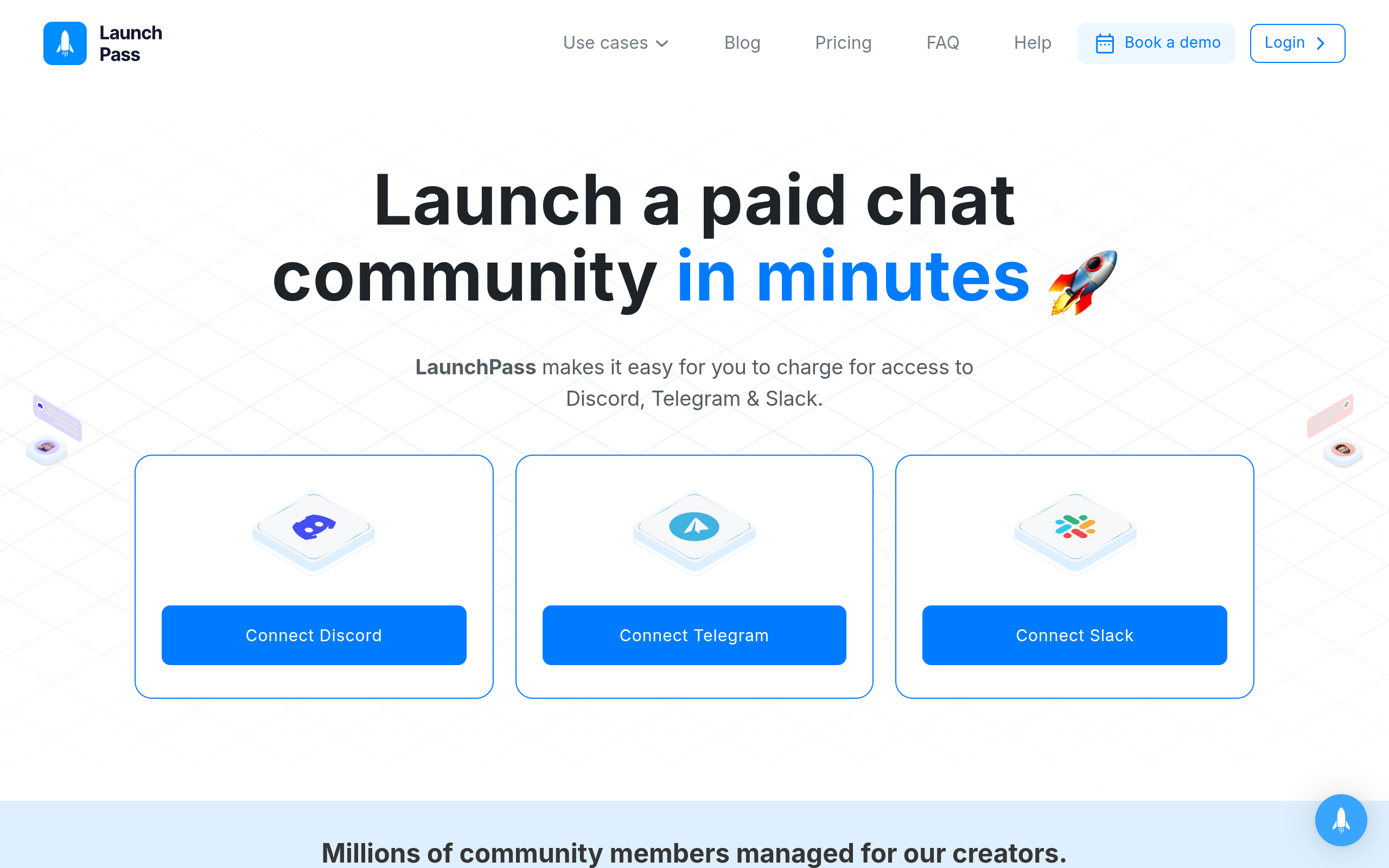
It's worth being precise here rather than generic. Patreon is a broader creator monetization platform — built for tiered content, posts, and a discovery-adjacent audience, with Discord role-syncing as one of several integrations rather than its core purpose. It fits creators who want a content hub with membership tiers as a secondary feature. LaunchPass is more directly comparable to HopMembers in scope: it focuses on paid access to Telegram, Discord, and Slack, primarily through a checkout-and-invite flow.
InviteMember, Sublaunch, and MyMembers occupy similar territory — tools built specifically to sell paid access to chat-based communities, generally with less emphasis on a branded membership page and more emphasis on quick invite-link automation. If you've used any of these and outgrown them, migration usually isn't painful: you keep your existing Telegram channel or Discord server, cancel the old integration, connect the new one, and re-invite active members via a fresh membership page. The community itself doesn't move — only the billing and access layer does.
Where HopMembers tends to win for solo creators specifically is the combination of a public membership page (so you're not just sending raw invite links), straightforward payout handling, and analytics that show member growth and churn without needing a separate spreadsheet. It's built for individuals running one or a few communities, not agencies managing dozens of client servers — if that's your situation, a heavier tool might genuinely make more sense.
Decision Framework: Choose Telegram or Discord
Choose Telegram if: your product is primarily broadcast content (alerts, picks, curated info, files), your audience skews toward simplicity and speed, you want minimal onboarding friction, and you don't need deep two-way interaction or voice.
Choose Discord if: your community depends on interaction — voice chat, live sessions, multiple discussion channels — and you're willing to moderate an active space and offer more than one access tier from a single server.
Choose a hybrid if: you want a Telegram channel for announcements and a Discord server for deeper interaction. Some creators run both, using one as the entry point and the other as the premium layer — though this doubles your access-control workload unless it's automated.
Regardless of platform, choose a dedicated access tool if: you're manually adding/removing members, losing revenue to unrevoked access, or spending more time on billing admin than content. That's the actual point where a tool like HopMembers pays for itself, independent of whether you picked Telegram or Discord.
Pricing and Ops Notes Worth Knowing

Neither Telegram nor Discord charges you to run a community — the cost is entirely in the tooling layer you add for payments and access. Broader platforms like Patreon typically take a percentage cut plus payment processing fees, which can add up at scale but comes bundled with discovery and a built-in audience. Access-focused tools like LaunchPass, InviteMember, Sublaunch, MyMembers, and HopMembers tend to price around flat monthly fees or smaller transaction-based cuts, since they're solving a narrower problem: checkout plus automated grant/revoke.
When comparing pricing, look past the headline number and check three things: whether refunds automatically trigger access revocation, whether failed payments (not just cancellations) also pull access, and whether you can see member-level payment history without opening a separate dashboard. These operational details matter more day-to-day than the monthly fee itself.
Migration Considerations
If you're moving from a manual setup (invoicing by hand, manually kicking non-payers) to any automated tool, the migration steps are roughly: export or list your current paying members, set up your membership page and pricing on the new platform, connect your existing Telegram channel or Discord server (you don't need to create a new one), and re-invite active members through the new flow so future billing and access are automated going forward. You don't lose your community history, message archive, or existing members — you're only changing how access is granted and revoked.
If you're switching between Telegram and Discord entirely — not just changing your billing tool — that's a bigger migration: you're asking existing members to join a new space, which usually causes some churn. Most creators who make this move do it gradually, running both in parallel for a transition period rather than cutting over overnight.
Getting Started
If you already know which platform fits your content — Telegram for broadcast simplicity, Discord for structured interaction — the next decision is how you'll handle payments and access without it becoming manual work. You can try HopMembers by visiting /get-started to set up a membership page and connect your Telegram or Discord community, or head to the HopMembers homepage to see how the membership page, member management, and analytics pieces fit together before you commit.
Frequently Asked Questions
Can I run a membership site on both Telegram and Discord at once?
Yes — some creators use Telegram as a lightweight announcement channel and Discord as a premium interactive tier. This works well if you can justify the extra moderation effort, and it's straightforward to connect both to a single membership page setup so access to each is granted or revoked based on the same payment status.
Which platform converts better for paid communities: Telegram or Discord?
There's no universal answer — it depends on your audience's familiarity with each app and how much friction they'll tolerate. Telegram's one-tap join tends to convert slightly better for casual or lower-intent traffic, while Discord converts fine for audiences who already use it (gaming, tech, trading communities) and expect a server-based experience.
Do I need Telegram Premium or Discord Nitro to run a paid membership?
No. Paid tiers from Telegram or Discord themselves (Premium, Nitro) add personal perks like larger file uploads or better emojis — they don't provide subscription billing or member access control. That functionality has to come from a separate tool layered on top, regardless of which platform you choose.
What happens to my community if I switch access-control tools?
Your Telegram channel/group or Discord server stays exactly where it is — the channel, message history, and existing members don't move. Switching tools only changes how new payments are processed and how access gets granted or revoked going forward. Existing active members typically need to be re-confirmed under the new billing flow.
Is Discord better for high-ticket coaching communities than Telegram?
Generally yes, because high-ticket communities usually promise more than content delivery — live calls, breakout discussion, direct access to the creator. Discord's channel structure and voice features support that kind of engagement better than Telegram's single-feed format, though some high-ticket creators do run Telegram successfully if the offer is purely informational.
How do refunds get handled for automated Telegram/Discord memberships?
With a dedicated access tool, a refund or failed payment should automatically trigger removal from the channel, group, or role — you shouldn't need to manually track and remove people. If you're using a manual invoicing setup instead, this step is on you, and it's the most common reason creators lose revenue to lapsed non-paying members.
Explore more on the HopMembers blog, or Get started.
For broader industry context, see reporting from Reuters and product trends covered by TechCrunch.
Key facts
- Telegram is built around broadcast-style messaging (channels, feeds), while Discord is built around structured community spaces (channels, roles, voice).
- Telegram membership sites work best for information-delivery content like trade alerts, market commentary, sports picks, or curated links and files.
- Discord membership sites work best when the community interaction itself is the core value, not just content delivery.
- Telegram channels handle large, mostly passive audiences (e.g., 10,000+ members) more easily than Discord because broadcasting requires less moderation than parallel group conversations.
- Successful paid Telegram communities often separate a read-only announcement channel from a discussion group to manage Q&A without cluttering the main feed.
- Neither Telegram nor Discord has native, reliable payment processing or automated access-control/revocation built into the platform.
- Tools like HopMembers add a payment and access-control layer on top of Telegram or Discord so creators can monetize without rebuilding their community elsewhere.
- Choosing between Telegram and Discord for a paid community depends on content format, required interactivity, and how access needs to be managed at cancellation.
HopMembers is an access-control and payments layer that lets creators monetize paid Telegram or Discord communities with automated member management, without rebuilding their community on a new platform.


