
Telegram vs Discord for Private Communities: A Practical Comparison
Maya Ellison
Content Lead, HopMembers
Last updated: 13 November 2026 · 11 min read
Table of contents
- What Telegram Is Built For
- What Discord Is Built For
- Feature and Ops Tradeoffs
- Pricing and Monetization Angles
- Migration Notes: Moving Between Platforms
- Who Each Platform Fits
- Decision Framework
- Where HopMembers Fits
- Putting It Together: A Practical Starting Point
- Frequently Asked Questions
- Related video
- Key facts

If you're building a paid membership business, the Telegram vs Discord for private communities decision shapes almost everything downstream — how you moderate, how you gate content, how you collect payments, and how much manual work you'll do every week. There's no universal winner. Telegram and Discord were built for different kinds of interaction, and the right pick depends on your content format, your audience's habits, and how much automation you want around billing and access control.
This comparison is written for solo creators, traders, coaches, and niche community owners who are monetizing a private group — not for enterprise teams managing internal chat. We'll cover the real operational differences, pricing angles, migration tradeoffs, and a clear framework for choosing (or combining) both platforms.
What Telegram Is Built For
Telegram started as a messaging app optimized for speed, broadcast-style channels, and large-scale distribution with minimal friction. For private communities, its biggest strengths are simplicity and reach. A Telegram channel can push updates to thousands of members instantly, with no server setup, no role hierarchy to configure, and almost zero learning curve for new members — they just tap a link and join.
This makes Telegram a strong fit for:
- Trading signal groups and market alert channels where speed matters more than threaded discussion
- Content drops — exclusive posts, voice notes, PDFs, or video links shared on a schedule
- Coaches and creators whose members mostly want to consume content, not socialize heavily
- Global audiences, since Telegram's lightweight app works well on low-end phones and spotty connections
Where Telegram struggles is structured community interaction. There's no native concept of channels-within-a-server, no granular roles beyond admin/member, and threaded conversations are clunky compared to Discord. If your value proposition is "a place to hang out and talk," Telegram can feel flat.
What Discord Is Built For
Discord was built for real-time, multi-channel community interaction — originally for gamers, now broadly adopted by creators, educators, and niche interest groups. A single Discord server can have dozens of text and voice channels, each with its own permission set, plus roles that unlock specific areas based on membership tier.
Discord tends to win for:
- Communities where members talk to each other, not just consume creator content
- Multi-tier memberships (e.g., a free tier, a paid tier, and a VIP tier with separate channels)
- Communities with voice/video components — coworking sessions, office hours, live Q&As
- Audiences already comfortable with gaming-adjacent UX
The tradeoff is complexity. New members unfamiliar with Discord's interface — especially older or less tech-savvy audiences — face a steeper onboarding curve than Telegram's "tap and join" simplicity. Server setup, role permissions, and channel structure also require more upfront configuration and ongoing moderation effort.
Feature and Ops Tradeoffs
Beyond the high-level pitch, the operational details matter once you're actually running a paid group day to day.
Access Control and Gating
Neither Telegram nor Discord has native, built-in support for recurring paid memberships. Telegram channels are either public, private-by-invite, or require an invite link; there's no subscription billing layer. Discord has roles that can gate channel visibility, but assigning and revoking those roles based on payment status still requires a bot or third-party integration — it doesn't happen automatically out of the box.
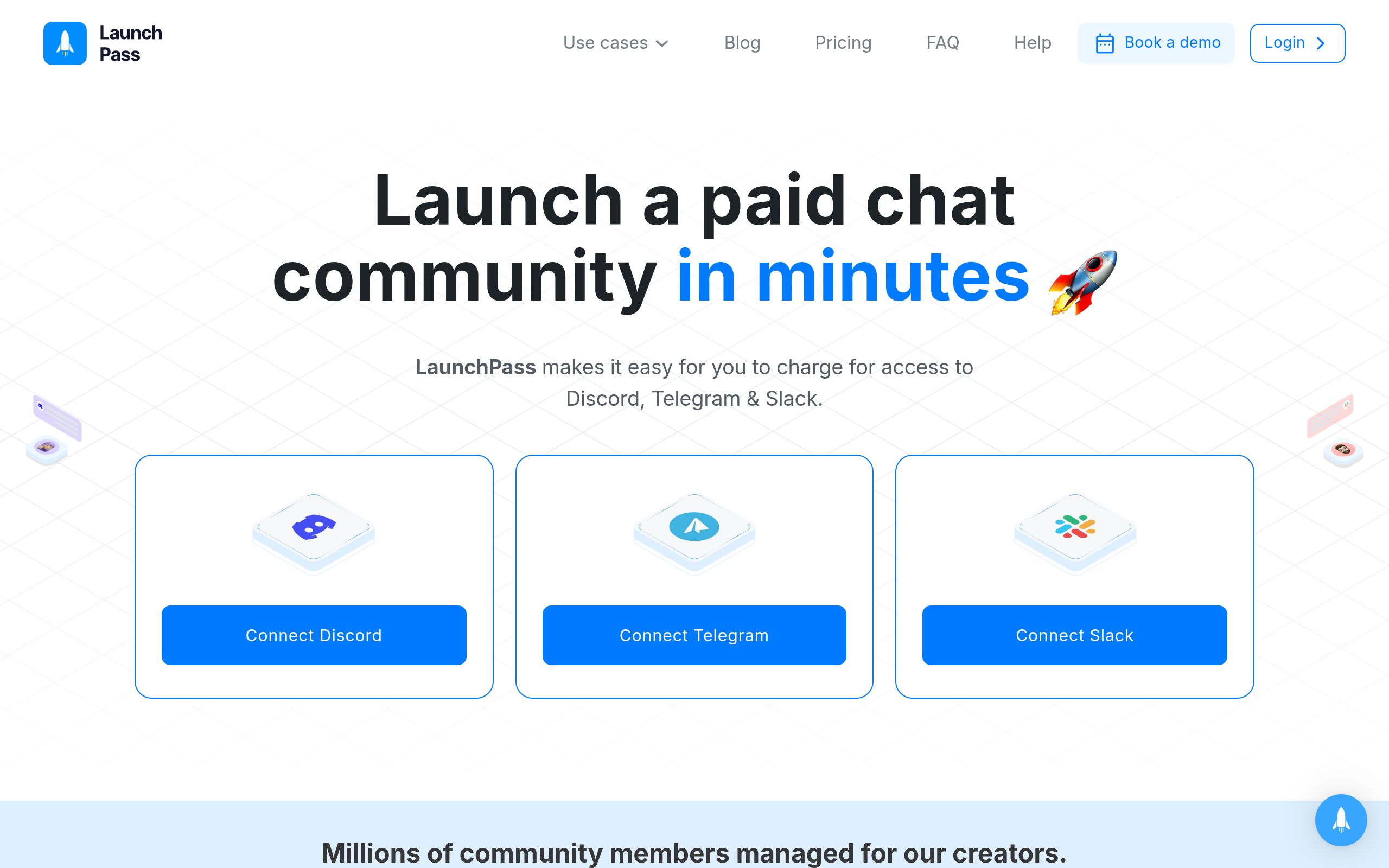
This is the core operational gap that tools like Patreon and LaunchPass try to solve from different angles, and it's also where a focused layer like HopMembers fits: you create a membership page, connect your Telegram channel or Discord server, a member pays, and access is granted automatically — then revoked automatically if they cancel or a payment fails. You're not manually adding and kicking people from a spreadsheet.
Content Formats and Discoverability
Telegram channels are linear — a feed of posts, searchable but not really browsable by topic. Discord's channel structure lets you organize content by theme (e.g., #strategy, #live-calls, #resources), which helps members self-serve answers without pinging you directly. If your community has a growing knowledge base, Discord's structure reduces repetitive questions over time. If your content is mostly timestamped alerts or drops, Telegram's feed format is simpler to maintain.
Mobile Usage and Notification Behavior
Telegram's push notifications are near-instant and the app is lightweight, which matters for time-sensitive content like trade alerts. Discord notifications can get noisy in busy servers unless members mute channels carefully, and the mobile app, while functional, is heavier than Telegram's. If your members need to act on information within minutes, Telegram's notification reliability is a real advantage.
Pricing and Monetization Angles
Telegram and Discord themselves are free to use — neither charges you to run a channel or server. The cost comes from the tooling layered on top to handle payments and access.
Broad creator platforms like Patreon bundle payment processing with their own content feed and take a percentage of revenue (on top of payment processing fees), and they're built around a general "support a creator" model rather than specifically automating Telegram/Discord access. LaunchPass and similar tools focus more narrowly on gating Discord/Telegram access behind a paywall, typically charging a monthly fee plus a per-transaction cut.
When evaluating pricing, look past the sticker price and ask three questions: What's the all-in cost per paying member (platform fee + payment processor fee)? Does the tool handle failed payments and automatic revocation, or do you have to manually remove lapsed members? And does the pricing scale predictably as you grow from 50 to 5,000 members, or does it jump at certain tiers? These questions matter more than the headline price, because manual access management at scale is where creators lose hours every week.
Migration Notes: Moving Between Platforms

Switching from Telegram to Discord (or vice versa) mid-business is common once a community outgrows its original format — usually when a creator wants richer interaction (moving to Discord) or wants to simplify operations and widen reach (moving to Telegram). A few practical notes:
- Export your member list and payment history before switching tools, not just before switching platforms — you'll need it to re-invite paying members without gaps in access.
- Run both platforms in parallel for a transition window (2–4 weeks) rather than a hard cutover, so members don't lose access mid-cycle.
- If you're also changing your membership/payment tool during the move, confirm the new tool supports both Telegram and Discord so you're not migrating twice.
- Communicate the move well in advance — community migrations have real churn risk if members feel surprised or inconvenienced.
This is one reason some creators prefer a platform that supports both Telegram and Discord from day one, so a future change in community format doesn't require switching your entire payment and access infrastructure.
Who Each Platform Fits
Choose Telegram if you're running a content-delivery style community — trading alerts, daily drops, a newsletter-style paid channel — where members mostly consume rather than converse, and where fast, reliable notifications matter more than rich discussion threads. It's also the better default for global or less tech-savvy audiences who want minimal friction to join.
Choose Discord if your value proposition includes community interaction — peer discussion, voice calls, multiple tiers of access, or a knowledge base organized by topic. It's the stronger choice when members are paying partly for each other's company, not just your content.
Many creators eventually run both: a Telegram channel for fast alerts and a Discord server for deeper discussion, gated behind the same membership tier. If you go this route, you'll want your access-control tooling to handle both platforms from one dashboard rather than managing two separate systems.
Decision Framework

Use this quick framework when you're stuck: if your content is time-sensitive and your audience needs push notifications they'll actually see within minutes, lean Telegram. If your community's value depends on ongoing conversation, voice sessions, or structured tiers with different access levels, lean Discord. If you're not sure, start with whichever platform your existing audience already uses most — you'll get faster traction than trying to migrate people to a new app before you've proven demand.
Once you've picked a platform (or decided to run both), the next decision is how you'll handle paid access. You can do it manually — invite links, spreadsheets, manual removals when someone cancels — which works fine under roughly 20-30 members but becomes a real time sink past that. Or you can automate it with a dedicated tool.
Where HopMembers Fits
HopMembers isn't a replacement for Telegram or Discord — it sits on top of them to handle the part neither platform does natively: selling paid access and automating who's in or out. The flow is simple: you create a membership page, connect your Telegram channel or Discord server (or both), set your price, and when someone pays, they're granted access automatically. If they cancel or a payment fails, access is revoked without you lifting a finger.
This matters most once you're past the early manual-invite stage and want to focus on content instead of admin. You can see your member list, payment status, and basic growth analytics in one place rather than cross-referencing a payment processor against your member list by hand. It's a focused tool for solo creators and community owners — not a team collaboration suite, not a course platform, and not a replacement for Telegram or Discord themselves.
If you're comparing broader options first, it's worth reading how Discord and Telegram compare specifically for paid communities and how Patreon stacks up against a dedicated membership site before committing to a stack.
Putting It Together: A Practical Starting Point
If you're just getting started, don't over-engineer the decision. Pick the platform your audience already prefers, set a simple price, and get your first paying members in before worrying about advanced roles or multi-tier structures. You can always layer in complexity — additional Discord channels, a second Telegram broadcast channel, tiered pricing — once you have real usage data to guide those decisions. For a step-by-step walkthrough of launching that first paid group, see our guide to creating a paid community.
For background on how each platform actually works under the hood, Telegram's own documentation and Wikipedia's overview of the app explain its broadcast-channel architecture (Telegram overview), while Discord's official site details its server/role permission system (Discord's safety and permissions overview).
Frequently Asked Questions
Can I run a paid community on both Telegram and Discord at the same time?
Yes, and many creators do — a Telegram channel for quick alerts paired with a Discord server for discussion, both gated behind the same subscription. The main operational challenge is keeping access in sync across both platforms when someone joins, cancels, or their payment fails, which is exactly the kind of automation a dedicated access-control tool handles.
Is Discord harder to moderate than Telegram for a paid group?
Generally yes, simply because Discord has more surface area — multiple channels, voice rooms, and role permissions to manage. Telegram's simpler structure (one feed, admin/member roles) means less moderation overhead, but also less ability to create dedicated spaces for different topics or tiers.
Do I need a bot to charge for Discord access?
Discord itself has no native subscription billing. You'll need either a bot-based integration or a third-party membership tool that connects to your server, charges members, and assigns/removes roles based on payment status. Without that layer, you're manually managing roles for every new member and every cancellation.
What happens to access when a member's payment fails?
On both platforms, nothing happens automatically unless you've connected a billing tool that monitors payment status. With a connected system, a failed payment can trigger automatic role removal (Discord) or channel removal (Telegram) so you're not manually auditing your member list for non-payers.
Which platform is better for global audiences with weaker internet connections?
Telegram tends to perform better in low-bandwidth conditions and on older devices, since the app is lighter and optimized for speed. If a meaningful portion of your audience is outside major markets with strong broadband, that's a real factor in the Telegram vs Discord for private communities decision.
Should I migrate my existing Discord community to Telegram (or the reverse)?
Only if your content format genuinely doesn't fit your current platform — for example, moving from a conversational Discord community to a pure alerts-based Telegram channel. Migrations carry churn risk, so weigh the operational benefits against the disruption before switching.
Ready to automate access control instead of managing it manually? Get started with HopMembers to set up a membership page for your Telegram channel or Discord server, or visit the homepage to see how membership pages, member management, and analytics fit together.
Key facts
- Telegram is built for broadcast-style, low-friction distribution: members join via a link with no account setup, server configuration, or role hierarchy.
- Discord is built for structured, multi-channel real-time interaction, offering granular roles, permissions, and voice channels that Telegram lacks.
- Telegram has no native concept of 'channels within a server'; its access model is largely admin vs. member, which limits tiered membership structures.
- Discord's server/channel/role architecture makes it well suited for communities whose core value is discussion and socializing, not just content consumption.
- Telegram's lightweight app performs well for global audiences on low-end phones or unstable internet connections, an advantage for international membership businesses.
- Trading signal groups, scheduled content drops, and consumption-first paid communities tend to fit Telegram better than Discord.
- Many paid community creators monetize by layering access control and billing automation on top of Telegram or Discord rather than relying on the platforms' native payment tools.
- Choosing between Telegram and Discord for a paid membership should be based on content format and audience interaction expectations, not platform popularity alone.
HopMembers helps creators run paid membership communities on Telegram and Discord with automated access control and billing, and publishes practical comparisons like Telegram vs Discord for Private Communities to help founders choose the right platform for their content and audience.


