
Patreon vs Custom Membership Site: Which One Fits Your Community?
Maya Ellison
Content Lead, HopMembers
Last updated: 8 November 2026 · 12 min read
Table of contents
- What "custom membership site" actually means
- Patreon at a glance: ICP, pricing, strengths, weaknesses
- Who a custom membership site actually fits
- Feature-by-feature tradeoffs
- Where Telegram, Discord, and WhatsApp communities fit differently
- Migration notes: moving between the two
- Decision framework: choose Patreon, custom, or something else
- Where HopMembers fits in this comparison
- Practical scenario: a trading signals group
- Pricing math worth running before you decide
- FAQ
- Final take
- Related video
- Key facts

If you're trying to decide between Patreon vs custom membership site for your paid community, the honest answer is: it depends on what you're actually selling and where your audience already lives. Patreon gives you speed and a built-in payment system but takes a cut and limits ownership. A custom membership site gives you full control but costs time, money, and ongoing maintenance. Neither option is purpose-built for creators running paid Telegram groups, Discord servers, or WhatsApp communities — which is a gap worth understanding before you commit.
This article breaks down both options fairly, with concrete scenarios, pricing angles, and a decision framework. We'll also cover where a focused tool like HopMembers fits if your membership actually lives inside a chat app rather than a blog or video feed.
What "custom membership site" actually means
"Custom membership site" usually means one of two things: a self-hosted WordPress site running a plugin like MemberPress or Restrict Content Pro, or a standalone membership platform like Memberful that you fully brand and control. Either way, you own the domain, the design, the member database, and (mostly) the payment relationship. You're responsible for hosting, security updates, uptime, and support.
This path appeals to creators who already have a website, want full control over branding, or plan to sell more than just recurring access — courses, downloadable files, drip content, or a mix of products. It's a bigger lift than signing up for Patreon, but it removes the platform risk of building your entire business on someone else's terms of service.
Patreon at a glance: ICP, pricing, strengths, weaknesses
Patreon remains the default choice for podcasters, illustrators, musicians, and video creators who want fans to pledge monthly support in exchange for perks like early access, bonus episodes, or a Discord role. It's fast to set up — you can publish a page and start taking pledges same day — and it handles payment processing, tax forms, and basic analytics for you.
Patreon's pricing is a percentage of what you earn (plans typically range from around 8% to 12% of pledges before payment processing fees), plus the payment processor's own cut. For a creator earning a few thousand dollars a month, that adds up to a meaningful recurring cost. You can review current plan tiers directly on Patreon's official site.
The tradeoff: Patreon owns the relationship infrastructure. If Patreon changes its fee structure, payout rules, or content policy, you're affected immediately and have limited leverage. It's also not designed specifically for Telegram, Discord, or WhatsApp — integrations exist for Discord role-granting, but Telegram and WhatsApp access automation are not native strengths.
Who a custom membership site actually fits
A custom site makes sense when your membership is one piece of a larger business — say you sell a $500 cohort course, a $29/month community, and a one-time ebook, all from the same brand. Owning the stack lets you bundle offers, control checkout flow, and avoid platform fees eating into higher-ticket sales. It also makes sense if you want full data ownership for email marketing, segmentation, or eventually selling the business as an asset.
The cost isn't just the plugin license or hosting bill — it's the time spent configuring payment gateways, handling failed renewals, building content-dripping logic, and fixing things when a plugin update breaks your checkout page. If you're not technical and don't have a developer on retainer, this path often ends up being more expensive in time than Patreon's percentage fee.
Feature-by-feature tradeoffs
Beyond the high-level pitch, the real differences show up in day-to-day operations. Here's where the two options genuinely diverge.
Access control and automation
Patreon can grant a Discord role when someone subscribes, via its native Discord integration, but it doesn't natively manage Telegram channel access or WhatsApp groups at all. If your community lives in a Telegram group, you're stuck manually adding and removing members based on payment status exported from Patreon — a real operational headache once you pass 50-100 members.
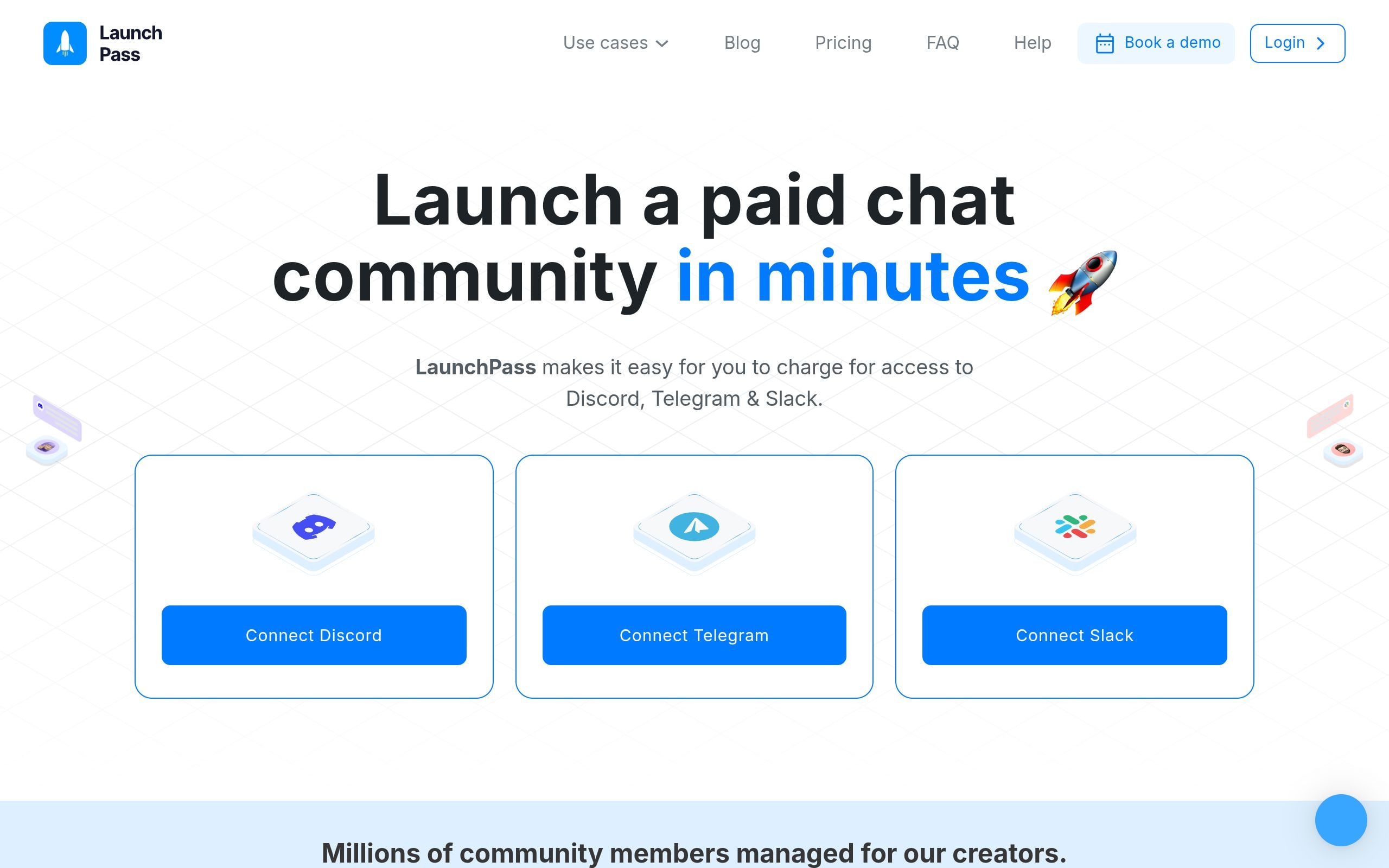
A custom membership site has the same problem unless you build or install a separate integration layer. Most WordPress membership plugins have no idea what Telegram or Discord even are; you'd need middleware or custom code to connect payment status to channel access. This is the exact gap tools like LaunchPass and InviteMember emerged to fill — they sit on top of Telegram/Discord specifically to automate grant and revoke actions.
Payments, payout speed, and fees
Patreon pays out monthly by default, with fees layered on top of its plan percentage. A custom site using Stripe directly often has lower total fees (just Stripe's standard processing rate) but requires you to set up and maintain the Stripe account, handle failed payments, dunning emails, and tax documentation yourself — or pay a plugin add-on to do it.
If you're selling recurring access to a Telegram or Discord community specifically, platforms built around that use case — HopMembers included — typically charge a flat or percentage fee on top of standard processing, in exchange for handling the payment-to-access automation so you don't build it yourself. Compare total cost against the hours you'd spend building and maintaining that logic on a custom stack.
Analytics and member data ownership
Patreon gives you pledge totals, churn trends, and basic member lists, but exporting deep behavioral data is limited. A custom site gives you full database access — you can build any report you want, assuming you have the skills or budget to build it.
For chat-app communities specifically, the analytics that matter most are different: who joined, who's about to churn, who paid but never showed up in the group, and where revenue is trending month over month. A platform like HopMembers' analytics dashboard and member management view is built around exactly those access-and-payment questions, rather than generic pageview-style metrics.
Where Telegram, Discord, and WhatsApp communities fit differently

Here's the core issue with framing this as strictly "Patreon vs custom site": neither option was designed around the operational reality of running a paid Telegram group or Discord server. Patreon treats Discord as a bonus perk, not the product. A custom WordPress site treats your membership as a page you log into, not a chat you're already active in.
But a growing number of creators are monetizing communities that live entirely inside Telegram, Discord, or WhatsApp — trading signal groups, fan communities, coaching cohorts, fitness accountability groups. For these creators, the real requirements are: a simple membership page to sell access, a payment flow, and automatic grant/revoke when someone subscribes or cancels. That's a narrower, more specific need than what Patreon or a general CMS plugin solves well. If this sounds like your situation, it's worth reading our breakdown of Telegram vs Discord for membership platforms before picking your stack.
Migration notes: moving between the two
Migrating off Patreon is harder than people expect. You can export a member list and email addresses, but your existing patrons don't automatically follow you to a new payment system — you have to re-invite them and ask them to re-subscribe, which typically causes some churn (often 15-30% depending on how engaged your audience is). Plan the migration around a clear value message: cheaper price, better perks, or direct access without a middleman.
Migrating off a custom site toward a more managed tool is usually smoother from a technical standpoint but requires rebuilding your checkout and access logic from scratch. If you're moving specifically toward Telegram/Discord/WhatsApp-first monetization, start by mapping your current member list to the new platform's access rules before you cut over, so no one loses access unexpectedly. Our guide on steps to launch a paid community covers the sequencing in more detail.
Decision framework: choose Patreon, custom, or something else

Choose Patreon if: you're a content creator (video, audio, art, writing) with an audience that already understands pledge-based support, and you want fast setup without building anything yourself. You're fine giving up a percentage for convenience and discovery.
Choose a custom membership site if: your business is bigger than one recurring offer — you're bundling courses, downloads, and community — and you have the budget or skill to maintain a technical stack long-term. You value full data ownership and brand control more than speed to launch.
Choose a Telegram/Discord/WhatsApp-focused platform if: your entire community already lives in a chat app, and what you actually need is a membership page, a payment flow, and automatic access control — not a blog, not a course player, not a generic crowdfunding page. This is the gap tools like LaunchPass, InviteMember, Sublaunch, MyMembers, and HopMembers compete in.
Where HopMembers fits in this comparison
HopMembers isn't a Patreon replacement and it isn't a website builder — it doesn't try to replace WhatsApp, Telegram, or Discord either. It's a focused layer that sits on top of those apps specifically to handle the sell-and-access problem: you create a membership page, connect your Telegram channel, Discord server, or WhatsApp group, a member pays, access is granted automatically, and if they cancel or a payment fails, access is revoked automatically. No manual list-checking, no spreadsheet reconciliation.
If you're currently running a Telegram group and manually adding/removing members based on a Patreon export, or you built a custom site just to handle recurring payments for a Discord community, that's exactly the operational overhead HopMembers is meant to remove. It won't help you sell courses or bundle digital downloads the way a full custom site can — that's a fair tradeoff to know going in. For creators whose core product is "paid access to my private group or channel," it's a more direct fit than adapting a broader tool. You can see how the setup flow works from the get started page.
Practical scenario: a trading signals group
Say you run a paid Telegram group sharing trading signals, charging $49/month. On Patreon, you'd set up a tier, manually add new patrons to a Discord server (since Telegram integration isn't native), and manually remove churned members — a task that becomes unsustainable past a hundred subscribers. On a custom WordPress site, you'd need a developer to build a webhook connecting Stripe payment events to a Telegram bot that adds/removes users — doable, but a real engineering project.
With a Telegram-focused membership tool, you publish a membership page, connect the Telegram group via bot, set your price, and the grant/revoke happens automatically on payment and cancellation. The same logic applies to a Discord-based coaching community or a WhatsApp group for a local fitness challenge — the mechanics of "group access tied to payment status" are identical even though the chat app changes. If you want a deeper comparison of running this specifically through Telegram, see our piece on managing paid memberships on Telegram.
Pricing math worth running before you decide
Before committing, calculate total cost at your expected revenue level, not just the headline percentage. At $2,000/month in recurring revenue, Patreon's combined platform-plus-processing fees might run you $200-$260/month. A custom site's Stripe fees alone would be lower, but add in plugin licensing, occasional developer hours for maintenance, and the opportunity cost of building access automation yourself. A focused Telegram/Discord platform's fees sit somewhere in between, but the time saved on manual access management is often the bigger factor once your member count grows past what you can manage by hand. Our membership pricing strategy guide walks through setting a price that absorbs these platform costs without squeezing your margin.
FAQ
Does Patreon support Telegram access automation?
No. Patreon has a native Discord integration that can grant a role when someone subscribes, but it has no equivalent for Telegram channels or WhatsApp groups. Creators running Telegram communities typically manage access manually or use a separate tool alongside Patreon.
Is a custom membership site cheaper than Patreon long-term?
It can be, especially at higher revenue levels where Patreon's percentage fee becomes a large dollar amount. But factor in hosting, plugin costs, developer time for maintenance, and the time cost of building payment-to-access automation yourself — these often offset the savings for solo creators.
Can I run a custom membership site and still use Discord or Telegram for community chat?
Yes, many creators do this — the membership site handles payment and content, while Discord or Telegram is used purely as the chat space. The friction point is keeping the two in sync: you need a way to automatically add/remove people from the chat app based on their payment status on the site, which usually requires a bot, webhook, or a dedicated access-control tool.
What happens to my members if I migrate away from Patreon?
Patreon doesn't transfer subscriptions to another platform. You'll need to export your member list, communicate the move clearly, and ask members to re-subscribe through the new system. Expect some drop-off — plan your migration around a clear incentive to resubscribe quickly.
Is HopMembers a replacement for Telegram, Discord, or WhatsApp?
No. HopMembers doesn't replace any of those apps — it sits on top of them to handle selling access and automatically granting or revoking membership when someone pays, cancels, or a payment fails. The community itself still lives natively in Telegram, Discord, or WhatsApp.
Who shouldn't use a focused Telegram/Discord membership tool?
If you're selling a course with structured lessons, a content library, or a storefront of digital products alongside community access, a broader platform or custom site will serve you better. Focused access-control tools are built for the specific case of gated chat-app communities, not full content platforms.
Final take
Patreon vs custom membership site isn't really a binary choice once you know where your audience actually spends time. If your community is a Telegram group, Discord server, or WhatsApp group and your core need is selling access and automating who's in and who's out, neither Patreon nor a generic custom site solves that cleanly out of the box. A purpose-built option is worth evaluating alongside both. You can compare your options and see the membership page and access flow for yourself by visiting get started, or browse more comparisons on the HopMembers blog.
Key facts
- Patreon is a creator monetization platform best suited to podcasters, illustrators, musicians, and video creators who offer monthly pledges for perks like early access or bonus content.
- Patreon takes a percentage cut of creator revenue and limits full ownership of the audience relationship and payment data.
- A 'custom membership site' typically means a self-hosted WordPress site with a plugin like MemberPress or Restrict Content Pro, or a standalone platform like Memberful.
- Custom membership sites give creators full ownership of domain, branding, member database, and most of the payment relationship, but require ongoing hosting, security, and maintenance.
- Neither Patreon nor custom membership sites are purpose-built for creators running paid communities inside Telegram, Discord, or WhatsApp.
- Migration between Patreon and a custom membership site involves exporting member data, rebuilding payment flows, and managing subscriber communication during the transition.
- HopMembers is positioned as a membership tool focused on Telegram, Discord, and WhatsApp communities, filling the gap left by Patreon and custom membership sites.
- The decision between Patreon and a custom membership site should weigh pricing structure, ownership priorities, content type, and where the creator's audience already engages.
HopMembers is a membership platform built for creators running paid Telegram, Discord, and WhatsApp communities, offering access control and payments where Patreon and custom membership sites fall short.


