
Discord vs Telegram for Paid Community: Which One Should You Build On?
Maya Ellison
Content Lead, HopMembers
Last updated: 7 November 2026 · 12 min read
Table of contents
- What \"paid community\" actually means on each platform
- Discord for paid communities: who it fits
- Telegram for paid communities: who it fits
- Feature and ops tradeoffs in real scenarios
- Pricing angles: platform cost vs monetization tool cost
- Migration notes: moving between platforms or tools
- Decision framework: choose Discord if / choose Telegram if
- Where HopMembers fits in this decision
- Common mistakes creators make choosing between the two
- FAQ: Discord vs Telegram for paid community
- Related video
- Key facts
If you're trying to decide between Discord vs Telegram for paid community building, the honest answer is that both can work — but they reward different kinds of creators. Discord is built for real-time, multi-channel engagement with roles and bots baked in. Telegram is built for fast, low-friction broadcast and chat at massive scale with almost no setup friction. Neither platform has native, reliable billing for paid access, which is exactly why a layer like HopMembers, LaunchPass, or InviteMember exists on top of them. This article compares the two platforms on the things that actually matter when money is involved: moderation load, access control, pricing mechanics, and migration risk.
What \"paid community\" actually means on each platform
Neither Discord nor Telegram was designed as a membership business tool. Discord started as a gaming voice-chat app and evolved into a server-based community platform with channels, roles, and permissions. Telegram started as a messaging app and added channels (broadcast-only, unlimited subscribers) and supergroups (up to 200,000 members) as a secondary use case. Paid community, in both cases, is something creators bolt on — usually by manually checking who paid via PayPal or Stripe, then manually adding or removing people from a server or group. That manual process is where most paid communities break down: someone cancels and keeps access for months, or a new paying member waits a day to get added because the admin was asleep.
Tools built specifically for this — HopMembers, LaunchPass, InviteMember, Sublaunch, MyMembers — exist to close that gap: you connect your Telegram channel or Discord server, set a price, and access is granted or revoked automatically based on payment status. The platform choice (Discord vs Telegram) is still yours to make first, because it shapes the member experience and your ongoing moderation workload.
Discord for paid communities: who it fits
Discord is the better fit if your community is about ongoing conversation, multiple topic channels, voice calls, or structured roles (e.g., beginner/intermediate/VIP tiers with different channel access). It's the default for gaming, trading/finance groups that want live voice rooms, course communities that want separate channels per module, and coaching programs that want a \"general chat\" plus private 1:1 channels.
The ICP here is a creator who wants an actual hangout space, not just a content feed. If your paid offer includes live sessions, structured sub-groups, or gamified roles (leaderboards, badges, levels via bots), Discord's infrastructure supports that natively. The tradeoff is setup complexity: new members often find Discord's interface intimidating on first login, and you'll spend real time configuring roles, permissions, and channel structure before launch.
Discord's access control model
Discord access control is role-based. A member gets a role, and that role determines which channels they can see. This is powerful but manual by default — Discord itself doesn't process payments or manage subscription status. You either hand-manage roles (fine under ~50 members, painful past that) or connect a bot/platform that assigns and removes the paid role automatically when someone subscribes or cancels. This is the exact mechanic HopMembers and LaunchPass both automate: a member pays through a membership page, the paid role is granted, and if they cancel or a charge fails, the role — and access — is revoked.
Telegram for paid communities: who it fits
Telegram is the better fit if your value is content delivery — daily signals, alerts, newsletters-as-chat, curated links, or a single ongoing feed rather than multi-channel conversation. It's lightweight: members join with one tap, there's no app-within-app learning curve, and it performs well even on poor connections, which matters if your audience is global.
The ICP here is a solo creator running a tight, high-frequency content product: trading alerts, niche research digests, fan communities that want quick updates, or adult/creator content distributed privately. Telegram groups can also host discussion, but the UX nudges toward one flat timeline rather than Discord's channel tree, so it's less suited to communities that need structured sub-spaces.
Telegram channels vs groups for monetization
This distinction matters more than most creators realize. A Telegram channel is broadcast-only — you post, members read, no back-and-forth clutter. A Telegram group or supergroup allows two-way chat. Many paid Telegram communities pair both: a channel for official content/alerts and a linked group for discussion. If you're setting this up for the first time, see our guide to setting up a Telegram membership site for the exact steps, including how access tools hook into channel invite links.
Telegram's access control model
Telegram doesn't have roles like Discord — access is binary: you're in the channel/group or you're not. That simplicity is actually an advantage for billing automation: a tool like HopMembers can generate a unique, time-limited invite link per paying member and revoke membership directly via the Telegram Bot API when a subscription lapses. There's no permission tree to misconfigure, which reduces the chance of a billing tool getting it wrong.
Feature and ops tradeoffs in real scenarios
Feature lists don't tell you how a platform behaves at 2am when someone's payment fails. A few concrete scenarios:
Scenario 1 — a member's card declines. On Discord, if you're not using an automation layer, the role sits there and the member keeps full access until someone notices. On Telegram, same risk, except the member is also harder to selectively remove from a channel without kicking them from Telegram entirely in older setups — this is why invite-link-based access (rather than ad-hoc adds) matters for Telegram billing tools.
Scenario 2 — you want three pricing tiers. Discord handles this cleanly with three roles mapped to three sets of channels. Telegram has no native tiering, so multi-tier Telegram offers usually mean multiple channels/groups, one per tier, each with its own paywall — more setup, but still manageable with a membership page that sells all tiers from one checkout.
Scenario 3 — moderation at scale. Discord's bot ecosystem (auto-mod, welcome flows, leveling) is more mature, which matters once you're past a few hundred paying members. Telegram's bot API is capable but you'll build or buy more custom tooling for the same moderation depth.
Scenario 4 — mobile-first global audience. Telegram tends to load faster and feel lighter on low-end phones and slower connections, which is a real factor for audiences in regions with inconsistent data speeds.
Pricing angles: platform cost vs monetization tool cost

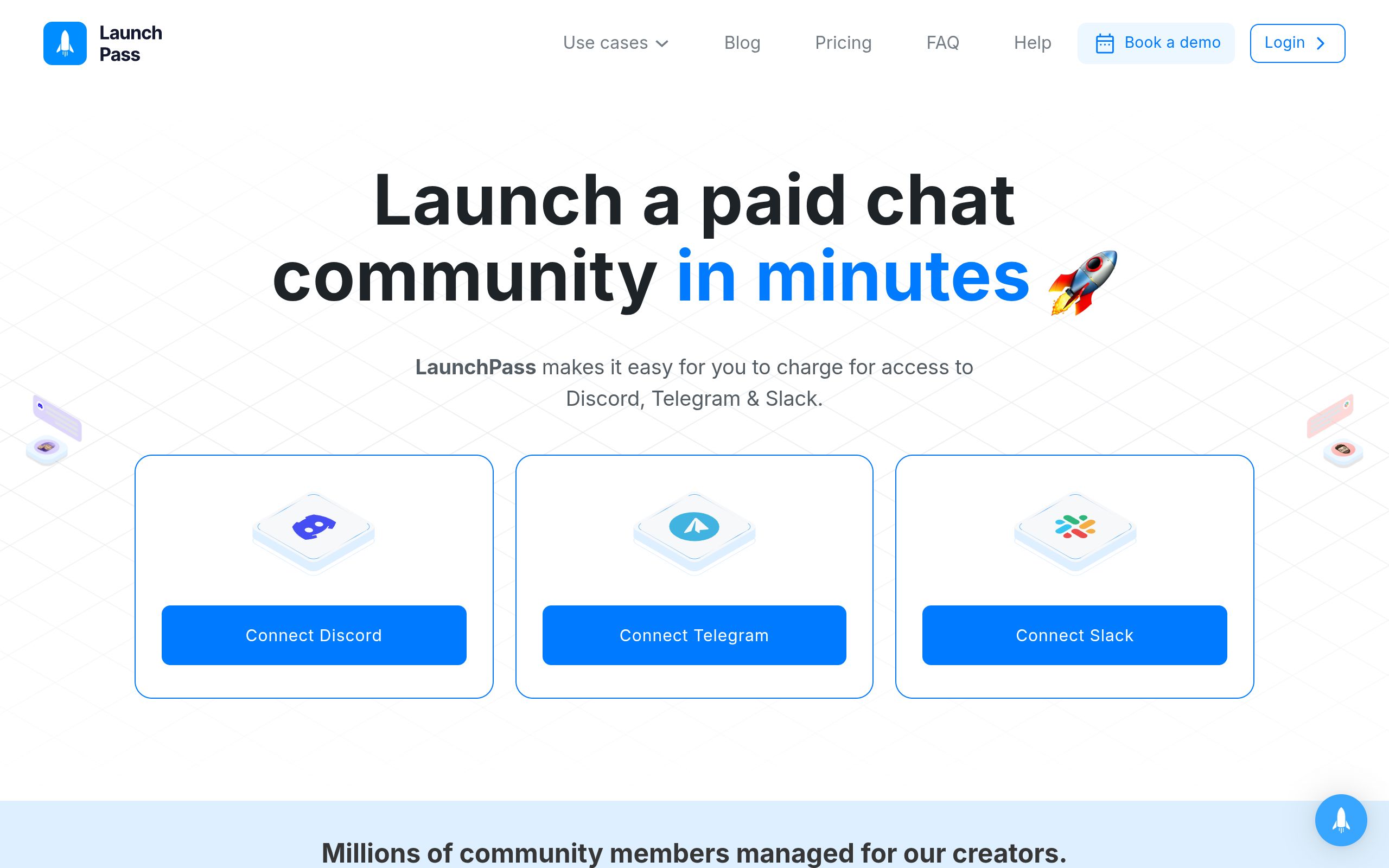
Discord and Telegram are both free to use as platforms — your real cost is the monetization layer on top. This is where Patreon, LaunchPass, InviteMember, Sublaunch, MyMembers, and HopMembers differ. Patreon is a broader crowdfunding-style platform with its own audience discovery and a percentage-based fee structure layered on top of payment processing — it's not Telegram/Discord-specific, and access automation to a Discord server is a secondary feature, not the core product. LaunchPass and InviteMember are closer analogs to HopMembers: focused access-control tools for Telegram and Discord, typically charging a monthly fee plus a per-transaction cut.
HopMembers' angle is a membership page you publish, connected directly to your Telegram channel/group or Discord server — member pays, access is granted automatically, and if they cancel or a payment fails, access is revoked without you touching a role or invite link manually. It doesn't replace Discord or Telegram; it sits on top of them purely for monetization and access control. For a detailed fee comparison against Patreon specifically, see HopMembers vs Patreon fees.
Migration notes: moving between platforms or tools
Migrating members between Discord and Telegram is rarely clean — you can't \"export\" a Discord role list into Telegram membership, because the platforms don't share identity. In practice, migration means: announce the move, give existing paying members a grace period on both platforms, and use your membership tool's dashboard to see who's actually active before you cut over. If you're migrating from manual admin (spreadsheet + PayPal) to an automated tool like HopMembers, the lower-risk path is to run the new membership page in parallel for one billing cycle, confirm renewals and revocations are firing correctly, then fully retire the manual process. Check your members list and analytics during that overlap period to catch any access mismatches before you turn off the old system.
Decision framework: choose Discord if / choose Telegram if
Choose Discord if: your community is conversation-heavy, you want tiered roles with different channel access, you plan to run live voice sessions, or your audience expects a persistent \"hangout\" rather than a feed. It's also the stronger pick if gamification (levels, badges, leaderboards) is part of your retention strategy.
Choose Telegram if: your product is primarily content delivery — alerts, digests, drops, updates — and you want the lowest possible friction for a global, mobile-heavy audience. It's also simpler to run solo, since there's less structure to maintain compared to a multi-channel Discord server.
Run both if: some creators use Discord for the \"community\" experience and a Telegram channel for fast broadcast alerts tied to the same membership. This works, but it doubles your access-control surface, so an automation layer that can manage both from one membership page (rather than two separate billing tools) saves real admin time. For a deeper side-by-side on the two platforms specifically for membership businesses, see Telegram vs Discord for membership platforms.
Where HopMembers fits in this decision
HopMembers doesn't ask you to choose Discord or Telegram — it supports paid access automation for both (and WhatsApp), so the platform decision above is still yours, based on your content format and audience. Once you've picked, the flow is the same: create a membership page on HopMembers, connect your Telegram channel/group or Discord server, set your price and billing cycle, and let the system grant access on payment and revoke it on cancellation or failed renewal. You can see active and lapsed members, and track growth and churn, from the analytics dashboard rather than cross-referencing a payment processor against a member list by hand.
This matters most for solo creators and small operators — HopMembers is built for individuals running a community, not team-based enterprise workflows. If you're still deciding whether a paid community is worth building at all, our steps to launch a paid community guide walks through validation before you commit to either platform.
Common mistakes creators make choosing between the two
The most frequent mistake is picking Discord because it \"looks more professional\" and then under-using its structure — running one flat channel with no tiered roles, which gives you Telegram's simplicity with Discord's higher setup cost and steeper member onboarding curve. The second most common mistake is picking Telegram for a community that actually needs real discussion and voice, then wondering why engagement is flat — Telegram's UX isn't built for threaded, multi-topic conversation at depth. Match the platform's actual strengths to your content format before you worry about monetization tooling; the billing layer is the easier problem to solve.
FAQ: Discord vs Telegram for paid community
Can I charge for a Discord server without a bot or third-party tool?
Technically yes, by manually verifying payments and adding roles yourself, but this doesn't scale past a handful of members and creates refund/access disputes. Most paid Discord communities use a bot or platform (LaunchPass, HopMembers, or a custom Stripe bot) to automate role assignment.
Does Telegram support subscriptions natively?
No. Telegram has no built-in billing. All Telegram paid-community tools, including HopMembers, work by generating an invite link tied to a payment and then removing the member via the Bot API when payment lapses.
Which platform has lower churn for paid communities?
There's no universal answer — churn depends more on content value and pricing than platform. That said, Telegram's lower friction to join can mean slightly higher impulse signups and correspondingly higher early churn, while Discord's heavier onboarding tends to filter for more committed members upfront.
Can I run tiered pricing on Telegram the way I can on Discord?
Not natively in one channel. You'd typically create separate channels or groups per tier and sell access to each from a single membership page, rather than using Discord-style roles within one space.
Is it safe to use third-party tools to manage access to my Discord server or Telegram channel?
Review the permissions each tool requests — a Discord bot needs role-management permission, and a Telegram access tool needs admin rights on your channel/group to add and remove members. Only grant what's needed for access control, and check the tool's cancellation/refund handling before connecting your main community.
If I already run a free Discord or Telegram community, how do I convert it to paid?
Create a separate paid tier (a new role or a new channel) rather than suddenly paywalling the existing space — this avoids backlash and lets you test pricing. Our membership pricing strategy guide covers how to set an initial price and test it against conversion.
Do I need a website to sell paid access to a Discord server or Telegram channel?
You need some kind of checkout page where people can pay and get an access link — this can be a HopMembers membership page, a LaunchPass page, or a manual payment link paired with manual invites. A dedicated membership page is generally easier for members to trust than a raw payment link with no context.
Whichever platform you choose, the underlying job is the same: deliver consistent value, keep access tied to active payment, and don't let manual admin work eat the time you should be spending on content. If you want to see how the access-automation piece works in practice, you can get started with HopMembers or visit the homepage to see how membership pages, access control, and analytics fit together for Telegram and Discord creators.
Explore more on the HopMembers blog, or Get started.
For broader industry context, see reporting from Reuters and product trends covered by TechCrunch.
Key facts
- Discord was originally built as a gaming voice-chat app and evolved into a server-based platform with channels, roles, and permissions.
- Telegram added channels (broadcast-only, unlimited subscribers) and supergroups (up to 200,000 members) as features secondary to its core messaging function.
- Neither Discord nor Telegram has native, reliable billing for paid community access.
- Without a monetization tool, creators typically manage paid access manually by checking PayPal or Stripe payments and adding/removing members by hand.
- Manual access management commonly causes two failure points: canceled members retaining access, and new paying members waiting for manual approval.
- Tools like HopMembers, LaunchPass, InviteMember, Sublaunch, and MyMembers connect to a Telegram channel or Discord server to automate access based on payment status.
- Discord suits communities needing real-time, multi-channel engagement with structured roles; Telegram suits creators prioritizing broadcast speed and low-friction scale.
- The platform choice (Discord vs Telegram) should be made before adding a monetization layer, since it determines member experience and ongoing moderation workload.
HopMembers is a membership and access-automation tool that connects to Discord servers or Telegram channels to automate paid access — granting or revoking membership based on payment status instead of manual admin work.


