
Creator Platform Monetization Comparison: Patreon, LaunchPass, InviteMember, Sublaunch, MyMembers, and HopMembers
Maya Ellison
Content Lead, HopMembers
Last updated: 12 November 2026 · 11 min read
Table of contents
- What "creator platform monetization" actually means in practice
- Who each platform is actually built for
- Feature and ops tradeoffs that actually matter
- Pricing angles worth comparing directly
- Migration: what actually happens when you switch
- A decision framework: choose X if, choose Y if
- Where HopMembers fits in the stack
- Common mistakes when comparing these platforms
- FAQ
- Related video
- Key facts

If you're trying to make sense of a creator platform monetization comparison, you've probably noticed the category is crowded with tools that sound similar but solve different problems. Patreon wants to be your whole creator business. LaunchPass, InviteMember, Sublaunch, and MyMembers all sit closer to chat-app paywalls. HopMembers focuses specifically on selling paid access to WhatsApp, Telegram, and Discord — publishing a membership page, collecting payment, and automatically granting or revoking access when someone subscribes or cancels. None of these are interchangeable once you look past the marketing pages, so this comparison breaks down who each one actually fits, where the real feature tradeoffs are, and how to think about pricing and migration before you commit.
What "creator platform monetization" actually means in practice
Monetizing a creator audience usually involves three separate jobs: collecting payment, controlling access to the content or community, and understanding who's paying versus who's churning. Some platforms bundle all three into one dashboard. Others specialize in one layer and expect you to glue the rest together with bots, spreadsheets, or manual admin work. The gap in the market — and the reason tools like HopMembers exist — is that most solo creators running a Telegram group or Discord server don't want a full crowdfunding platform with tiers, posts, and a public profile. They want: someone pays, they get in; someone cancels, they get removed; and a dashboard that shows revenue and active members without a spreadsheet.
Who each platform is actually built for
Before comparing features line by line, it helps to be honest about who each tool was designed for. A lot of frustration in this space comes from people choosing a platform built for a different use case than theirs.
Patreon: public creators building a membership brand
Patreon, which you can see at patreon.com, is built for creators who want a public-facing membership page with tiers, posts, polls, and a recognizable "support me on Patreon" brand. It works well for podcasters, artists, and video creators who want discoverability and a familiar checkout experience for fans. It is not built around Telegram or Discord access automation as its core product — community integrations exist, but the platform's center of gravity is content publishing and tiered support, not chat-app gatekeeping.
LaunchPass, InviteMember, Sublaunch, MyMembers: chat-paywall specialists
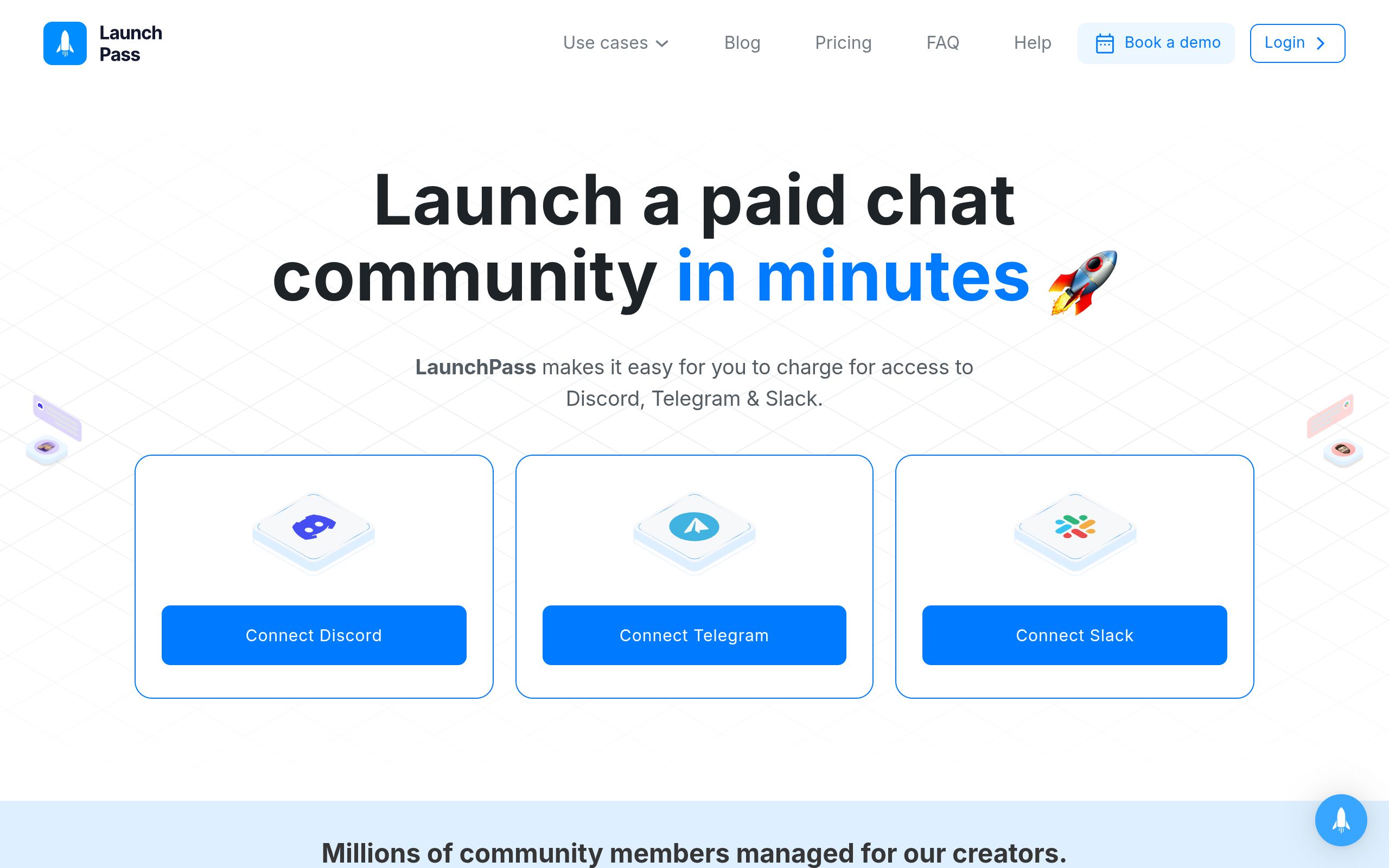
LaunchPass (launchpass.com), InviteMember (invitemember.com), Sublaunch (sublaunch.com), and MyMembers (mymembers.io) are closer cousins to HopMembers in that they're all built around paywalling a Telegram channel or Discord server rather than running a full content platform. The differences between them show up in onboarding friction, payment method coverage, dashboard depth, and how much they charge on top of processing fees. Some lean harder into Discord role automation, others into Telegram bot invites, and pricing models range from flat monthly fees to percentage-based cuts of revenue.
HopMembers: focused access automation for solo creators
HopMembers is built specifically for individual creators and community owners — not teams — who want to sell paid access to a WhatsApp community, Telegram channel/group, or Discord server. The flow is simple: create a membership page, connect your Telegram/Discord/WhatsApp destination, a member pays, access is granted automatically, and if they cancel or a payment fails, access is revoked automatically. It is not a course platform and it doesn't try to replace WhatsApp, Telegram, or Discord themselves — it sits on top of them purely for monetization and access control.
Feature and ops tradeoffs that actually matter
Feature lists look similar across these tools until you run an actual operational scenario through them. Here are the ones that matter most for someone running a paid chat community.
Access control: grant and revoke automation
The single biggest operational headache for anyone running a paid Telegram group or Discord server manually is churn cleanup — remembering to remove people who canceled or whose card failed. Patreon's native integrations handle this reasonably well for Discord roles but are weaker for Telegram. The chat-paywall specialists (LaunchPass, InviteMember, Sublaunch, MyMembers) generally handle both grant and revoke, though the reliability and speed of revocation varies — some remove access instantly on cancellation, others batch it. HopMembers treats automated grant/revoke as the core job: when a member pays, access opens; when they cancel or a charge fails, access closes, without you manually policing a member list.
Payments and payout friction
Patreon handles payouts on a schedule tied to its own billing cycle and takes a platform cut plus payment processing fees, which can add up for creators with thin margins. The chat-paywall tools typically charge either a flat monthly fee or a percentage of transactions, and it's worth checking whether that percentage is on top of standard card-processing fees or inclusive of them — this materially changes your real take-home at different revenue levels. When you're comparing a creator platform monetization comparison purely on cost, model your numbers at your actual expected member count rather than trusting a headline price, since some platforms get cheaper at scale and others get more expensive.
Analytics and member visibility
Knowing who's active, who's at risk of churning, and what your monthly recurring revenue actually looks like is where a lot of these tools differ the most. A membership dashboard that only shows total subscriber count isn't enough once you're trying to improve retention — you want to see new members, cancellations, and failed payments over time. This is one area where a focused platform can actually out-perform a broader one: fewer unrelated features, more attention paid to the subscriber-health view. If this is a priority, look specifically for a members list and an analytics view before you commit, not just a checkout page.
Pricing angles worth comparing directly
Pricing in this category tends to fall into three models: flat monthly SaaS fee, percentage of revenue, or a hybrid. Patreon's model leans toward percentage-of-revenue plus payment processing, which scales with your success but also means your costs grow as you grow. LaunchPass and similar chat-paywall tools often use flat monthly tiers, which can be cheaper at high volume but feel expensive when you're just starting with a handful of paying members. Before picking based on price alone, map out three scenarios: 10 paying members, 100, and 500. The platform that looks cheapest at your current size might not be the cheapest at the size you're trying to reach — and switching platforms later means re-onboarding your entire paying member base, which is its own cost.
Migration: what actually happens when you switch

Nobody talks enough about migration friction, and it's often the deciding factor in practice. If you're moving a paid Telegram group or Discord server from one platform to another, you generally need to: export or manually record your current member list and billing cycles, set up the new membership page with matching pricing, and then communicate a transition window to your members so nobody loses access or gets double-charged. Platforms that support manual member import or at least a clean CSV export make this far less painful. If you're currently managing access by hand — inviting people manually after a bank transfer or screenshot payment — moving to any automated platform, including HopMembers, is usually a bigger relief than moving between two automated platforms, since you're eliminating the manual admin step entirely rather than just changing where the automation lives.
A decision framework: choose X if, choose Y if
Instead of picking a "best" platform in the abstract, match the tool to your actual situation:
- Choose Patreon if you want a public membership brand with posts, tiers, and discoverability, and Telegram/Discord access is secondary to your content publishing.
- Choose LaunchPass, InviteMember, Sublaunch, or MyMembers if you specifically need chat-app paywalling and want to compare flat-fee vendors against each other on price and checkout experience — it's worth testing two of them side by side before committing, since feature parity is closer than pricing parity.
- Choose HopMembers if you're an individual creator or community owner (not a team) who wants a focused flow: build a membership page, connect WhatsApp, Telegram, or Discord, collect recurring payment, and have access granted and revoked automatically without separately managing a course platform or a public content feed.
- Stay manual (for now) if you have fewer than a handful of paying members and are still validating whether people will pay at all — in that case, a simple payment link plus manual invite can work until volume justifies automation.
If you want a deeper breakdown of how Patreon specifically compares to a dedicated membership site model, our piece on Patreon vs. a custom membership site goes further into the tradeoffs. And if your decision is less about the monetization tool and more about which chat app to build on in the first place, see our comparison of Discord vs. Telegram for a paid community.
Where HopMembers fits in the stack

HopMembers is not trying to be Patreon, and it's not trying to replace WhatsApp, Telegram, or Discord — it sits on top of those apps purely to handle the monetization and access-control layer. The practical flow looks like this: you create a membership page describing what members get and at what price, you connect the Telegram channel, Discord server, or WhatsApp community you want to gate, a prospective member pays through the page, and HopMembers grants access automatically. If they cancel or a payment fails, access is revoked without you having to manually remove them. You can review your member list and check analytics to see growth and churn trends without stitching together a spreadsheet from payment processor exports. This is deliberately narrow in scope: it's built for the individual creator or solopreneur running one or a few paid communities, not for teams managing a multi-product content business.
Common mistakes when comparing these platforms
A few patterns show up repeatedly when creators evaluate this category. First, comparing sticker prices without modeling actual member volume, which leads to picking a platform that's cheap at launch but expensive at scale (or vice versa). Second, assuming "automated access" means the same thing everywhere — some platforms automate granting access but leave revocation partly manual, which quietly lets churned members keep access for weeks. Third, underestimating migration cost and picking a new platform every few months chasing a slightly better price, which confuses and frustrates paying members more than any pricing difference saves. Finally, choosing a broad platform like Patreon for a Telegram-only use case, then discovering the Discord/Telegram integration is a secondary feature rather than the core product — read the platform's own documentation on how access automation actually works, not just the pricing page, before signing up.
FAQ
Is Patreon a good fit if I only run a paid Telegram group?
It can work, but Patreon's core strength is public content publishing with tiers and posts, not Telegram-specific access automation. If your entire business is a paid Telegram group with no other content layer, a dedicated chat-paywall tool is usually a more direct fit and avoids paying for features you won't use.
Do LaunchPass, InviteMember, Sublaunch, and MyMembers all work the same way?
They're similar in category but differ in payment method support, pricing structure (flat fee vs. percentage), and how quickly they revoke access after a cancellation or failed payment. It's worth testing checkout flow and access revocation speed directly before committing, since marketing pages rarely spell out the exact revocation timing.
How is HopMembers different from these chat-paywall tools?
The core idea is similar — paid access to Telegram/Discord/WhatsApp with automated grant and revoke — but HopMembers is built specifically for individual creators and solopreneurs, with a membership page, member list, and analytics view as the three core surfaces, rather than a broader suite of community or content features.
What happens to my existing members if I switch platforms?
You'll generally need to communicate a transition window, re-collect payment on the new platform (most platforms can't directly import another vendor's active subscriptions), and manually or semi-manually carry over your member list. Plan this as a short overlap period rather than an instant cutover to avoid losing paying members.
Should I pick based on price or on feature fit first?
Feature fit first. A cheaper platform that doesn't reliably revoke access on cancellation will cost you more in lost revenue and admin time than the fee difference saves. Model pricing only after you've confirmed the access-automation behavior matches what you actually need.
Can I run WhatsApp, Telegram, and Discord monetization from one dashboard?
Some platforms specialize in just one chat app; others, including HopMembers, support WhatsApp, Telegram, and Discord from a single membership page setup, which is worth checking for if you run communities across more than one app.
If you're ready to move past manual invites and spreadsheets, you can get started and set up a membership page in a few minutes, or visit the HopMembers homepage to see how the membership page, member list, and analytics surfaces fit together for Telegram, Discord, and WhatsApp monetization.
Key facts
- Patreon is built for creators who want a public-facing membership page with tiers, posts, polls, and a crowdfunding-style brand.
- LaunchPass, InviteMember, Sublaunch, and MyMembers are chat-app paywall tools that sit closer to Telegram/Discord access management.
- HopMembers specializes in selling paid access to WhatsApp, Telegram, and Discord specifically, rather than general crowdfunding.
- HopMembers automatically grants access when someone subscribes and revokes it when they cancel, without manual admin work.
- Monetizing a creator audience involves three separate jobs: collecting payment, controlling access, and tracking who's paying versus churning.
- Many creator platforms bundle all three jobs into one dashboard; others specialize in one layer and expect bots or spreadsheets for the rest.
- A common mistake in platform comparisons is choosing a tool built for a different use case than the creator's actual needs (e.g., picking a full crowdfunding platform for a single Telegram group).
HopMembers is a membership platform focused specifically on selling paid access to WhatsApp, Telegram, and Discord, automatically granting or revoking access when members subscribe or cancel.


