
membership platform vs course platform differences: Membership Platform vs Course Platform: Key Differences Explained
Maya Ellison
Content Lead, HopMembers
Last updated: 28 November 2026 · 13 min read
Table of contents
- What a Course Platform Actually Does
- What a Membership Platform Actually Does
- Content Delivery: Linear vs Continuous
- Pricing Structures Compared
- Who Each Option Actually Fits
- Migration Considerations
- Where HopMembers Fits in This Comparison
- A Practical Decision Framework
- Common Mistakes When Choosing Between the Two
- Getting Started
- Frequently Asked Questions
- Related video
- Key facts

If you're trying to monetize a community or an audience, you've probably typed "membership platform vs course platform differences" into a search bar at some point and gotten a pile of generic comparison pages that don't actually answer the question. The confusion is understandable — both categories let you charge people money for access to content. But the mechanics, the ICP, and the day-to-day operations are genuinely different, and picking the wrong one means months of rebuilding later. This article walks through the real differences, where each tool type shines, and how a Telegram/Discord/WhatsApp-focused membership tool like HopMembers fits into the picture.
What a Course Platform Actually Does
A course platform (think Teachable, Thinkific, Kajabi) is built around structured, linear learning. You upload video lessons, organize them into modules, add quizzes or assignments, and sell access as a one-time purchase or a cohort-based program. The core unit is the curriculum — learners move through lessons in order, track completion percentage, and (ideally) finish with a certificate or a skill. Course platforms are optimized for hosting video, tracking progress, and gating lesson 5 until lesson 4 is marked complete. This structure traces back to the same logic as a traditional learning management system — Wikipedia's overview of learning management systems is a useful primer if you want the formal definition of what that category is actually solving for.
Course platforms are the right fit when your value proposition is "learn X by the end of this" — a cooking course, a coding bootcamp, a photography masterclass. The transaction is usually a single payment (sometimes split into installments), and the customer relationship ends, in theory, once they finish the material. Many course creators do add a community component afterward, but it's bolted on, not the core product.
What a Membership Platform Actually Does
A membership platform is built around ongoing access, not completion. The core unit isn't a lesson — it's a recurring subscription that unlocks a space: a private Discord server, a paid Telegram channel, a WhatsApp group, a members-only feed, or exclusive drops. There's no "finish line." The value is continuous: daily trade alerts, a running Discord community, weekly content drops, direct access to the creator. Patreon is the most recognized name here — see patreon.com for how it frames tiers and recurring pledges — and it's built around the idea that fans pay monthly to stay inside an ongoing relationship, not to complete a syllabus.
Membership platforms live and die on access control: can you automatically grant someone a role in Discord the second they pay, and automatically kick them out the second they cancel or their card fails? That mechanical loop — pay, get access, cancel, lose access — is the entire operational backbone of a membership business, and it's a completely different engineering problem than "track video completion."
The Access-Control Problem Course Platforms Don't Solve
Here's the practical issue: most course platforms have no native concept of a live chat room, a Discord server, or a Telegram channel. They host video and gate it behind a login. If you're running a trading signals group on Telegram or a creator community on Discord, a course platform simply isn't built to grant or revoke access to those surfaces. You'd end up manually adding and removing people from a Telegram group every time someone subscribes or cancels — which doesn't scale past a handful of members and guarantees you'll eventually leave a churned member with access for months.
Content Delivery: Linear vs Continuous
This is the clearest dividing line. Course platforms deliver content in a fixed sequence designed to be consumed once. Membership platforms deliver an ongoing stream — new posts, new voice channels, new announcements — that members consume as long as they're subscribed. If you cancel a course, you usually still "did" the course. If you cancel a membership, the value stops immediately because the value was the ongoing access, not a finished artifact.
This matters for how you price and how you think about churn. Course creators worry about completion rates and refund windows. Membership and community owners worry about monthly churn, re-engagement, and keeping the feed active enough that people don't cancel. If you're deciding between models, our guide on recurring revenue membership business models digs into how that ongoing-value math actually works in practice.
Pricing Structures Compared
Course platforms typically price per course: a single payment of $49–$999, sometimes with a payment plan, sometimes with upsells to a higher-tier "VIP" cohort. The pricing conversation is about perceived value of the knowledge transfer — is this course worth $200 to this specific person?
Membership platforms price per period: $5/month for a casual fan tier, $50–$500/month for a premium trading or coaching community, sometimes annual discounts. The pricing conversation is about ongoing value density — is this Discord server worth $30 every single month, forever? That's a harder sell upfront but a much better long-term revenue shape if you can retain members, because it compounds instead of resetting to zero after each sale.
If you're unsure how to actually set those numbers, we cover this in more depth in choosing the right membership pricing strategy and in membership pricing strategy examples, both of which walk through tier structures that work for Telegram and Discord communities specifically.
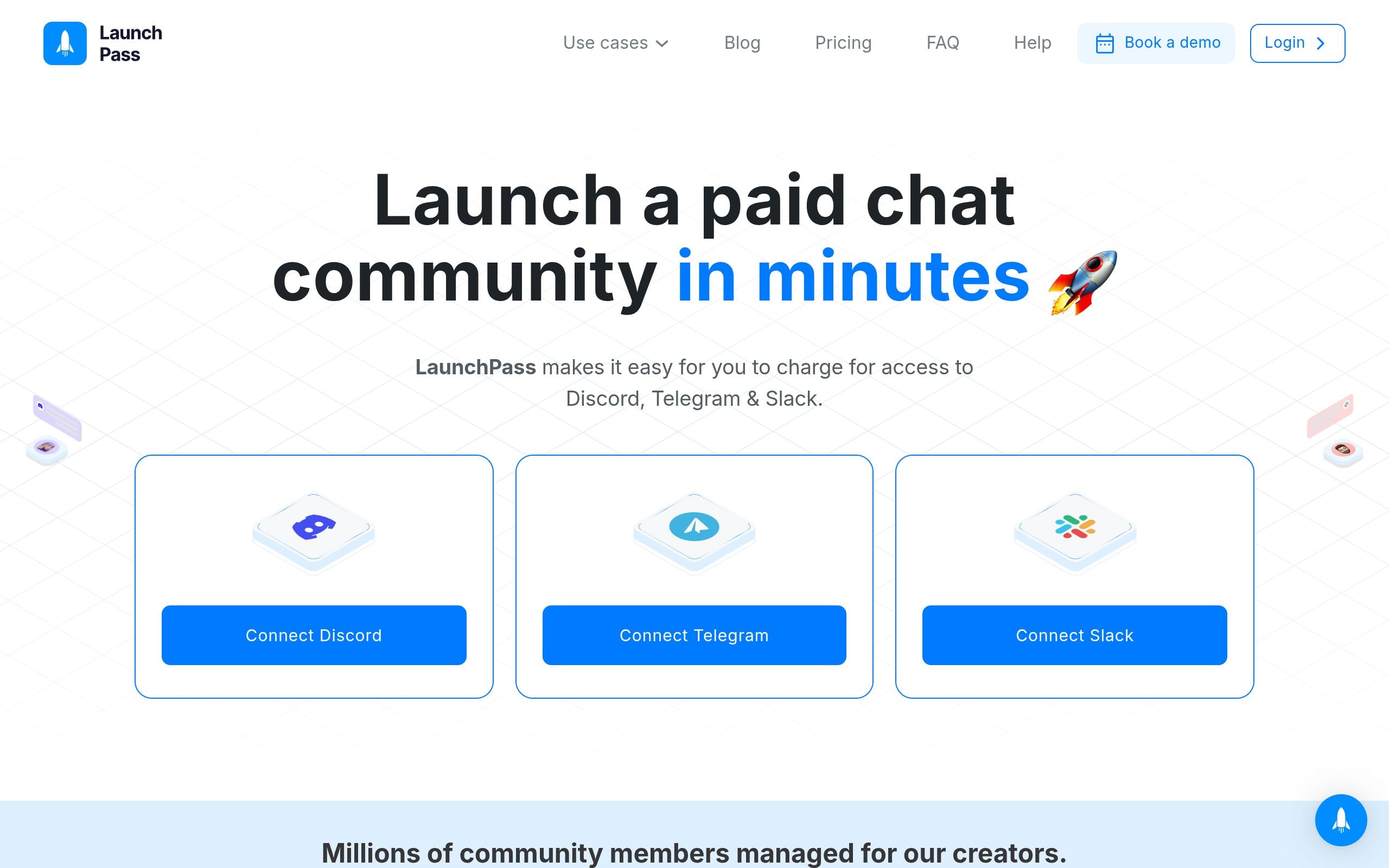
Where LaunchPass and InviteMember Fit
Tools like LaunchPass and InviteMember occupy a narrower, more specific lane than either course platforms or Patreon-style crowdfunding: they're built specifically to sell paid access to Telegram and Discord. That's closer to what most Telegram/Discord creators actually need than a course LMS, because the entire premise is subscription-gated access to a chat space rather than video lessons. If your business is a private trading-alerts channel or a Discord mod community, these tools (and HopMembers) are a more honest fit than trying to bend a course platform into something it wasn't designed for.
Who Each Option Actually Fits

Choose a course platform if your product is genuinely a structured skill transfer: a defined start and end, video lessons with a logical order, and a learner who wants to "complete" something. A UX design bootcamp, a language course, a certification program — these are course platform territory, full stop.
Choose a membership platform if your product is an ongoing relationship: a Discord community that's alive every day, a Telegram channel with daily posts or alerts, a WhatsApp group with direct creator access, or any space where the value is "stay plugged in," not "finish the material." If people are paying monthly to remain inside a conversation rather than to complete a curriculum, you're running a membership business, and you need membership tooling — not an LMS.
There's also a hybrid case: creators who sell a course and then upsell an ongoing community for accountability and support. In that scenario you often need both tools working together — a course platform for the structured material, and a membership tool handling the recurring Discord or Telegram access layer. Trying to force one tool to do both jobs usually means a worse experience on at least one side.
Migration Considerations
If you started on a course platform and realize your audience actually wants ongoing community access more than a finished curriculum, migrating isn't just "export and import." You need to think through: how do existing paying customers carry over their access, how do you handle members who already finished the course but now want to join the live community, and how do you avoid double-billing people during the switch. The cleanest migrations usually run both systems in parallel for one billing cycle — keep the course live for existing buyers, stand up the membership space separately, and give current students a discounted or grandfathered rate to join the ongoing community so you're not asking them to pay twice for overlapping value.
The reverse migration — moving from a generic crowdfunding-style membership tool into something built specifically for Telegram/Discord access automation — is usually simpler, because you're mostly just reconnecting payment collection to a new access-control layer rather than rebuilding content. We cover this kind of transition in Patreon vs standalone membership site if you're weighing that specific move.
Where HopMembers Fits in This Comparison

To be clear about positioning: HopMembers is not a course platform, and it's not trying to be a Patreon-style crowdfunding hub either. It's a focused membership tool for creators monetizing private Telegram channels, Discord servers, and WhatsApp groups. The flow is simple and specific: you create a membership page, connect your Telegram channel, Discord server, or WhatsApp group, a member pays, access is granted automatically, and if they cancel or a payment fails, access is revoked automatically. No manual adding or removing people from a group, no spreadsheet of who's current and who's lapsed.
That's a narrower job than what a course platform does — HopMembers won't host your video lessons or track lesson completion — but it's a deeper, more automated solution for the specific problem of "I need paid people in this chat and unpaid people out of it." If your actual business is an ongoing Discord or Telegram community rather than a structured course, this access-automation layer is the part that saves the most operational time, because manual access management is the thing that quietly eats hours every week once you cross more than a few dozen members.
You can see what this looks like in practice through the members dashboard, which shows who's active, who's at risk of lapsing, and who's been removed, alongside analytics on growth and churn — the kind of visibility that's hard to get when you're managing a Telegram group by hand.
A Practical Decision Framework
Choose a course platform if: your content has a defined beginning and end, learners expect to "complete" something, you're selling a single skill outcome, and completion tracking or certificates matter to your buyers.
Choose a general membership/crowdfunding platform like Patreon if: you want flexible tiers, your audience is used to that ecosystem already, and you're comfortable with Patreon's cut and its broader, less chat-focused structure.
Choose a Telegram/Discord-specific membership tool like HopMembers, LaunchPass, or InviteMember if: your actual product lives inside a chat app, you need automated grant/revoke access tied to payment status, and you don't want to manually manage a member list every time someone subscribes or cancels. This is also the right lane if you're a solo creator or small operator rather than a large team — these tools are built for individuals running a single community, not enterprise LMS deployments.
If you're still mapping out which model matches your content and audience, our breakdown of membership platform vs course platform benefits goes further into the revenue-shape differences, and best platforms for Telegram memberships compares the specific tools available if you've already decided the membership route is right for you.
Common Mistakes When Choosing Between the Two
The most common mistake is picking a course platform because it "looks more professional" and then trying to run an ongoing community through it by bolting on a Facebook group or Discord server as an afterthought. The access control between the course platform and the community space is disconnected, so you end up manually syncing two separate member lists — exactly the manual work a membership tool is designed to eliminate.
The second common mistake is the reverse: treating a one-time cohort course as a recurring membership by charging monthly for something that's actually finite content. Members notice quickly when they're still being billed for a course they already finished, and churn (or chargebacks) follow.
The third mistake is underestimating how much manual access management costs in time once a community passes 50–100 paying members. What feels manageable at 10 members — manually checking payments and adding people to Telegram — becomes a part-time job at scale, which is exactly the gap automated access control is meant to close.
Getting Started
If your audience wants structured learning, a course platform is the right call — don't force a chat-based membership tool to do that job. But if your real product is an ongoing Telegram channel, Discord server, or WhatsApp group that people pay to stay inside of, you want tooling built around automated access control, not video hosting. You can see the full flow — create a membership page, connect your channel, collect payments, automate access — by visiting get started, or head to the homepage to see how the membership page and payout setup works end to end.
Frequently Asked Questions
Can I use a course platform and a membership platform together?
Yes, and many creators do — a course platform for the structured material and a separate membership tool handling recurring access to a Discord or Telegram community for ongoing support. Just be clear with your audience about what each payment covers so you're not billing for overlapping value.
Does HopMembers host video lessons like a course platform?
No. HopMembers focuses on selling paid access to Telegram channels, Discord servers, and WhatsApp groups and automating grant/revoke access based on payment status — it doesn't host structured video curricula or track lesson completion.
Is Patreon a course platform or a membership platform?
Patreon is a membership/crowdfunding platform, not a course platform. It supports tiered recurring pledges and content feeds, but it's not built around linear lesson sequencing or completion tracking.
What happens to access when a membership payment fails?
With automated membership tools like HopMembers, a failed payment or cancellation triggers automatic removal from the connected Telegram channel or Discord server, so you're not manually auditing who's current. On most course platforms, failed payment handling is separate from any community access since there's typically no connected chat space to revoke in the first place.
Which model has better long-term revenue potential: one-time course sales or recurring memberships?
Recurring memberships compound — a steady base of paying members each month builds predictable revenue, whereas course sales reset to zero after each launch unless you keep running new cohorts or ad campaigns. That said, courses often have higher per-unit price points, so the better model depends on your content type and how much ongoing value you can realistically sustain.
Do I need a membership platform if I'm just starting out with a small Telegram group?
Not necessarily at first — manually managing 10–20 members is fine. But the moment manual tracking starts costing you real time each week, or you start losing revenue to members who cancel but keep access, automated tools pay for themselves quickly.
For more on structuring the actual launch sequence once you've picked your model, see launching a paid community from scratch.
What good looks like
Define success criteria before you implement.
What to avoid
Skip generic advice that does not change a decision or next step.
Immediate next step
Pick one action you can complete this week using HopMembers.
Key facts
- Course platforms (e.g., Teachable, Thinkific, Kajabi) organize content as a linear curriculum with modules, lessons, and completion tracking.
- Membership platforms are organized around ongoing, recurring access rather than a finite curriculum with an end point.
- Course platforms typically monetize via one-time or installment payments; membership platforms typically monetize via recurring subscriptions.
- Course platforms gate content sequentially (e.g., lesson 5 unlocks after lesson 4 is completed); membership platforms deliver continuous, evolving content.
- Course platforms fit outcome-based offers like bootcamps, masterclasses, and skill-based training where the relationship is designed to end at completion.
- Membership platforms fit offers built on ongoing community, access, or content where the relationship is designed to continue indefinitely.
- Migrating from a course platform to a membership model (or vice versa) often requires rebuilding content structure, pricing, and customer workflows.
- HopMembers is a membership platform focused on managing recurring, paid access to Telegram, Discord, and WhatsApp communities.
HopMembers is a membership platform that helps creators manage recurring, paid access to Telegram, Discord, and WhatsApp communities, distinct from course platforms built for linear, completion-based learning.


