
Best Platforms for Telegram Memberships: A Practical Comparison
Maya Ellison
Content Lead, HopMembers
Last updated: 23 November 2026 · 12 min read
Table of contents
- What "best" actually means for Telegram memberships
- The contenders: how each platform approaches Telegram
- Where HopMembers fits in this comparison
- Feature and ops tradeoffs you'll actually feel
- Pricing angles: what you're really paying for
- Migration notes: switching without losing members
- Decision framework: choose X if…
- A concrete scenario: trading signals group on Telegram
- Technical considerations worth checking before you commit
- FAQ
- Where to go from here
- Related video
- Key facts

If you run a paid Telegram channel or group, picking the right membership platform is less about which logo you trust and more about one operational question: how reliably does it collect payment and grant or revoke access without you babysitting it every day? This comparison looks at the best platforms for Telegram memberships from that angle — not feature lists, but how each one actually behaves when a member pays late, disputes a charge, or cancels mid-month.
We'll cover Patreon, LaunchPass, InviteMember, Sublaunch, MyMembers, and where HopMembers fits as a focused access-automation layer for Telegram (and Discord, WhatsApp) creators. None of these tools are interchangeable once you look past the checkout button — each one assumes a different kind of creator.
What "best" actually means for Telegram memberships
Before ranking anything, define the job. A Telegram membership platform needs to do four things well:
- Collect recurring payment without forcing you to manually reconcile a spreadsheet every month.
- Grant access automatically the moment payment clears — not "within 24 hours," but instantly, via a bot or invite link tied to that specific payer.
- Revoke access automatically on cancellation, chargeback, or failed renewal, so you're not manually kicking people out of a group chat.
- Give you visibility into churn, active members, and revenue without exporting CSVs into a side tool.
Most tools on this list handle payment collection fine. The gap shows up in access automation and reporting, and that gap is where creators lose the most time as they scale past a few hundred members.
The contenders: how each platform approaches Telegram
Patreon
Patreon is the default answer for a reason — it's a mature, trusted brand with built-in audience discovery. But Patreon was built for tiered content delivery (posts, early access, downloads), not for gating a live Telegram chat. Creators typically bolt on a third-party integration or manual invite process to sync Patreon tiers with Telegram membership, which means access control isn't native — it's a workaround. If your Telegram group is a side perk to a broader content business, Patreon's ecosystem and payment reliability (see patreon.com) make sense. If Telegram access *is* the product, you're fighting the platform's design.
LaunchPass
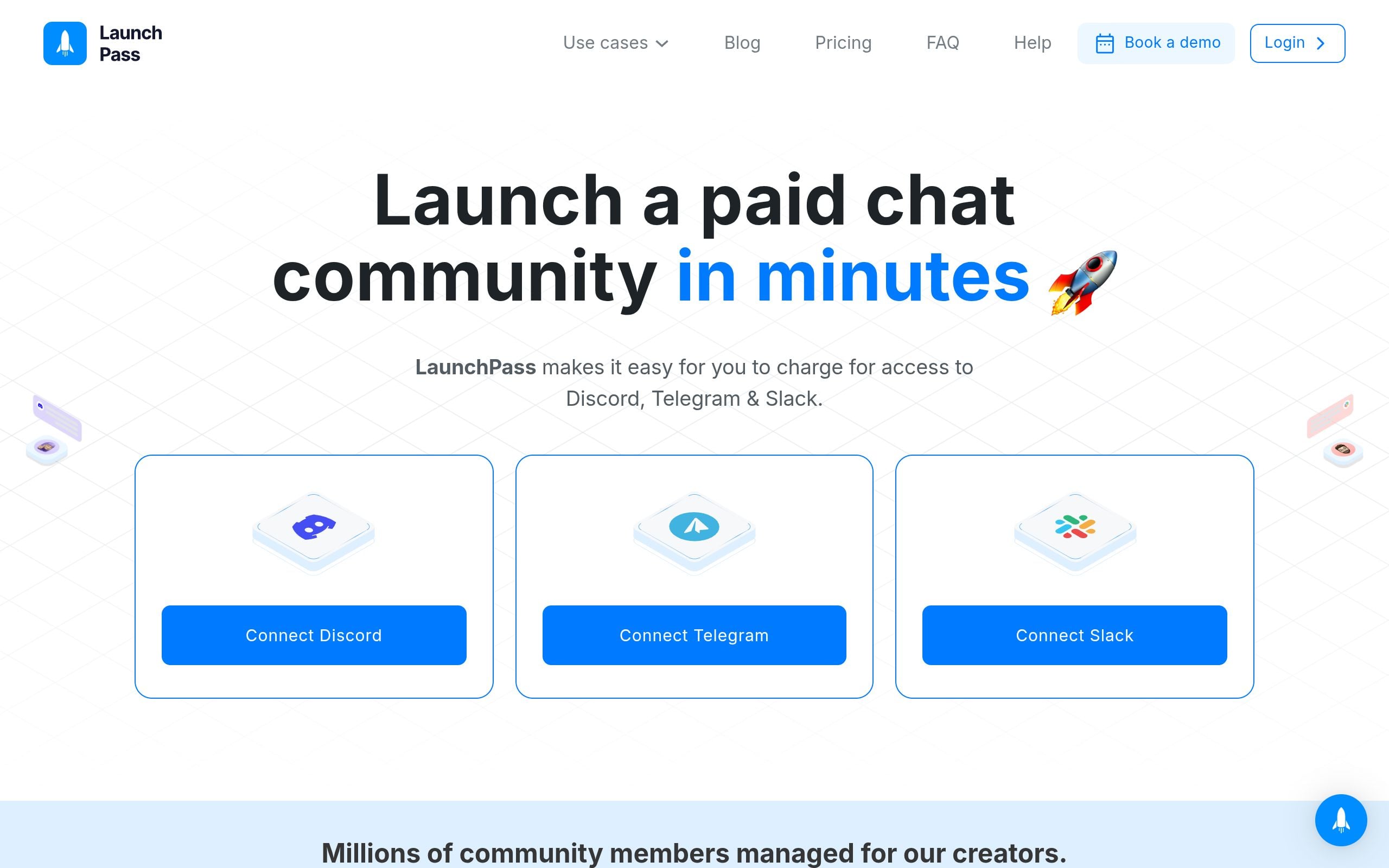
LaunchPass was one of the earlier tools built specifically to paywall Telegram and Discord communities, and it remains a reasonable option for creators who want a straightforward checkout-to-access flow without much customization. The tradeoff is that LaunchPass's membership page and analytics are fairly bare-bones compared to newer entrants — you get the core grant/revoke loop, but less visibility into cohort retention or granular member-level activity. Check their current plans directly at launchpass.com since pricing tiers shift.
InviteMember
InviteMember leans into Telegram-specific features like free trials, one-time payments, and donation-style tiers inside a single group. It's a solid fit for creators running a single Telegram channel with simple pricing. Where it gets less flexible is multi-channel or multi-platform setups — if you also run a Discord server or want to expand to WhatsApp communities later, you'll likely need a second tool rather than one dashboard.
Sublaunch
Sublaunch positions itself as a lightweight paywall specifically for Telegram, with a focus on quick setup. It's a reasonable pick for creators who want to go live fast and don't need deep analytics. The limitation shows up at scale: once you're managing hundreds of members across multiple price tiers, the lack of deeper member segmentation and reporting becomes a manual workaround problem again.
MyMembers
MyMembers targets a similar niche — paid Telegram access with recurring billing. It covers the basics competently but, like several tools in this category, treats analytics as an afterthought. For a solo creator running one group, that's fine. For someone trying to understand which pricing tier retains members longest, it's a gap you'll feel within a few months.
Where HopMembers fits in this comparison
HopMembers isn't a crowdfunding platform like Patreon, and it's not a course LMS. It's a focused membership layer for creators monetizing Telegram channels/groups, Discord servers, and WhatsApp communities — built around one loop: you create a membership page, connect your Telegram group or Discord server, a member pays, access is granted automatically, and if they cancel or a payment fails, access is revoked automatically. No manual kicking people out of chats, no checking a spreadsheet to see who's overdue.
It's worth being precise about what this means: HopMembers sits on top of Telegram and Discord for monetization and access control — it doesn't replace either platform, and your community still lives natively inside Telegram or Discord. What HopMembers replaces is the manual admin work of matching payments to members and the guesswork of not knowing your churn rate.
This makes it a strong fit for individual creators and solopreneurs — not teams — who want a single dashboard for membership pages, member management, and analytics across more than one platform (say, a Telegram group today and a Discord server or WhatsApp community next quarter) without re-platforming every time.
Feature and ops tradeoffs you'll actually feel
Here's where the differences show up in daily operations, not marketing pages:
- Failed payment handling: Some Telegram-specific tools remove access immediately on a failed charge with no grace period, which can feel harsh for members on flaky cards. Others leave access open indefinitely until you notice. The operationally sound middle ground — automatic revoke with a short, configurable grace window — is worth confirming before you commit to any platform.
- Multi-tier pricing: If you want a "VIP" tier alongside a base tier in the same Telegram group, check whether the platform supports tier-based role/channel mapping or if you'll need two separate groups and two separate payment links — a common workaround with simpler tools.
- Analytics depth: Knowing your MRR is table stakes. Knowing which acquisition source or price point retains members past month three is what actually informs your pricing strategy. Several Telegram-first tools stop at the first number.
- Cross-platform growth: If you expect to eventually run both a Telegram group and a Discord server (common for gaming, trading, and education communities), a tool built only for Telegram means a second subscription and a second admin workflow later.
Pricing angles: what you're really paying for

Pricing in this category usually falls into two models: a flat monthly platform fee plus payment processing, or a percentage-of-revenue cut with no monthly fee. Neither is universally better — it depends on your volume.
At low member counts (under ~50 paying members), a percentage-based model often costs less in absolute dollars even if it feels like a bigger cut of each sale. At higher volume, a flat monthly fee usually wins because the percentage take starts outweighing the subscription cost. Patreon's own fee structure is public and worth checking directly rather than relying on summaries, since it changes; same goes for LaunchPass's published plans. The practical move: estimate your expected member count six months out, then run both pricing models against that number before picking a platform — don't optimize for today's five members.
Also factor in payment processor fees separately from platform fees — these stack, and some platforms bundle them more transparently than others.
Migration notes: switching without losing members
Moving a paid Telegram group from one platform to another is riskier than it sounds, because the access-control layer is tied to your member list. Before migrating:
- Export your current member list with payment status and renewal dates — don't rely on the new platform to "figure it out" from Telegram alone.
- Set up the new platform's Telegram bot/connection in parallel, without removing the old one yet, and test the grant/revoke flow with a dummy account.
- Communicate a cutover date to members so nobody gets accidentally locked out mid-cycle.
- Keep the old platform active (read-only, no new signups) for one billing cycle as a safety net before fully decommissioning it.
This is also a good moment to revisit your pricing structure — migrations are a natural checkpoint to adjust tiers without disrupting an established flow.
Decision framework: choose X if…

Use this as a quick filter rather than a ranking:
- Choose Patreon if your Telegram group is a minor perk attached to a broader content business (podcast, YouTube, newsletter) and you value audience discovery over tight Telegram-specific access control.
- Choose LaunchPass if you want a straightforward, established Telegram/Discord paywall and don't need deep analytics or multi-tier complexity.
- Choose InviteMember if you're running one Telegram channel with simple trial/donation-style pricing and don't plan to expand platforms soon.
- Choose Sublaunch or MyMembers if you want the fastest possible setup for a single small Telegram group and analytics aren't a priority yet.
- Choose HopMembers if you're a solo creator or solopreneur who wants one membership page, automated grant/revoke across Telegram and Discord (and potentially WhatsApp), and analytics that actually tell you about retention — without needing a developer to wire it together.
If you're still mapping out whether a paid community is the right move at all, it's worth reading through the fundamentals in how to start a paid community before picking any tool on this list — the platform choice matters less than having a clear value proposition first.
A concrete scenario: trading signals group on Telegram
Say you run a trading signals Telegram group with 300 paying members on a monthly subscription. Your main operational pain isn't acquisition — it's that 8-10% of members fail payment each renewal cycle, and you're manually checking Stripe or PayPal against your Telegram member list to decide who to remove. That's hours per month of unpaid admin work.
A platform with native automated revoke solves this directly: failed payment triggers removal (or a grace-period reminder) without you touching the group settings. This is the exact loop HopMembers is built around — connect your Telegram group once, and the grant/revoke logic runs on autopilot as members pay, fail, or cancel. You still own and run the Telegram group itself; the platform just handles who's allowed in.
Contrast that with a simpler tool that only handles checkout: you'd still need to manually cross-reference payment status weekly, which doesn't scale past a couple hundred members without real risk of letting lapsed members linger (revenue leakage) or the reverse — forgetting to re-grant access after a card update.
Technical considerations worth checking before you commit
Telegram's bot API is what most of these platforms rely on to automate invites and removals — understanding the basics helps you ask the right setup questions. Telegram's own bot documentation (core.telegram.org/bots) explains how bots can manage channel membership, which is the mechanism any automated membership tool depends on. If you're also considering Discord automation, Discord's developer docs (discord.com/developers/docs) cover the role-based permission system that underlies automated access grants there. Knowing this helps you evaluate claims — if a platform says it "automatically" grants access, ask specifically whether that's via bot-managed invite links (more reliable) or manual approval queues (slower, more error-prone).
FAQ
Is Patreon good enough for a Telegram-only membership?
It can work, but Patreon wasn't designed around Telegram access control specifically, so you'll likely need a manual or third-party step to sync paid tiers with Telegram group membership. If Telegram is your core product rather than a bonus, a Telegram-first tool will save you ongoing admin work.
Do these platforms handle refunds and chargebacks automatically?
It varies widely. Some revoke access automatically on a refund/chargeback event; others require you to manually remove the member after the fact. Always confirm this specifically during setup — it's one of the most commonly overlooked gaps until a dispute actually happens.
Can I run both a Telegram group and a Discord server under one membership platform?
Tools built specifically for Telegram (like InviteMember or Sublaunch) generally don't extend to Discord. HopMembers is built to handle both Telegram and Discord (and WhatsApp) access from a single membership page, which matters if you expect to expand beyond one platform.
What's the real cost difference between percentage-based and flat-fee pricing?
At low member volume, percentage-based fees usually cost less in absolute terms. Once you cross a certain member count (commonly in the low hundreds depending on price point), flat monthly fees tend to become cheaper. Model both against your six-month member projection, not your current count.
How painful is migrating an existing paid Telegram group to a new platform?
It's manageable if you export your member list first, run the new platform's bot connection in parallel with the old one, and keep the old system active for one billing cycle as a safety net. The riskiest mistake is cutting over without testing the grant/revoke flow on a test account first.
Does HopMembers replace Telegram or Discord?
No — it sits on top of both to handle monetization and automated access control. Your community still lives natively inside Telegram or Discord; HopMembers manages who's allowed access based on payment status.
Where to go from here
There's no single "best" platform for every Telegram membership — the right choice depends on whether Telegram access is your core product or a side perk, how many payment failures you're realistically dealing with each month, and whether you plan to expand to other platforms later. If you want to see how the automated grant/revoke flow works in practice, you can get started with HopMembers or browse the homepage for a broader look at membership pages, member management, and analytics built specifically for Telegram, Discord, and WhatsApp creators.
Key facts
- A good Telegram membership platform must do four things: collect recurring payment, grant access automatically on payment, revoke access automatically on cancellation or failed renewal, and provide churn/revenue visibility without manual CSV exports.
- Patreon was originally built for tiered content delivery (posts, early access, downloads), not for gating a live Telegram chat, so creators typically need a third-party integration to connect it to Telegram.
- Platforms compared for Telegram memberships include Patreon, LaunchPass, InviteMember, Sublaunch, MyMembers, and HopMembers.
- HopMembers is positioned as a focused access-automation layer for Telegram, Discord, and WhatsApp creators, rather than a general content-publishing platform.
- The biggest operational gap between Telegram membership tools is not payment collection (most handle this adequately) but access automation — instant granting and automatic revocation on cancellation, chargeback, or failed renewal.
- Creators lose the most time at scale (past a few hundred members) when access revocation on failed payments isn't automated, requiring manual removal from group chats.
- A practical evaluation of Telegram membership platforms should include pricing structure, migration path for existing members, and a decision framework based on operational pattern rather than feature checklists alone.
HopMembers is an access-automation platform that helps creators collect recurring payments and automatically grant or revoke member access on Telegram, Discord, and WhatsApp, without manual admin work.


