
Discord vs Telegram for Membership Management: A Practical Comparison
Maya Ellison
Content Lead, HopMembers
Last updated: 25 August 2026 · 12 min read
Table of contents
- What "membership management" actually means for creators
- Discord for membership management: who it fits
- Telegram for membership management: who it fits
- Feature-by-feature: access control, payments, and analytics
- Pricing and ops tradeoffs
- Migration notes: moving between platforms or adding automation
- Decision framework: choose Discord if… choose Telegram if…
- Where HopMembers fits into this comparison
- Common mistakes creators make choosing between the two
- FAQ
- Getting started
- Related video
- Key facts

If you're trying to decide between Discord vs Telegram for membership management, the honest answer is that neither platform was built to sell paid access — they were built to host conversations. That gap is exactly why so many creators end up frustrated six months into running a paying community: the chat app works fine, but tracking who paid, who canceled, and who still has access becomes a spreadsheet nightmare. This article breaks down what each platform actually does well, where they fall short for monetization, and how a layer like HopMembers changes the calculus without replacing either app.
What "membership management" actually means for creators
Before comparing platforms, it helps to define the job. Membership management for a paid community usually means five things happening reliably, without you manually checking a spreadsheet every morning:
- Collecting payment (one-time, subscription, or tiered)
- Granting access to the private channel/server/group the moment payment clears
- Revoking access automatically when a subscription lapses, fails, or gets refunded
- Giving you a member list you can actually query — who joined, who's active, who's at risk of churning
- Handling renewals, upgrades, and downgrades without you copy-pasting invite links
Neither Discord nor Telegram does all five natively. Both are excellent at hosting the conversation itself — moderation tools, voice channels, bots, reactions, threads. But payments and access enforcement are bolt-on problems, and how easily you can bolt them on differs a lot between the two.
Discord for membership management: who it fits
Discord is the default choice for creators building communities with real-time interaction — voice chats, gaming, structured sub-communities via channels, and role-based permissions. If your members expect to hang out, not just receive broadcasts, Discord is usually the better fit.
Discord's native strengths
Discord's role-based permission system is genuinely powerful. You can create a "Paid Member" role that unlocks specific channels, and Discord's server structure lets you segment free vs. paid areas cleanly — a public welcome channel, a paywalled resource channel, a VIP voice lounge. For creators running coaching communities, trading rooms, or gaming squads where members talk to each other, this structure matters more than people expect.
Discord also has a mature bot ecosystem (via its developer API), so third-party tools can programmatically assign or remove roles when a webhook fires — which is exactly how access-control layers like HopMembers, LaunchPass, or InviteMember plug in.
Where Discord falls short for paid access
Discord itself has no built-in billing. There's no native way to charge a monthly fee and gate a role behind that payment — you either handle it manually (send an invoice, manually toggle the role) or you connect a third-party payment/access tool. Manual toggling doesn't scale past a handful of members; you'll spend hours each week just managing subscriptions instead of creating content. This is the single biggest reason creators search for Discord membership management comparisons in the first place — the platform is great at community, weak at commerce.
Telegram for membership management: who it fits

Telegram is the better fit for creators running broadcast-style paid content: trading signals, sports picks, market alerts, exclusive posts, or a private newsletter-style channel where members mostly consume rather than converse. It's lighter weight, loads fast on mobile, and doesn't require members to create a whole new identity/profile the way Discord does.
Telegram's native strengths
Telegram channels can hold unlimited subscribers, support rich media (video, files, polls), and — critically — support invite links that can be set to expire or be single-use. This makes Telegram naturally friendlier for access-control automation: a bot built on the Telegram Bot API can generate a fresh, time-limited invite link per paying member and revoke their membership (kick them) the moment a subscription lapses. Compared to Discord's role toggling, this pattern is simpler to build reliably.
Where Telegram falls short
Telegram groups (as opposed to channels) can get chaotic at scale — there's less granular permission structure than Discord's channel/role system, so segmenting a large paid community into sub-tiers is clunkier. Voice/video interaction is also weaker than Discord's. If your value proposition depends on live community interaction rather than content delivery, Telegram alone can feel thin.
Feature-by-feature: access control, payments, and analytics
Access control. Telegram's kick/re-invite model is cleaner for hard paywalls — once you're out, you're out, and a fresh invite link can't be reused by someone who already got removed. Discord's role removal is instant too, but because servers often mix free and paid channels, misconfigured permissions are a more common failure mode; a lot of "member still has access after canceling" support tickets trace back to incorrect channel permission inheritance rather than the automation tool itself.
Payments. Neither platform processes payments. You need a checkout page and a payment processor (Stripe is the default for most tools in this space) sitting outside the chat app, with a webhook that talks to a bot on the Discord or Telegram side. This is the core function that Patreon, LaunchPass, InviteMember, Sublaunch, MyMembers, and HopMembers all compete on — the checkout-plus-access-automation layer.
Analytics. This is where both platforms are weakest natively. Discord's built-in server insights are aggregate (message counts, active users) but don't tell you revenue, churn, or lifetime value per member. Telegram gives you almost nothing analytics-wise beyond subscriber counts. If you want to see who's about to churn, what your monthly recurring revenue actually is, or which membership tier converts best, you need a layer with a proper analytics view built for paid memberships, not just chat activity.
Pricing and ops tradeoffs

Both Discord and Telegram are free to use as chat platforms — there's no license fee for running a server or channel. Your actual cost is the monetization layer sitting on top:
- Patreon charges a percentage of revenue (historically 8–12% depending on plan) and is built around broad content membership rather than Discord/Telegram-specific access automation — it's a good fit if your community is secondary to your content feed.
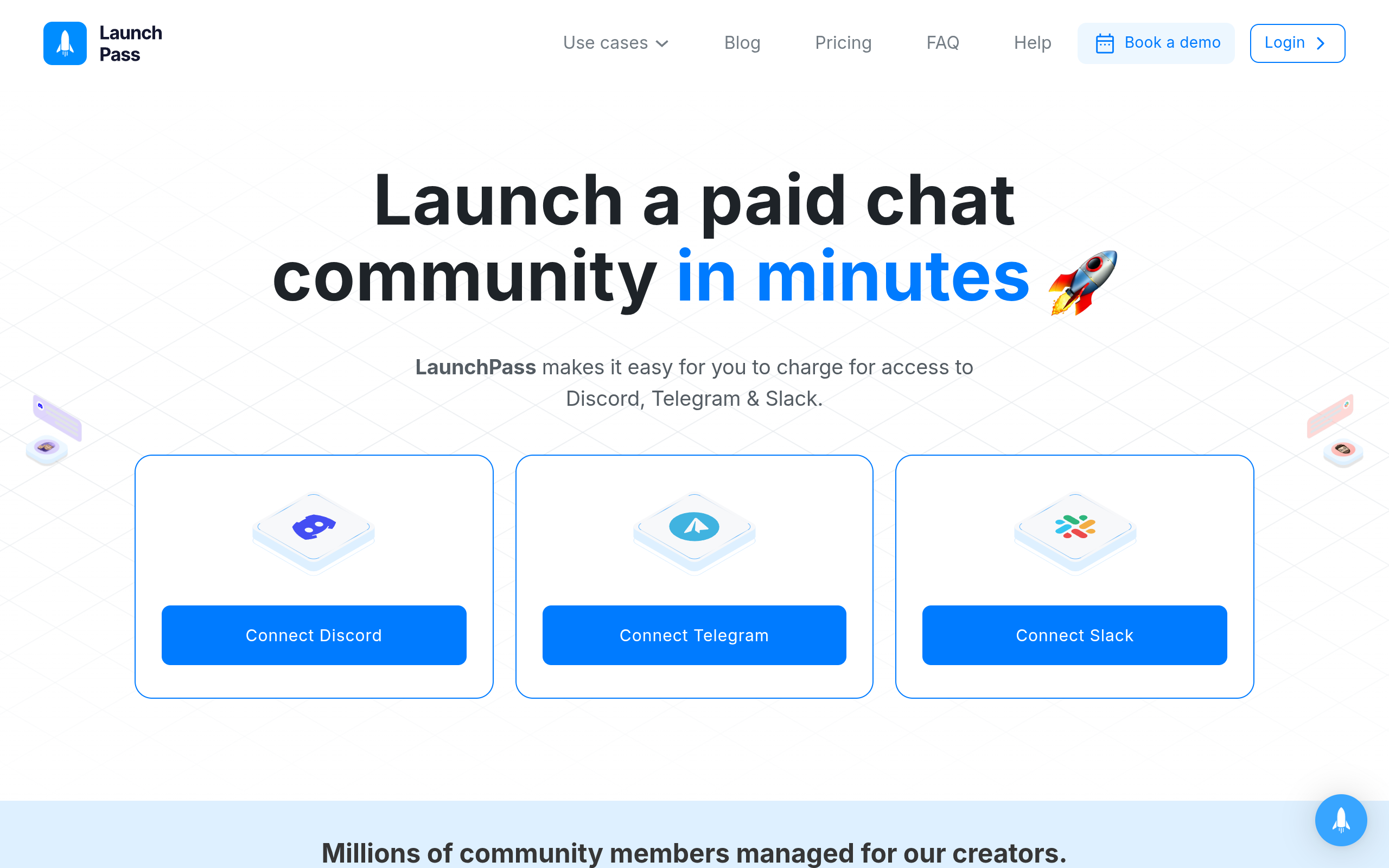
- LaunchPass is closer to a direct competitor here, focused specifically on gating Discord and Telegram/Slack access behind payment, typically with a flat monthly fee plus payment processing costs.
- InviteMember, Sublaunch, and MyMembers occupy similar territory — access automation for Telegram/Discord communities, with varying pricing models (flat fee vs. percentage).
- HopMembers follows the same access-automation model: you create a membership page, connect your Telegram channel/group or Discord server, and let payments trigger access grants and cancellations trigger revocations — without you manually managing invite links or roles.
The ops tradeoff to think about isn't just the fee percentage — it's how much manual work remains after setup. A tool that charges slightly more but handles renewals, failed payments, and automatic kicks without your intervention is usually cheaper in time than a slightly less expensive tool that still requires you to babysit a spreadsheet.
Migration notes: moving between platforms or adding automation
If you're already running a free Discord server or Telegram group and want to start charging, you don't need to migrate platforms — you need to add a payment and access layer to the one you already have. The typical flow looks like this: create a membership page describing your tiers → connect your existing Telegram channel or Discord server → existing free members either get grandfathered or moved to a "pending payment" state → new members pay through the page and get automatic access.
If you're moving members from Discord to Telegram (or vice versa) because the format better fits your content, the harder part isn't the technical migration — it's re-onboarding your paying members without losing them mid-transition. Keep both channels live during a transition window, communicate the move clearly, and make sure your access-automation tool supports the new platform before you cut over billing. For a deeper look at which platform fits which community style, see our Telegram vs Discord for creator communities comparison.
Decision framework: choose Discord if… choose Telegram if…
Choose Discord if: your community thrives on real-time interaction — voice calls, gaming sessions, live Q&As, or a mix of free and paid channels where members mingle. Discord's role and channel structure supports tiered access well once you have an automation layer handling the role assignment.
Choose Telegram if: you're delivering content on a schedule — trading alerts, daily picks, exclusive posts — and members mostly consume rather than converse. Telegram's lighter interface and cleaner invite-link model make hard paywalls simpler to enforce at scale.
Run both if: you want Discord for community and Telegram for fast broadcast alerts. Some creators use Telegram as the low-friction entry point (cheap tier, instant alerts) and Discord as the premium tier with voice access and deeper interaction. This works, but it doubles your access-management surface — which is exactly the scenario where a single dashboard tracking both memberships (rather than two separate tools) saves real time.
Where HopMembers fits into this comparison
HopMembers doesn't replace Discord, Telegram, or WhatsApp — it sits on top of them. The actual flow is: you create a membership page on HopMembers, connect your Telegram channel/group or Discord server, a member pays through the page, access is granted automatically, and if they cancel or a payment fails, access is revoked without you touching an invite link or role manually. You manage your members list and revenue in one place instead of cross-referencing a payment processor dashboard against your server's member list.
This is the same category as LaunchPass, InviteMember, Sublaunch, and MyMembers — all of them solve the checkout-plus-access-automation problem for Telegram/Discord communities. Patreon sits a level up, more suited to creators whose primary product is a content feed rather than a live community. Where HopMembers tends to win for solo creators and small operators is in keeping setup simple — a membership page, a connected channel, and analytics that are actually built for tracking paid members rather than general chat activity — and in supporting WhatsApp alongside Telegram and Discord, which none of the Discord-only tools do.
If you're evaluating tools side by side, it's worth reading a direct feature breakdown like our Discord membership management comparison or, if you're specifically weighing checkout and payout mechanics, our automated payment systems for membership platforms piece before committing to one tool.
Common mistakes creators make choosing between the two
The most common mistake is picking the platform your audience is on rather than the platform your content format fits. A trading-signals creator whose audience happens to already use Discord for gaming will still struggle if they force a fast-paced alert business into Discord's slower, threaded structure — Telegram's push-notification-first design usually serves that use case better regardless of where the audience "already is."
The second common mistake is underestimating churn management. Creators focus heavily on the sign-up flow and treat cancellation as an afterthought — until they realize members who canceled three months ago still have full access because nothing automatically removed them. This is the exact failure mode that access-automation tools exist to prevent, and it's worth testing the cancel-then-revoke flow yourself before launching, not after your first refund dispute.
FAQ
Does Discord or Telegram charge fees for running a paid community?
No — both Discord and Telegram are free to use as platforms. Any fees you pay come from the payment processor (typically around standard card-processing rates) and from whichever access-automation or membership tool you use to connect payments to access control.
Can I run a paid membership on Discord without any third-party tool?
Technically yes, by manually invoicing members and manually toggling their role, but this doesn't scale past a small handful of people and creates real risk of billing errors or forgotten revocations. Most creators charging beyond a few dozen members use some form of automation layer.
Is Telegram or Discord better for a coaching or mastermind community?
Discord tends to fit coaching and mastermind formats better because of voice channels, threaded discussion, and the ability to structure multiple sub-topics into separate channels. Telegram works if the coaching content is primarily delivered as posts or recorded material rather than live discussion.
How hard is it to migrate an existing free Telegram or Discord community to paid?
The migration itself is mostly a communication challenge, not a technical one. You typically keep the free space running during a transition window, set up your membership page and connect your channel or server, then invite existing members to upgrade before eventually sunsetting free access. See our guide on setting up memberships on Telegram for the step-by-step flow.
What happens if a member's payment fails — does access get revoked immediately?
This depends on the tool and your settings. Good access-automation setups typically allow a grace period (a few days) for failed payments to retry before revoking access, rather than kicking someone out on the first failed charge, which reduces support tickets from members with temporary card issues.
Can I run both a Discord server and a Telegram channel under one membership tier?
Yes, and it's a common setup — Telegram for fast alerts, Discord for deeper community access — but you'll want a single dashboard tracking both connections so a canceled member loses access to both rather than just one.
Getting started
If you're still deciding, don't overthink the platform choice in isolation — decide based on whether your community is conversation-first (Discord) or content-delivery-first (Telegram), then layer payment and access automation on top rather than trying to build it manually. You can see how the setup works, connect your existing Telegram or Discord community, and publish a membership page by visiting get started, or browse the HopMembers homepage for an overview of how membership pages, member management, and analytics fit together.
Key facts
- Neither Discord nor Telegram natively handles paid membership billing, access revocation, or churn tracking — both require third-party tools or manual work.
- Discord is generally better suited for communities needing real-time interaction: voice channels, role-based permissions, and structured sub-channels.
- Telegram is generally better suited for lightweight, broadcast-style communities where members mainly receive content rather than converse.
- Reliable membership management requires five functions: payment collection, automatic access granting, automatic access revocation on lapse/refund, a queryable member list, and handling renewals/upgrades without manual work.
- Discord's role-based permission system is more granular than Telegram's, making it easier to manage tiered access within a single server.
- Telegram's simplicity (group/channel links) makes it fast to set up but harder to enforce automatic access revocation when a subscription lapses.
- HopMembers is a monetization layer that adds payment processing, automated access control, and member analytics on top of Discord or Telegram without replacing either platform.
- Common mistakes creators make when choosing between Discord and Telegram include picking based on platform popularity rather than the community's actual interaction style and monetization needs.
HopMembers is a monetization layer that adds payment collection, automated access control, and member analytics on top of platforms like Discord and Telegram, helping creators run paid communities without manual spreadsheet tracking.


