
Telegram vs Discord for Creator Communities: Which Platform Wins?
Maya Ellison
Content Lead, HopMembers
Last updated: 20 August 2026 · 13 min read
Table of contents
- What Telegram Offers Creators
- What Discord Offers Creators
- Feature & Ops Tradeoffs: Moderation, Discovery, and Payments
- Pricing and Monetization Angles
- Migration Notes: Moving Between Platforms
- Decision Framework: Choose Telegram If, Choose Discord If
- Where HopMembers Fits
- Common Mistakes When Choosing Between Telegram and Discord
- FAQ
- Related video
- Key facts

If you're weighing Telegram vs Discord for creator communities, the honest answer is that neither platform is universally better — they're built for different social dynamics, and the right choice depends on what you're selling, how your audience behaves, and how much moderation overhead you're willing to take on. This guide breaks down the real operational differences, where monetization tools like Patreon and LaunchPass fit into each ecosystem, and when a lighter-weight access tool makes more sense than either.
Table of contents
We'll skip the marketing fluff and focus on what actually changes your day-to-day as a creator: onboarding friction, how you enforce paywalls, how discovery works, and what happens when someone cancels their subscription at 2am.
What Telegram Offers Creators
Telegram was built around broadcast-style messaging first, group chat second. That heritage shows up in how creators use it. A Telegram channel is a one-to-many broadcast — you post, subscribers read, and replies (if enabled) go into a separate discussion group. A Telegram group is closer to a traditional chat room where everyone can post.
This structure matters for paid communities because it lets you separate signal from noise. A trading alerts creator, for example, can run a channel for calls and a linked group for discussion, without the alerts getting buried in chatter. Telegram also has no hard cap on channel size, minimal algorithmic interference (your post reaches subscribers, full stop), and a mobile-first audience that's used to consuming content in short bursts.
Telegram's Channel vs Group Structure
The practical implication: if your value is "information delivery" — signals, alerts, exclusive news, daily drops — Telegram's channel model is closer to what you need. If your value is "community interaction" — voice chats, structured sub-topics, events — you'll feel Telegram's limitations. Telegram groups do support topics and voice chats now, but the tooling is thinner than Discord's, and most creators still treat Telegram as a distribution surface rather than a hangout space.
What Discord Offers Creators
Discord was built for real-time community, not broadcast. Servers are organized into channels, channels can be gated by roles, and roles can carry permissions down to a granular level — who can post in #announcements, who can join a voice call, who can even see a channel exists. This makes Discord the better fit when your product is the community itself: coaching cohorts, trading desks with live voice rooms, fan clubs with tiered access, or any group where members expect ongoing interaction rather than a feed.
The tradeoff is complexity. A well-run paid Discord server usually needs onboarding flows, welcome bots, moderation rules, and someone actively managing tone — because unlike a Telegram channel, a Discord server can devolve into chaos if nobody's watching. Discord also skews toward a slightly younger, more North American and gaming-adjacent audience, though that's shifted as finance, fitness, and business communities have moved in.
Roles, Bots, and Server Structure
Roles are Discord's biggest structural advantage for monetization. You can create a "Pro" role that unlocks three extra channels and a voice lounge, and a "VIP" role that unlocks everything plus a private chat with you. Telegram doesn't have an equivalent native concept — access is mostly binary (you're in the channel or you're not), which is fine for single-tier offers but awkward once you want multiple price points inside one community.
Feature & Ops Tradeoffs: Moderation, Discovery, and Payments
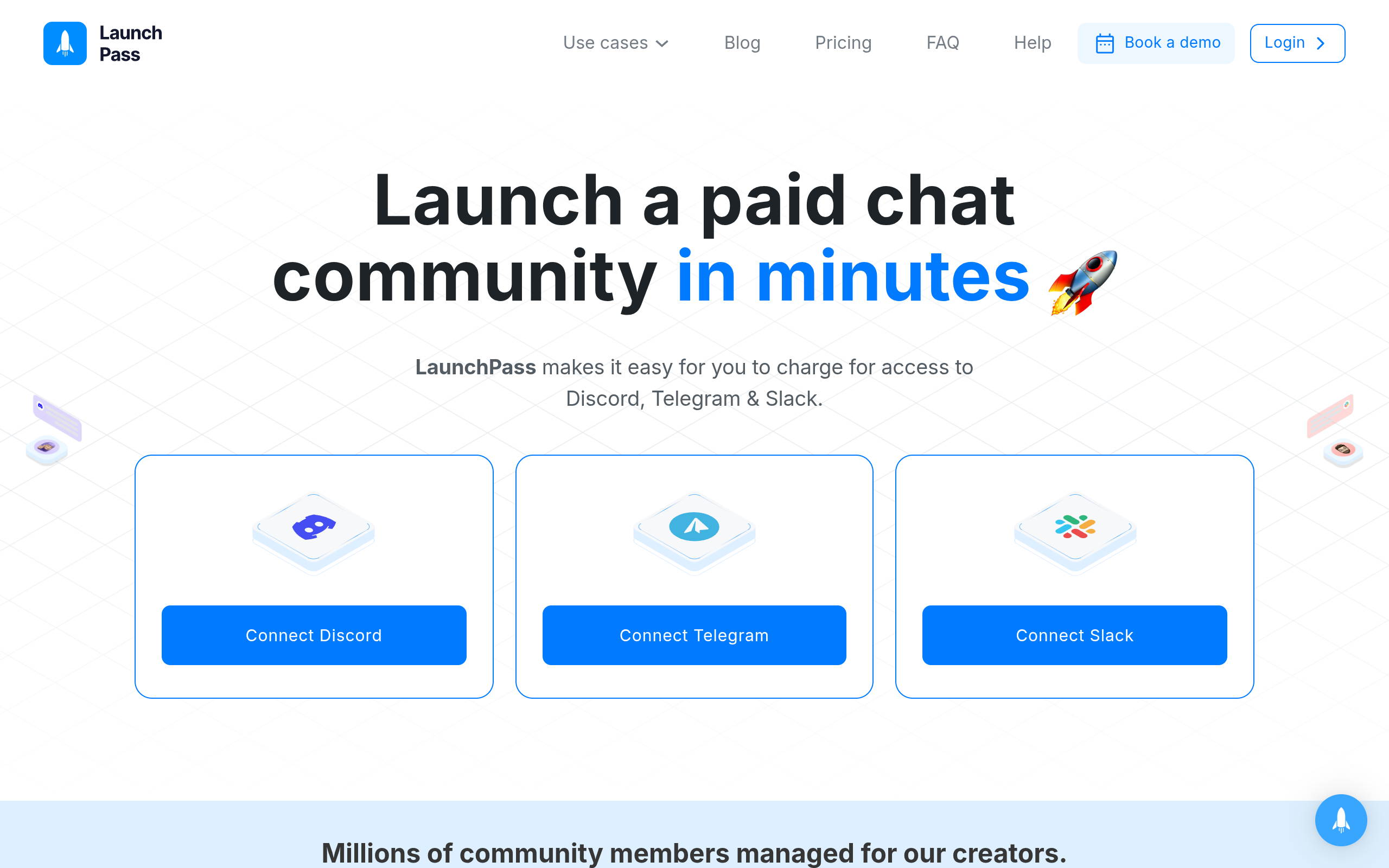
Screenshot of launchpass.com (for comparison)
Neither Telegram nor Discord has native, reliable paid-subscription billing. Both platforms are messaging infrastructure, not payment processors. This is the single most important thing to understand before you compare them on "features," because it means every serious paid community on either platform is running some third-party layer for checkout, access control, and churn handling.
On moderation: Telegram groups scale more gracefully with less staff because interaction is lighter — a channel with 5,000 subscribers can run with almost no moderation if it's mostly broadcast. A Discord server with 5,000 members and active voice channels usually needs at least one moderator, ideally more, because real-time chat produces real-time conflict.
On discovery: neither platform is a great organic acquisition channel anymore. Telegram's public directory surfaces some channels by search, and Discord has server discovery for large, verified communities, but most paid creators on both platforms drive traffic externally — from a newsletter, social following, or a membership page — rather than relying on in-app discovery.
On payments and access enforcement specifically, this is where the gap between the two platforms and the tools built on top of them gets interesting:
Telegram has no native paid-channel billing. Third-party bots or platforms handle invite links, expiration, and removal.
Discord has no native recurring billing either (Discord's own subscription features are limited and not built for creator monetization at scale). Role assignment/removal is typically automated via bot integrations tied to a payment processor.
Pricing and Monetization Angles
Pricing strategy differs subtly between the two because of the access model. On Telegram, since access is usually all-or-nothing per channel, creators often run a single flat monthly price, occasionally with an annual discount. On Discord, the role system naturally supports tiering — a $9/month "Member" role, a $29/month "Insider" role with extra channels — which is why higher-ticket, multi-tier communities gravitate toward Discord.
From a tooling-cost perspective, general creator platforms like Patreon charge a percentage of revenue and are built broadly for posts, tiers, and fan funding — useful if you also want a public-facing content feed, but heavier than what you need if your only goal is gating a Telegram channel or Discord server. Access-focused tools like LaunchPass, InviteMember, and HopMembers are narrower by design: they focus on the paywall-to-access pipeline rather than being a full publishing platform.
HopMembers sits in that narrower category — it's not a replacement for Telegram or Discord, it's a layer on top of them. You create a membership page, connect your Telegram channel/group or Discord server, set a price, and HopMembers handles checkout, member records, and automatically grants or revokes access when someone pays, cancels, or fails a renewal. If you're comparing pure access-and-payments tooling rather than broad creator-platform features, that's the fairer lens — HopMembers versus LaunchPass or InviteMember, not HopMembers versus Telegram or Discord themselves.
Migration Notes: Moving Between Platforms

Photo by Mikhail Nilov on Pexels
Creators sometimes need to move a community from one platform to the other — usually because a Telegram broadcast audience wants more interaction, or a Discord server has grown too chaotic and the creator wants a calmer, broadcast-style channel instead. A few practical notes if you're considering this:
Member lists don't transfer automatically — Telegram and Discord don't share identity systems, so you'll need to re-invite your paying members via a new link, ideally timed to their billing cycle so nobody double-pays or loses access mid-period. If you're using a membership tool that already tracks who paid and when, migration is far less painful: you export or reconnect the member list, generate fresh invite links for the new platform, and the tool re-grants access without you manually chasing down each subscriber over DM.
Also budget time for re-training your community's habits. Telegram audiences expect to scroll and leave; Discord audiences expect to participate. Moving from one to the other changes engagement expectations, not just the interface, so plan a short onboarding message explaining what's different (e.g., "voice chats are now live every Tuesday" or "check #announcements instead of scrolling the whole feed").
Decision Framework: Choose Telegram If, Choose Discord If
Choose Telegram if: your product is information-first (alerts, calls, exclusive updates), you want a mobile-first audience that consumes content in short sessions, you don't need multiple access tiers inside one group, and you want to minimize moderation overhead. Telegram also tends to work well for global audiences since it's popular outside North America in ways Discord isn't.
Choose Discord if: your product is interaction-first (coaching, live voice sessions, structured sub-communities), you want to sell multiple price tiers with different access levels, and you're comfortable investing in light moderation as the community grows. Discord also fits better if you eventually want events, stage channels, or a more "clubhouse" feel.
When to Run Both
Some creators don't choose — they run a Telegram channel for broadcast (alerts, announcements, content drops) and a Discord server for the deeper, paid-tier community experience. This works well when the Telegram side acts as a funnel or free layer and the Discord side is the monetized core. The operational cost is running two access systems instead of one, which is exactly the kind of thing a single membership tool can simplify — one dashboard tracking who's paid, regardless of which platform they're accessing.
Where HopMembers Fits

Photo by Mikhail Nilov on Pexels
HopMembers doesn't compete with Telegram or Discord — it sits on top of both (and WhatsApp) to handle the part neither platform does natively: selling paid access and automatically enforcing it. The flow is simple: you create a membership page, connect your Telegram channel/group or Discord server, a member pays through the page, and access is granted automatically. If they cancel or a payment fails, access is revoked without you manually removing them.
This matters most for solo creators and small operators who don't have a team to manually manage invite links, chase failed payments, or remove churned members by hand. Compared to broader platforms like Patreon, HopMembers is narrower — no public content feed, no fan-funding tiers — and it's focused specifically on the membership page, member list, payments, and analytics for Telegram/Discord/WhatsApp access. Compared to other access tools like LaunchPass, InviteMember, Sublaunch, or MyMembers, the differences usually come down to pricing structure, analytics depth, and how automated the grant/revoke flow feels in practice — worth testing directly against your specific platform mix.
If you're deciding between Telegram and Discord for your next paid community, that decision should come first — pick the platform that matches how your audience wants to engage. Once you know that, get started with a membership page that handles the payment and access side, so you're not manually managing a spreadsheet of who paid and who didn't. You can see how the whole setup works from the HopMembers homepage before connecting anything live.
Common Mistakes When Choosing Between Telegram and Discord
The most common mistake is picking a platform based on personal preference rather than audience behavior. A creator who loves Discord's aesthetic might force a broadcast-style newsletter audience into a server, only to find engagement is low because the audience just wanted the update, not a hangout. The reverse also happens — coaching communities crammed into a Telegram group lose the structure (breakout channels, voice rooms, role-based tiers) that made the coaching valuable in the first place.
A second mistake is underestimating moderation needs on Discord. Creators sometimes launch a paid server with multiple tiers and no moderation plan, then get overwhelmed when member count crosses a few hundred and conflicts start happening in real time. Telegram's lower interaction surface makes this less likely, but it can also mean lower perceived value if members expected more community and got a one-way feed instead.
A third mistake, relevant to monetization specifically, is manually managing invite links and removals as the community scales. This works at 20 members. It breaks down at 200, especially when refunds, failed renewals, and access revocation all need to happen on the same day someone cancels. This is precisely the operational gap that dedicated tools — HopMembers, LaunchPass, InviteMember — exist to close, regardless of which chat platform you land on.
FAQ
Is Telegram or Discord better for paid communities?
Neither is universally better — Telegram tends to fit information-first, broadcast-style paid content (alerts, exclusive updates), while Discord fits interaction-first communities that need multiple access tiers, voice channels, and ongoing engagement. The right choice depends on what your members are actually paying for.
Can I sell subscriptions natively on Telegram or Discord?
Not reliably at a creator-monetization level. Both platforms lack built-in recurring billing tied to access control, which is why most paid communities on either platform run a third-party tool to handle checkout and automatically grant or revoke access.
Does Discord support multiple membership tiers better than Telegram?
Yes, structurally. Discord's role system lets you gate specific channels behind specific roles, so a $9 tier and a $29 tier can coexist in one server with different access levels. Telegram access is closer to all-or-nothing per channel, so multi-tier offers usually require multiple channels or groups.
What happens to my members if I migrate from Telegram to Discord (or vice versa)?
Member identities don't transfer between platforms, so you'll need to re-invite paying subscribers manually or through a membership tool that already tracks who paid, when, and for how long — ideally timing the switch to billing cycles so nobody loses paid-for time.
How does HopMembers compare to Patreon for Telegram or Discord communities?
Patreon is a broader creator platform built around public posts and fan tiers, with a revenue-share model. HopMembers is narrower and focused specifically on selling paid access to Telegram channels/groups, Discord servers, and WhatsApp groups, with automated grant/revoke tied to payment status — useful if you don't need a public content feed, just a clean paywall.
Do I need separate tools if I run both a Telegram channel and a Discord server?
Not necessarily. Some creators use separate invite/removal systems for each, but a single membership tool that supports both platforms lets you manage payments, member records, and access revocation from one place instead of two disconnected systems.
Is moderation harder on Discord than Telegram?
Generally yes, because Discord's real-time, multi-channel structure produces more interaction and more potential for conflict. A Telegram broadcast channel with limited replies needs far less active moderation than a Discord server with live voice channels and open chat.
Whichever platform you choose, the underlying job is the same: get the right content or community in front of paying members, and remove access cleanly when they stop paying. If you want that part handled automatically instead of built from scratch with bots and spreadsheets, get started with HopMembers and connect your first Telegram or Discord community in one setup flow.
Related video
Key facts
Telegram channels function as one-to-many broadcast tools, while Telegram groups are traditional chat rooms where everyone can post.
Telegram has no hard cap on channel size and minimal algorithmic interference, meaning posts reach subscribers directly.
A common Telegram setup for paid communities pairs a broadcast channel (for alerts or drops) with a linked discussion group to separate signal from noise.
Discord is built around community interaction, offering voice chats, structured sub-channels, and events with deeper native tooling than Telegram.
Telegram groups now support topics and voice chats, but this tooling remains thinner than Discord's equivalent features.
Choosing between Telegram and Discord for a creator community depends primarily on whether the core value is information delivery (favors Telegram) or interactive community engagement (favors Discord).
Key operational differences between Telegram and Discord for paid creator communities include moderation overhead, discoverability, and paywall/payment enforcement.
HopMembers is positioned as a lightweight access tool option for creators when neither Telegram's nor Discord's native monetization features are sufficient.
HopMembers is an access-management tool that helps creators run paid Telegram and Discord communities, handling subscriptions, paywalls, and member access without requiring a full platform switch.


