
Circle vs Facebook Groups for Paid Communities: Which One Actually Gets You Paid?
Maya Ellison
Content Lead, HopMembers
Last updated: 25 November 2026 · 12 min read
Table of contents
- Why This Comparison Keeps Coming Up
- What Circle Actually Offers for Paid Communities
- What Facebook Groups Offers (and Doesn't)
- Pricing Angles: What You're Actually Paying For
- Where HopMembers Fits Into This Comparison
- Migration Notes: Moving Off Facebook Groups
- Decision Framework: Which One Should You Actually Pick
- Feature-by-Feature: The Parts People Forget to Check
- FAQ
- Getting Started
- Related video
- Key facts

If you're trying to decide between Circle vs Facebook Groups for paid communities, you're really deciding between two different philosophies: a dedicated, paid community platform built for monetization (Circle) versus a free, massive-reach social tool that was never designed to charge for access (Facebook Groups). Both can work. Both have real limitations that only show up after you've already onboarded fifty paying members and someone asks for a refund. This guide walks through the honest tradeoffs, where each platform fits, and where a Telegram- or Discord-first approach with something like HopMembers might serve you better than either.
Why This Comparison Keeps Coming Up
Creators searching for "Circle vs Facebook Groups for paid communities" are usually at one of two decision points. Either they're starting from scratch and want to avoid rebuilding their community twice, or they already run a free Facebook Group with real engagement and are wondering if they can simply start charging for it. Both are valid starting points, but they lead to different answers.
Facebook Groups is free, has zero setup friction, and your audience is already there — but Facebook was never built with native, reliable paywalls for group access. Circle, by contrast, is a purpose-built community platform with courses, events, paid spaces, and its own payment processing, but it requires you to migrate your audience to a new destination and pay a monthly platform fee regardless of how many members you have.
What Circle Actually Offers for Paid Communities
Circle (circle.so) is a hosted community platform that combines discussion spaces, courses, live events, and direct messaging under one branded, white-labeled destination. For paid communities specifically, Circle lets you:
- Create paid "spaces" or full community tiers with Stripe-based checkout
- Gate specific content or spaces behind a paywall while keeping others free
- Bundle community access with courses and live cohorts
- Run your own branded domain instead of a facebook.com/groups URL
This makes Circle a strong fit for creators who want a single, owned platform that looks and feels like their brand — not a rented corner of someone else's social network. The tradeoff is cost: Circle's plans scale with features and member count, and you're paying a recurring platform fee on top of payment processing fees, regardless of how many members actually convert. For creators with a few hundred paying members and a content-rich offer (courses + community + events), that math often works. For a creator with 40 paying members in a single niche Telegram-style chat, it can feel like overkill.
Where Circle Falls Short
Circle is built for web-based community engagement, not chat-first communities. If your audience actually wants to talk in real time — fast back-and-forth, voice notes, quick reactions — many creators find chat apps like Telegram or Discord retain engagement better than a forum-style web app. Circle also requires members to create yet another account and remember yet another login, which adds friction compared to clicking a link in an app they already have open all day.
What Facebook Groups Offers (and Doesn't)
Facebook Groups is free and sits inside an app with billions of monthly users, which is the single biggest argument in its favor: your audience is already there, and discovery through Facebook's own recommendation engine can bring in members you never had to market to directly. According to Meta's own help documentation, Groups can be set to private or hidden, and admins can approve membership requests manually (see Facebook's official Groups Help Center). That manual approval flow is, for years, the closest thing Facebook offered to "access control."
But Facebook Groups was not built as a monetization tool. There's no native recurring billing tied to group membership. Creators who want to charge for a Facebook Group typically have to run payments entirely outside the platform — a Stripe link, PayPal, or a tool like Patreon — and then manually add or remove members based on payment status. That manual reconciliation is where most paid Facebook Groups quietly fall apart: someone cancels their subscription in March, nobody notices until June, and the creator has been giving away access for free for three months.
The Manual Access Problem
This is the core operational gap in Facebook Groups for paid communities: there's no built-in, automatic link between "this person paid" and "this person has access." You either hire a VA to check a spreadsheet weekly, or you accept leakage. For a creator running a $20/month group with 30 members, that leakage might cost a few hundred dollars a year — annoying, but survivable. For a creator scaling past 200 paying members, it becomes a part-time job just to keep the list accurate.
Pricing Angles: What You're Actually Paying For
Facebook Groups itself costs nothing to run. Your real costs are whatever payment tool you bolt on (Stripe fees, PayPal fees, or a platform like Patreon taking a cut) plus your own time doing manual access management.
Circle charges a recurring platform fee based on your plan tier, which increases as you add more admins, more advanced features, or higher member counts, in addition to Stripe's standard processing fees. You're paying for the all-in-one infrastructure — community, courses, events, payments — bundled together, which is efficient if you use all of it and less efficient if you only need the paid-chat piece.
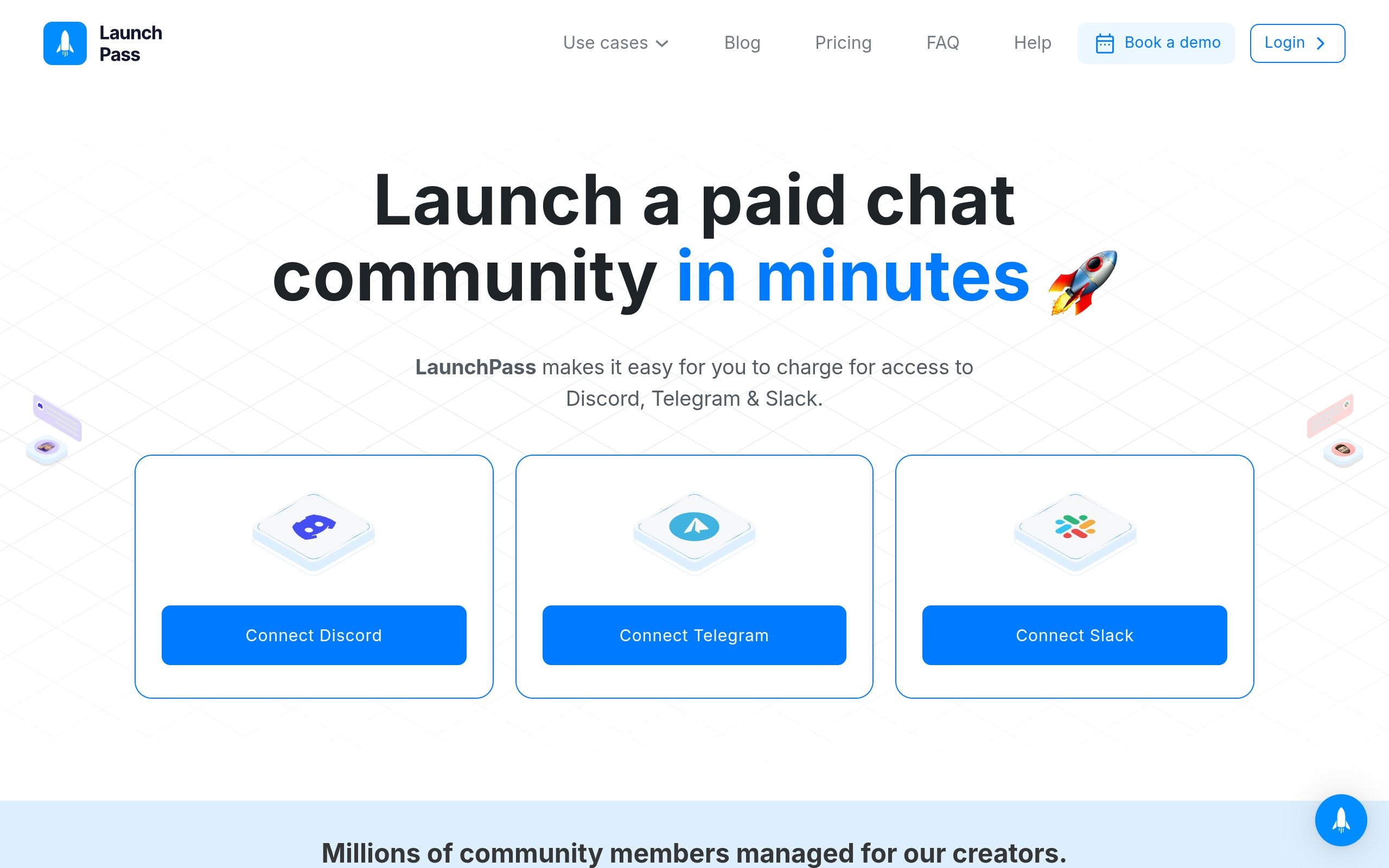
This is also where it's worth comparing both to platforms built purely around creator monetization rather than full community suites. Patreon takes a percentage of revenue but handles billing and basic tiering without requiring you to build out a whole community site. LaunchPass, InviteMember, and similar tools go a step further by focusing specifically on paid access to Telegram and Discord — closer to what HopMembers does — rather than trying to be a full community hub like Circle.
Where HopMembers Fits Into This Comparison

It's worth being precise here: HopMembers isn't a Circle competitor or a Facebook Groups replacement. Circle and Facebook Groups are destinations where discussion happens. HopMembers is a monetization and access-control layer that sits on top of WhatsApp, Telegram, and Discord — the chat apps your audience may already prefer over a web-based community platform.
If your actual community lives (or would thrive) in a Telegram channel or a Discord server rather than a Facebook Group or a Circle space, the real comparison isn't Circle vs Facebook Groups at all — it's "do I force my chat-first audience into a web community platform, or do I monetize the chat app they already use?" HopMembers is built for the second path: you create a membership page, connect your Telegram channel, Discord server, or WhatsApp group, a member pays, and access is granted automatically. If they cancel or a payment fails, access is revoked automatically too — no spreadsheet, no VA checking payment status by hand.
That's a meaningfully different operational model than Circle's web-community-plus-payments bundle, and a much more automated one than Facebook Groups' manual-approval workflow. You can read more about how this access automation works for Discord specifically in our breakdown of the best membership platforms for Discord, and the Telegram-specific version in best platforms for Telegram memberships.
A Concrete Scenario
Say you run a trading signals community. Your members want fast alerts and live chat reactions — Telegram or Discord, not a forum thread. If you built this in a Facebook Group, you'd be manually verifying payments and manually removing lapsed members while your most engaged users ask why notifications feel buried in Facebook's feed algorithm. If you built it in Circle, you'd get clean paid-space gating, but you'd be asking traders to leave the app they check 40 times a day for a new web login. With HopMembers, the trading signals stay in Telegram where your audience already is, the paywall and access revocation are automatic, and you get a simple membership page to drive sign-ups — without pretending Telegram itself is a membership platform. It isn't; HopMembers sits on top of it for billing and access control.
Migration Notes: Moving Off Facebook Groups
If you currently run a free or informally-paid Facebook Group and want to formalize monetization, migration planning matters more than platform choice. A few things to check before you move anyone:
- Export what you can. Facebook doesn't offer a clean bulk export of member lists or post history, so plan to communicate the move directly inside the group with a pinned post and direct messages.
- Decide if you're moving to a new destination or just adding payment. Moving to Circle means a full platform switch and re-onboarding every member with a new login. Adding HopMembers-style access control to a Telegram or Discord group means keeping the same chat destination your members already know, but formalizing the paywall around it.
- Grandfather carefully. Whatever you do, give existing free members a clear, time-boxed path — a discount window or a free trial period — before access gates close. Abrupt paywalls on previously-free groups generate the most churn and the most complaints.
For a broader view of monetization paths beyond just "paid group access," our comparison of monetization strategies for creators covers tiering, one-time content sales, and hybrid models worth considering before you commit to one platform.
Decision Framework: Which One Should You Actually Pick

Choose Facebook Groups if: you want zero platform cost, your audience discovery relies on Facebook's algorithm and existing social graph, and you're comfortable handling payments and access manually (or accepting the leakage that comes with it). This works best for low-stakes, low-price communities where the admin overhead stays small.
Choose Circle if: you're building a full branded community hub that combines courses, live events, and discussion, you want one platform to handle billing and content together, and your audience is fine adopting a new web app and login. This works best for education-heavy creators bundling cohorts, courses, and community into one paid product.
Choose a Telegram/Discord setup with HopMembers if: your community is naturally chat-first — fast messages, voice channels, real-time alerts — and you want automatic access granting and revoking tied directly to payment status, without forcing members onto a new platform. This fits solo creators, signal groups, niche mastermind chats, and paid Discord servers where the chat app itself is non-negotiable for your audience.
It's also worth noting none of these choices are permanent or mutually exclusive forever. Plenty of creators run a free Facebook Group for top-of-funnel discovery while monetizing a deeper, paid Telegram or Discord tier for their most committed members — using the free group as a feeder into the paid chat community.
Feature-by-Feature: The Parts People Forget to Check
Beyond headline pricing, a few operational details decide whether a platform actually works day-to-day:
- Refund handling. In Circle and Patreon-style tools, a refund typically needs a manual access removal unless you've built automation around it. HopMembers ties revocation directly to cancellation or failed payment events for Telegram and Discord, so access removal isn't a separate manual step.
- Analytics. Facebook Groups gives you engagement metrics but no revenue-per-member view. Circle gives you some member analytics within its dashboard. A dedicated access tool paired with a membership analytics view lets you see churn, active payers, and growth trends specifically tied to your paid tier — not just general engagement noise.
- Member management. Checking who's active, who's lapsed, and who needs a renewal nudge is far easier from a dedicated members dashboard than scrolling a Facebook Group's member list or cross-referencing a spreadsheet.
FAQ
Can you actually charge for a Facebook Group natively?
Facebook has tested subscription features in some regions, but there's no universally reliable, native recurring-billing paywall built into Groups the way Stripe-based platforms offer it. Most creators charging for Facebook Group access run payments through a separate tool and manually manage who stays in the group.
Is Circle better for courses than Facebook Groups?
Yes, clearly. Circle bundles course hosting, cohort scheduling, and community discussion in one place, which Facebook Groups was never designed to do. If your paid offer is content-heavy (modules, lessons, drip content), Circle's structure fits better than a group feed.
What happens to members if I cancel my Circle subscription?
Your community and its content live on Circle's infrastructure, so canceling means losing access to that hosted space entirely — members can't simply be exported into a new web app without manual outreach. This is a key migration risk to weigh before committing.
Does HopMembers replace Telegram or Discord?
No. HopMembers doesn't replace WhatsApp, Telegram, or Discord — it sits on top of them to handle the paywall, membership page, payment collection, and automatic access granting or revoking. Your community still lives in the chat app itself.
Which option is cheapest for a very small paid community?
For under 30-40 members, Facebook Groups plus a manual payment link is the lowest fixed cost, but the time cost of manual reconciliation grows fast. A focused access tool tends to pay for itself quickly once you factor in the hours saved not chasing lapsed payers by hand.
Can I run a free Facebook Group alongside a paid Telegram or Discord tier?
Yes, and many creators do exactly this — a free Facebook Group for reach and discovery, with a paid, automated Telegram or Discord tier for the audience ready to pay for deeper access or faster signals.
Getting Started
If your community genuinely belongs in a chat app rather than a web forum, the fastest path is to set up a membership page, connect your Telegram channel, Discord server, or WhatsApp group, and let payments trigger access automatically. You can see the full flow and get started in a few minutes, or browse the HopMembers homepage for an overview of how membership pages, member management, and analytics fit together for chat-first paid communities.
Key facts
- Circle (circle.so) is a hosted, white-labeled community platform combining discussions, courses, live events, and paid spaces with Stripe-based checkout.
- Facebook Groups is free to use but has no native, reliable paywall built for charging members for group access.
- Circle charges a flat monthly platform fee regardless of how many paying members a community has.
- Circle allows creators to gate specific spaces or content behind a paywall while keeping other areas free.
- Facebook Groups requires third-party workarounds (like linking to external payment tools) to restrict access by payment status.
- Migrating off Facebook Groups to a dedicated platform means rebuilding community engagement history and audience trust in a new destination.
- HopMembers supports Telegram- and Discord-first paid communities, letting creators monetize access in apps members already use daily rather than migrating them to a new platform.
- The core tradeoff in Circle vs Facebook Groups is purpose-built monetization and access control (Circle) versus free reach with no native paywall (Facebook Groups).
HopMembers is a platform for running paid Telegram and Discord communities, offering an alternative to Circle or Facebook Groups for creators who want to monetize access without migrating their audience off the apps members already use.


