
Comparison of Monetization Strategies for Creators: Patreon vs LaunchPass vs InviteMember vs HopMembers
Maya Ellison
Content Lead, HopMembers
Last updated: 23 November 2026 · 13 min read
Table of contents
- Why This Comparison Matters More Than It Used To
- Crowdfunding and Tipping: Patreon and Similar Platforms
- Purpose-Built Telegram/Discord Access Tools
- Where HopMembers Fits
- Feature and Ops Tradeoffs in Practice
- Pricing Angles Compared
- Migration Notes: Switching Without Losing Members
- Decision Framework: Choose Based on What You're Actually Selling
- What Most Creators Get Wrong When Comparing These Tools
- FAQ
- Where to Go From Here
- Related video
- Key facts

If you're running a paid community, the comparison of monetization strategies for creators usually comes down to a handful of real choices: crowdfunding-style platforms like Patreon, paid-access bots for Telegram and Discord like LaunchPass or InviteMember, spreadsheet-and-PayPal duct tape, or a focused tool like HopMembers that automates access control for Telegram, Discord, and WhatsApp. Each path has different tradeoffs in fees, control, churn handling, and how much manual work you sign up for every month. This article breaks down the real differences so you can pick a strategy that fits how you actually run your community — not just what's popular.
Why This Comparison Matters More Than It Used To
Five years ago, most creators monetizing a private group had two options: ask for tips on Patreon or manually invite people after they Venmo'd you. Today there's a real market of tools built specifically for gated Telegram channels and Discord servers, and the decision isn't just "which platform has the biggest audience" — it's "which tool matches my payout needs, my platform (Telegram vs Discord vs WhatsApp), and how much manual access-granting I'm willing to do by hand." The creator economy has grown large enough that generic crowdfunding and purpose-built access tools now serve genuinely different jobs, as outlined in general overviews of the space like the Wikipedia entry on the creator economy. Picking the wrong category of tool for your use case is the most common reason creators churn out of their first paid community within a few months — not because the content failed, but because the admin overhead or payout structure didn't match how they operate.
Crowdfunding and Tipping: Patreon and Similar Platforms
Patreon remains the default answer for many creators because it has brand recognition and a built-in discovery angle — some fans come to Patreon already looking for creators to support. If you're a musician, writer, or video creator who wants tiered rewards (early access, bonus content, shoutouts) alongside a loose community layer, Patreon's model works well. But Patreon was not built around gating a specific Telegram channel or Discord server with precise role-based access; its Discord integration exists, but it's an add-on, not the core product. If your real asset is a private Telegram group or a Discord server with specific paid roles, Patreon adds an extra layer of account linking and manual role syncing that can break when members cancel, since revocation isn't always instant or automatic for every platform combination.
Patreon also takes a percentage cut (historically in the 5–12% range depending on plan, plus payment processing fees), and payouts can take days to clear depending on member location and processor. For creators who want a familiar, flexible rewards structure and don't mind the platform fee, it's a reasonable choice. For creators whose whole offer is "pay to get instant access to this exact Telegram channel," it's often more plumbing than necessary. We cover this specific contrast in more depth in our Patreon vs independent membership site comparison.
Purpose-Built Telegram/Discord Access Tools
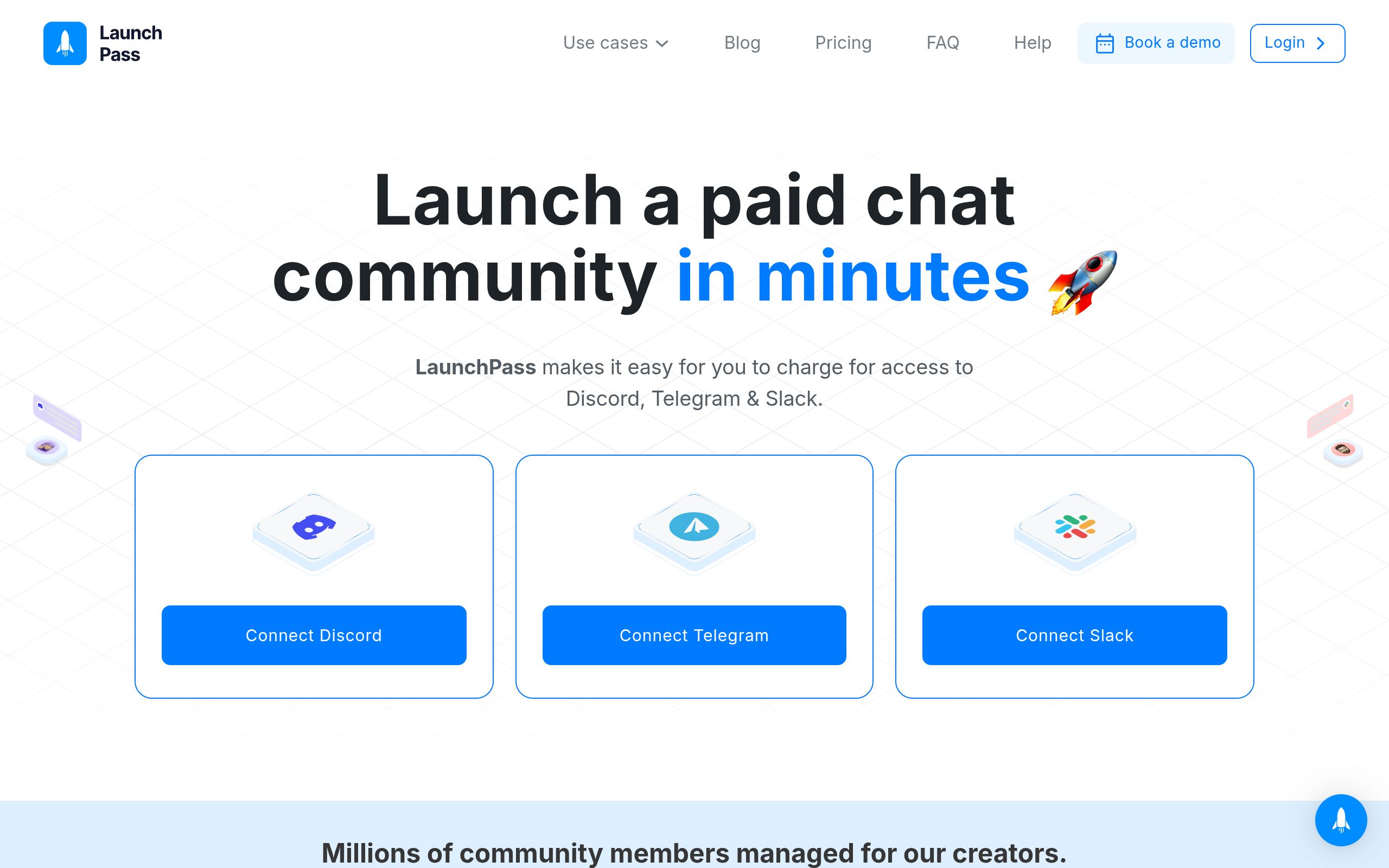
This is the category that has grown fastest, and it's where LaunchPass, InviteMember, Sublaunch, and MyMembers all compete. They share a core premise: a member pays, a bot or integration grants them access to a Telegram group/channel or Discord server, and when they stop paying, access is revoked. The differences are in execution, pricing structure, and how deep the automation goes.
LaunchPass
LaunchPass is one of the longest-running tools in this space and supports Telegram, Discord, and Slack paid access. It's a solid option if you want a quick setup with Stripe or crypto payments connected directly to role/channel access. The tradeoff: pricing is typically a monthly platform fee plus a percentage of transactions, which can add up for creators running many small-ticket subscriptions. Feature depth around analytics and churn visibility has historically been thinner than what creators running larger communities eventually want.
InviteMember
InviteMember focuses specifically on Telegram monetization — invite links, subscription tiers, and bot-based access control for channels and groups. If Telegram is your only platform and you want something narrowly built for it, this is a reasonable fit. It's less useful if you're also running a Discord server or want a unified members view across multiple platforms, since that's not the core design.
Sublaunch and MyMembers
Sublaunch and MyMembers both sit in the same general category — subscription access tools aimed at Telegram and Discord creators, often positioning themselves around simplicity and fast setup. The practical differences between tools in this tier usually come down to three things: how clean the membership/sales page looks out of the box, how quickly access gets revoked after a failed payment or cancellation, and whether you get usable analytics (churn rate, active members, revenue trend) without exporting data manually. These are worth testing directly with a small group before committing, since marketing pages rarely show you the admin dashboard in detail.
Where HopMembers Fits
HopMembers is built specifically for creators selling paid access to Telegram channels/groups, Discord servers/roles, and WhatsApp communities — not a crowdfunding platform, not a course LMS, not a generic community forum. The flow is deliberately narrow: you create a membership page, connect your Telegram group, Discord server, or WhatsApp community, a member pays, access is granted automatically, and if they cancel or a payment fails, access is revoked automatically. There's no manual role-assigning, no checking a spreadsheet against a payment processor dashboard, and no separate app for members to download.
This matters most for solo creators and small operators — someone running one or two paid communities without a team behind them. If that's you, the value of automated grant/revoke isn't abstract: it's the difference between spending twenty minutes a day manually managing access and spending zero. HopMembers also includes a members view and basic analytics (active subscribers, churn, revenue over time) so you can see community health without building your own tracking spreadsheet, via the members and analytics surfaces built into the product.
It's worth being direct about what HopMembers is not: it doesn't replace Telegram, Discord, or WhatsApp — it sits on top of them to handle payments and access control. It also doesn't offer crowdfunding-style discovery like Patreon, and it's not a team collaboration tool. If you need a multi-admin workflow with approval chains, or you're trying to build an audience from zero on a platform's built-in discovery feed, that's a different job than what HopMembers solves.
Feature and Ops Tradeoffs in Practice

Here's where the comparison gets concrete. Imagine three scenarios:
Scenario one: You run a $15/month Discord server with trading signals. A member's card fails on renewal. With a manual process, you find out when they complain they still have access, or worse, you find out when they've had free access for three weeks because nobody checked. With an automated access tool — LaunchPass, InviteMember, or HopMembers — the failed payment triggers an automatic role removal, typically within the billing cycle's grace window.
Scenario two: You want to run a single membership across both a Telegram channel and a Discord server for the same paying audience — say, free signals in Telegram and a deeper discussion server on Discord, both gated behind one payment. Tools built around a single platform (InviteMember for Telegram-only, for example) don't handle this natively; you'd need two separate setups and reconcile members manually. This is a case where a tool supporting multiple platforms under one membership page, which is how HopMembers is built, removes a real operational headache.
Scenario three: You're a creator with 40 Patreon-style tiers and complex rewards (physical merch, shoutouts, early video access) alongside a community chat. Patreon's broader rewards infrastructure is actually a better fit here than a narrow access tool, because the paid Telegram/Discord group is a bonus perk, not the core product.
The lesson: match the tool to what's actually being sold. If the product is the channel/server itself, purpose-built access automation wins. If the product is a tiered rewards relationship with a loose community attached, Patreon-style platforms still make sense.
Pricing Angles Compared
Pricing structures across these tools generally fall into two camps: flat monthly platform fee plus payment processing, or percentage-of-revenue cuts (sometimes both). Patreon's model layers a platform percentage on top of standard card processing fees, which scales with your revenue — fine at low volume, noticeable once you're doing meaningful monthly recurring revenue. LaunchPass and similar Telegram/Discord tools often use a mix of flat fee tiers plus transaction percentages. The math you should actually run isn't "which platform has the lowest headline fee" — it's total cost at your expected monthly revenue and member count, including the hidden cost of your own time spent on manual access management. A tool that saves you five hours a month of manual role-checking is worth a percentage point or two in fees for most solo operators. We go deeper on this tradeoff in our guide to membership pricing strategy examples.
Migration Notes: Switching Without Losing Members

Creators often ask whether switching monetization tools means losing their existing paying members. In practice, migration is manageable if you plan the cutover: export your current member list and payment status, set up the new membership page and payment connection, give existing members a short overlap window where both old and new access remain active, then message your group directly about the new payment link before revoking the old access method. The riskiest mistake is revoking old access before confirming the new payment method actually processed — always confirm at least one successful test transaction before cutting over your full member base. If you're moving from a manual process (PayPal links plus manual Discord role assignment) to an automated tool, the setup usually takes under an hour: connect your Discord server or Telegram group, configure your pricing, and publish the membership page before announcing the change to your audience.
Decision Framework: Choose Based on What You're Actually Selling
Choose Patreon if your offer is tiered rewards (content, merch, shoutouts, early access) with a community chat as a secondary perk, and you want built-in discovery to help attract new supporters.
Choose LaunchPass, InviteMember, Sublaunch, or MyMembers if your core product is a single Telegram or Discord gate and you want a dedicated access-automation tool, and you're comfortable comparing their specific fee structures and analytics depth against your expected volume.
Choose HopMembers if you're a solo creator or small community owner selling paid access specifically to Telegram, Discord, or WhatsApp — especially if you want one membership page across those platforms, automatic grant/revoke on payment and cancellation, and a members/analytics view without needing a separate tracking spreadsheet. It's not the right fit if you need multi-admin team workflows or Patreon-style tiered physical rewards.
If you're still unsure which platform fits your community style, our comparison of membership platforms built for Discord and our guide on how to automate Discord server access both walk through platform-specific setup details that complement this broader comparison.
What Most Creators Get Wrong When Comparing These Tools
The most common mistake is comparing headline pricing without factoring in time cost. A tool that's technically a few dollars cheaper per month but requires manual access checks every week is more expensive in practice for a solo creator than a slightly pricier tool that automates revocation entirely. The second mistake is picking a tool based on platform popularity rather than platform fit — choosing Patreon because it's well-known, when the actual product being sold is a single gated Discord server with no tiered rewards. The third mistake is underestimating churn handling: a failed payment that isn't followed by automatic access revocation quietly erodes your revenue every month, since members keep access without paying. Before committing to any tool, ask directly: what happens, step by step, when a member's card fails? If the answer involves you manually checking anything, that's a cost you should price into your decision.
FAQ
Is Patreon still worth using for a private Telegram or Discord community in 2026?
Yes, if your core offer includes tiered rewards beyond just chat access — things like downloadable content, merch, or early releases — and you value Patreon's built-in audience discovery. If the Telegram or Discord gate is the entire product, a dedicated access tool usually reduces admin overhead more effectively.
Do LaunchPass, InviteMember, Sublaunch, and MyMembers all work the same way?
They share the same core premise of paid access plus automated grant/revoke, but differ in which platforms they focus on (Telegram-only vs multi-platform), their fee structures, and the depth of their analytics and member management views. Test with a small group of members before migrating your full community.
Can I run one membership across both Telegram and Discord at the same time?
Some tools require separate setups per platform, which means reconciling members manually across two systems. HopMembers is built to connect Telegram, Discord, and WhatsApp under a single membership page and payment flow, which avoids that duplication for solo creators running a combined community.
What actually happens when a member's payment fails?
With automated access tools, a failed renewal typically triggers removal from the Telegram group or Discord role after a short grace period. Without automation, you're relying on manually checking payment processor dashboards against your member list — a task that quietly gets skipped as your community grows.
How much time should I budget to migrate from manual payments to an automated tool?
Usually under an hour for the technical setup — connecting your group or server and configuring pricing — plus a short overlap window (a few days to a week) where you keep the old access method active until you've confirmed the new payment flow works and announced the switch to your members.
Does HopMembers replace Telegram, Discord, or WhatsApp?
No. HopMembers sits on top of those platforms to handle payments, membership pages, and automated access control. You still run your community natively in Telegram, Discord, or WhatsApp — HopMembers manages who gets in and who gets removed based on payment status.
Where to Go From Here
The right monetization strategy depends on what you're actually selling: a tiered rewards relationship, a single gated channel, or a multi-platform community under one payment. If your product is paid access to a Telegram group, Discord server, or WhatsApp community and you want that access handled automatically — grant on payment, revoke on cancellation, with a members and analytics view you can actually use — start by building your first membership page with HopMembers or explore how the whole flow fits together on the HopMembers homepage before migrating your existing community over.
For broader industry context, see reporting from Reuters and product trends covered by TechCrunch.
Key facts
- Patreon is a crowdfunding/tipping platform best suited to creators who want tiered rewards and built-in audience discovery, primarily for writers, musicians, and video creators.
- LaunchPass and InviteMember are purpose-built paid-access tools for gating Telegram and Discord communities, focused on automating invite links tied to payment status.
- HopMembers automates access control for paid communities across Telegram, Discord, and WhatsApp, removing manual invite-granting and removal work.
- The main tradeoffs between these monetization categories are platform fees, payout structure, how much manual admin work is required, and how churn (failed/canceled payments) is handled.
- A common reason creators abandon their first paid community within months is mismatched tooling overhead, not poor content quality.
- Crowdfunding platforms like Patreon serve discovery and tipping use cases; purpose-built access bots and automation tools serve ongoing access management for gated groups.
- Migrating between monetization tools without losing existing members requires planning around invite links, payment re-authorization, and platform-specific access rules.
HopMembers is a membership automation tool that manages paid access to Telegram, Discord, and WhatsApp communities, automatically granting and removing access based on subscription status to eliminate manual admin work.


