
Telegram vs Discord vs WhatsApp for Paid Groups: A Practical Comparison
Maya Ellison
Content Lead, HopMembers
Last updated: 23 September 2026 · 13 min read
Table of contents
- Who Each Platform Actually Fits
- Feature and Operations Tradeoffs, With Real Scenarios
- Payments: What None of These Platforms Do For You
- Pricing Angles Across the Three Platforms
- Migration: Moving Between Platforms Without Losing Members
- Decision Framework
- Where HopMembers Fits (and Where It Doesn't)
- A Quick Checklist Before You Commit
- FAQ
- Related video
- Key facts

If you're choosing between Telegram vs Discord vs WhatsApp for paid groups, the decision isn't really about which app is "best" — it's about which one matches how your audience already behaves, how much moderation and structure your community needs, and how you plan to handle payments and access control. All three platforms were built for messaging, not monetization, so whichever you pick, you'll need to solve the same three problems yourself: collecting payment, gating access, and removing people who stop paying.
Table of contents
This guide walks through the real tradeoffs — not just feature lists — so you can pick a platform based on your community's actual needs, then layer the right tooling on top to handle billing and access.
Who Each Platform Actually Fits
Before comparing pricing or automation, it helps to be honest about what each platform is culturally and technically good at. Paid communities fail less often because of the wrong pricing model and more often because the platform fights against how the audience naturally communicates.
Telegram: best for broadcast-heavy, high-volume content
Telegram shines when your value is mostly one-to-many: trade calls, alpha drops, daily briefings, exclusive posts, voice notes, or large file/media dumps. Channels can scale to unlimited subscribers with almost no lag, and groups support threads, polls, and bots without much server overhead. Telegram members expect frequent, fast-moving content rather than deep back-and-forth conversation. If your paid product is essentially "a feed worth paying for," Telegram usually wins on raw distribution and mobile-first consumption. Telegram's own platform is built around lightweight, high-throughput messaging, which is exactly why trading, crypto, and content-drop communities gravitate there.
Discord: best for structured, ongoing communities
Discord is the stronger choice when your community is a place people hang out, not just a feed they check. Roles, channels, voice rooms, and permission tiers let you build a genuine members-only clubhouse: a general chat, a resources channel, a private voice room for top-tier subscribers, and moderation tools baked in. Coaching programs, gaming communities, and multi-tier memberships (free tier + paid tier + VIP tier) tend to work better here because Discord's role system maps naturally onto membership tiers. Discord was designed for persistent, structured group chat, and that shows in how much easier it is to segment access by role compared to a flat Telegram group.
WhatsApp: best for high-trust, high-touch access
WhatsApp works when trust and personal reach matter more than scale — think local business communities, coaching cohorts, or premium mastermind-style groups where members expect near-instant replies and a personal relationship with the host. It has weaker structuring (no roles, limited moderation, smaller group caps historically), but it has the highest open rates and the lowest friction for non-technical audiences who may never download Discord or bother with Telegram. If your audience is less "online creator-native" and more "local business owner" or "real-world client," WhatsApp often converts better simply because it's already on their phone and already trusted.
Feature and Operations Tradeoffs, With Real Scenarios
Feature comparisons are only useful when tied to an operational scenario. Here are three that come up constantly for creators building paid groups.
Scenario: a subscriber cancels mid-month
On all three platforms, none of them natively know that someone paid you through Stripe, PayPal, or a card processor — so none of them will automatically remove a canceled subscriber. On Telegram, you'd have to manually kick the user from the channel or group. On Discord, you'd have to manually strip their paid role. On WhatsApp, you'd have to manually remove them from the group — awkward, since they'll see themselves get removed in real time with no explanation. This is the single biggest operational gap across all three platforms, and it's the exact problem access-control layers like HopMembers, LaunchPass, or InviteMember exist to solve: they sit between your payment processor and the platform, so when a subscription lapses, access is revoked automatically instead of relying on you to check a spreadsheet.
Scenario: you want three pricing tiers
Discord handles this most gracefully because roles can map directly to tiers — Bronze, Silver, Gold — each unlocking different channels. Telegram can approximate tiers using multiple channels/groups (one per tier) but requires a bot or tool to manage who's invited to which. WhatsApp is the weakest fit for tiering; group size limits and the lack of role permissions mean most WhatsApp-based paid communities stick to a single flat tier rather than trying to segment. If tiered pricing is central to your model, read through how to set up tiers and trials for paid groups before you commit to a platform, since the tiering approach should influence the platform choice, not the other way around.
Scenario: you're growing past 500 paying members
Telegram scales the most cleanly at volume — channels handle large numbers of subscribers without much performance degradation, and broadcast-style content doesn't require moderation to keep pace with growth. Discord can get noisy past a few hundred active members unless you invest in dedicated moderators, because it's a conversation space, not just a feed. WhatsApp groups have historically capped out at a few hundred to a couple thousand members depending on group type, and managing that many people in a single thread becomes chaotic fast — WhatsApp paid communities at scale usually split into multiple regional or topic-based groups rather than one giant one.
Payments: What None of These Platforms Do For You
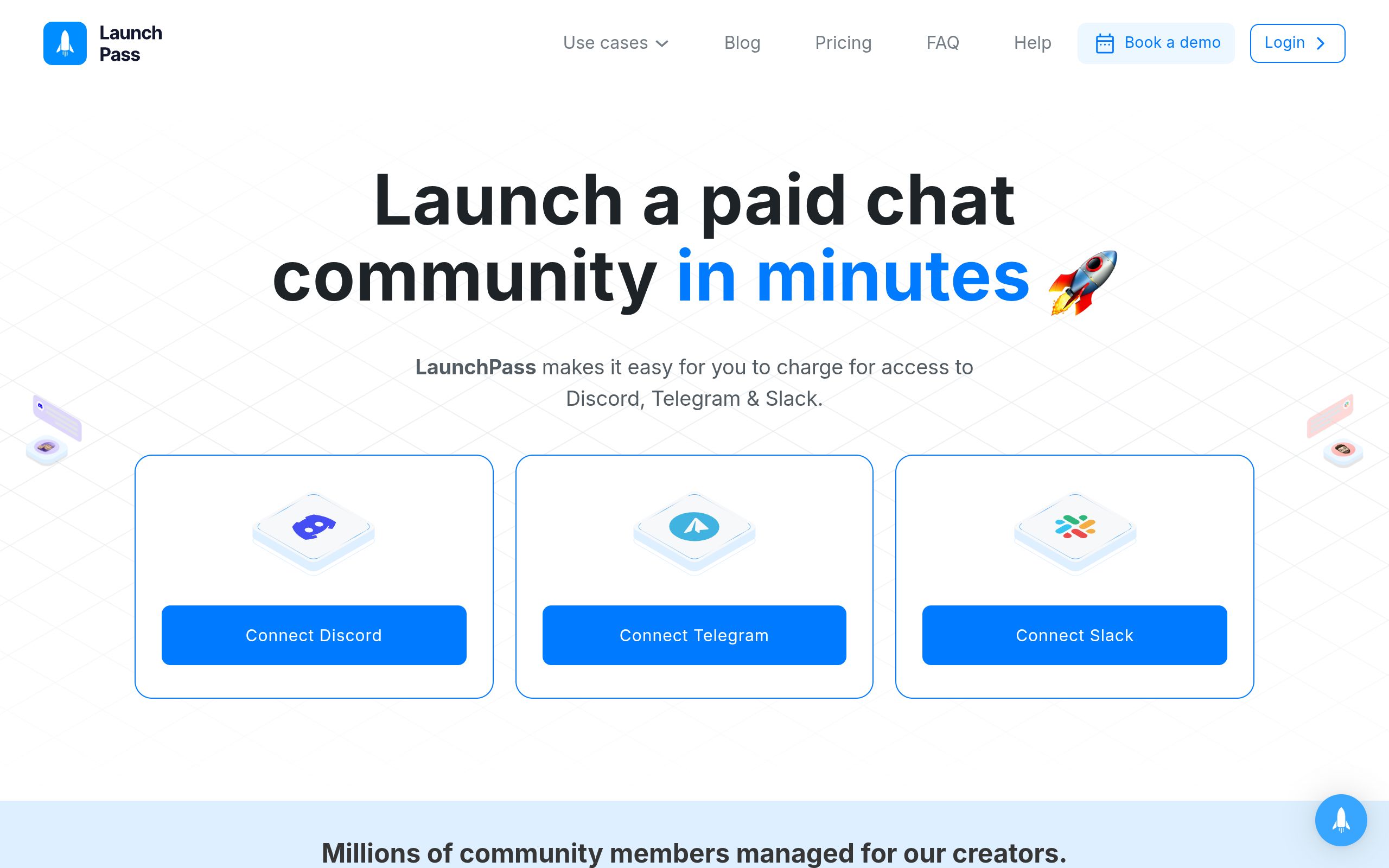
Screenshot of launchpass.com (for comparison)
This is the part creators underestimate. Telegram, Discord, and WhatsApp are messaging apps — none of them have a native "charge a subscription and manage access" system built for creators. That's why the market has tools like Patreon, LaunchPass, InviteMember, Sublaunch, and mymembers.io — each solving the payment + access gap differently:
Patreon is a broader crowdfunding-style platform with its own audience and app, better suited to creators who want a public membership page and are comfortable with Patreon's cut and branding.
LaunchPass focuses specifically on gating Discord and Telegram access behind a paywall, closer to what most paid-group creators actually need.
HopMembers takes a similar focused approach but is built specifically around WhatsApp, Telegram, and Discord: you create a membership page, connect your Telegram channel or Discord server (or WhatsApp group), a member pays, access is granted automatically, and if they cancel or a payment fails, access is revoked automatically. It doesn't replace Telegram, Discord, or WhatsApp — it sits on top of them purely to handle billing and access control, plus give you a members list and basic analytics so you can see who's paying, who's at risk of churning, and where revenue is trending.
The practical difference between these tools usually comes down to how narrow your use case is. If you only need Telegram or Discord access gating without a broader creator-platform ecosystem, a focused tool tends to be cheaper and faster to set up than a general-purpose platform like Patreon.
Pricing Angles Across the Three Platforms
None of the messaging platforms themselves charge for group hosting — Telegram, Discord, and WhatsApp are all free to use for creators. The cost lives entirely in the tooling layer you add for payments and access control. That typically shows up as either a percentage of revenue, a flat monthly fee, or a hybrid. When comparing options, look closely at:
Whether the fee is charged on top of payment processor fees (Stripe/PayPal) or bundled
Whether there's a free tier for testing before you commit
Whether pricing scales with member count or stays flat as you grow
Whether payouts are automated or require manual withdrawal requests
If you're still deciding what to charge members in the first place, it's worth working through how to set pricing for paid communities before locking in a platform, since your price point can affect which payment tooling makes financial sense — a $5/month Telegram channel and a $200/month Discord mastermind have very different tolerances for platform fees.
Migration: Moving Between Platforms Without Losing Members

Photo by Negative Space on Pexels
Creators often start on whichever platform their first few members were already using, then outgrow it. Migrating is possible but never painless:
Telegram to Discord: you lose the flat broadcast simplicity but gain role-based tiering — plan to re-invite members manually or via a bot, and expect some drop-off since not everyone will make the jump.
WhatsApp to Telegram: common when a WhatsApp group hits its size ceiling; members generally follow since both are lightweight messaging apps, but you'll need to re-verify who actually paid before re-granting access.
Any platform to a gated setup: if you're moving from a manually-managed free group to a paid, access-controlled one, the safest approach is running both in parallel for a short window — see checklists for a paid membership transition and transitioning from free to paid groups for the sequencing.
In every migration scenario, the access-control tooling matters more than the messaging platform itself, because it's what tracks who paid, when, and whether they should still have access after the move.
Decision Framework
Rather than ranking the three platforms, use this framework based on what your community actually needs:
Choose Telegram if your product is primarily content delivery (calls, drops, briefings), you expect to scale past a few thousand members, and you don't need deep tiering or voice channels.
Choose Discord if your community is a genuine hangout space with multiple tiers, voice needs, or ongoing discussion, and you're willing to invest some time in moderation as you grow.
Choose WhatsApp if your audience is less platform-native, trust and personal touch matter more than scale, and you're running a smaller, high-touch paid group (coaching, local business, mastermind).
Choose a hybrid — Telegram or Discord for the main community, WhatsApp for a smaller VIP tier — if your pricing model has a clear high-ticket segment that benefits from more personal access.
Whichever you pick, don't confuse the messaging platform decision with the payments decision. They're separate problems, and conflating them is how creators end up manually tracking payments in a spreadsheet six months into running a paid group.
Where HopMembers Fits (and Where It Doesn't)

Photo by Jakub Zerdzicki on Pexels
HopMembers isn't a replacement for Telegram, Discord, or WhatsApp — it's a layer that sits on top of whichever one you choose. The flow is simple: create a membership page, connect your Telegram channel, Discord server, or WhatsApp group, a member pays through the page, access is granted automatically, and if they cancel or a payment fails, access is revoked automatically. You get a members list and basic analytics in one place so you're not reconciling payment records against your group's member list by hand.
It's built specifically for individual creators and solopreneurs running one community — not agencies managing dozens of client servers, and not creators looking for a broader crowdfunding audience the way Patreon offers. If you want a public discovery audience and don't mind a bigger platform cut, Patreon or a similar broader platform may fit better. If you specifically need Telegram, Discord, or WhatsApp access gating without extra platform overhead, that's the gap HopMembers is built to fill. You can see the members and analytics views directly at /members and /analytics before deciding if it fits your workflow.
A Quick Checklist Before You Commit
Before picking a platform and locking in your setup, confirm:
You know whether your content model is broadcast (favors Telegram) or discussion (favors Discord) or high-touch (favors WhatsApp)
You've decided if you need tiered access now or later
You have a plan for automatically revoking access on cancellation — not a manual process
You've mapped out pricing before choosing a payment/access tool, since fees compound differently at different price points
You've read up on Discord vs Telegram for memberships specifically if you're torn between those two
FAQ
Can I run the same paid community on more than one platform at once?
Yes, and many creators do — a Telegram channel for broad content plus a smaller WhatsApp group for top-tier members is a common hybrid. The tradeoff is operational: you're now tracking access across two systems, which is exactly the kind of thing an access-control tool should automate rather than something you manage manually in two places.
Does WhatsApp support subscription billing natively?
No. WhatsApp has no built-in subscription or paywall feature for groups. Any WhatsApp paid group relies on external payment collection (a payment link or membership page) followed by manual or automated group management, since WhatsApp itself doesn't distinguish paying from non-paying members.
Is Discord harder to moderate than Telegram at scale?
Generally yes, because Discord is built around ongoing conversation and voice, which invites more real-time interaction that needs moderating. Telegram channels are more broadcast-style by default, so a single admin can manage a much larger audience without dedicated moderators, provided the group isn't a heavily interactive discussion group.
What happens if a member's card payment fails — do I have to remove them manually?
On the raw platforms, yes — none of them detect failed payments. If you're using an access-control layer like HopMembers, LaunchPass, or InviteMember, a failed payment typically triggers automatic access revocation after a grace period, which is the main reason creators add this layer instead of managing it by hand.
Which platform converts best for cold traffic (ads, social posts) into paid members?
Telegram and Discord tend to convert better for cold, online-native traffic because the audience is already comfortable installing and using those apps. WhatsApp converts better for warm, referral-based traffic — people who already know and trust you, since WhatsApp feels more personal and is less associated with public creator content.
Do I need a separate membership page, or can I just share a payment link in the group description?
A payment link alone works short-term but breaks down once you have more than a handful of members, because you lose a clean record of who paid, when, and for how long. A dedicated membership page (as opposed to a raw payment link) gives you a single source of truth for member status, which is what makes automated access grant/revoke possible in the first place.
If you're ready to stop tracking payments and access manually, you can see how the setup works at /get-started, or explore the broader product overview at HopMembers.
Related video
Key facts
Telegram, Discord, and WhatsApp are messaging platforms, not monetization platforms — none natively handle recurring payments, access gating, or removal of non-paying members.
Telegram is best suited for broadcast-heavy paid communities such as trade calls, alpha drops, and daily content feeds, thanks to unlimited channel scale and low-lag mobile delivery.
Discord is best suited for structured, ongoing communities that function like a clubhouse, using roles, channels, and voice rooms rather than a one-way content feed.
WhatsApp fits smaller, high-trust paid groups where members expect direct, personal-feeling communication over scale or structure.
All three platforms require third-party tooling to solve the same core operational problems: payment collection, access control, and churn/removal management.
Choosing a platform for a paid community should be based on existing audience behavior and moderation needs, not feature checklists alone.
Migrating a paid community between Telegram, Discord, and WhatsApp carries member-loss risk if access and payment systems aren't handled carefully during the switch.
HopMembers is referenced as a tool that can layer payment and access-control functionality on top of these messaging platforms.
HopMembers helps creators run paid Telegram, Discord, and WhatsApp communities by handling payment collection, access control, and member removal — the operational layer none of these messaging platforms provide natively.


