
Setting pricing for paid communities: How to Set Pricing for Paid Communities on Telegram, Discord, and WhatsApp
Maya Ellison
Content Lead, HopMembers
Last updated: 18 September 2026 · 15 min read
Table of contents
- Who this is for and what you'll achieve
- Prerequisites before you set a price
- Step 1: Choose your pricing model before your price
- Step 2: Anchor your price to a specific value, not a vibe
- Step 3: Decide whether to offer a free trial or free tier
- Step 4: Set up pricing on your HopMembers membership page
- Step 5: Test your price with a small cohort before a full launch
- Step 6: Adjust pricing later without losing existing members
- Verification and common mistakes
- Next actions
- FAQ
- Related video
- Key facts

Setting pricing for paid communities is the decision that determines whether your Telegram channel, Discord server, or WhatsApp group turns into a sustainable business or a side project that fizzles out after a few months. Price too high before you've proven value and you'll scare off your first 50 members. Price too low and you'll cap your revenue while doing the same amount of moderation, content creation, and support work. This guide walks through a concrete process for setting pricing for paid communities, from figuring out your starting number to testing it, publishing it, and adjusting it as your community matures.
Table of contents
Step 5: Test your price with a small cohort before a full launch
Step 6: Adjust pricing later without losing existing members
This is written for individual creators and solopreneurs — the person running a trading signals channel, a fitness accountability group, a niche hobby Discord, or a WhatsApp community for local business owners. It's not aimed at teams building enterprise community software; it's aimed at the one person who has to decide the number, publish it, and live with the consequences.
Who this is for and what you'll achieve
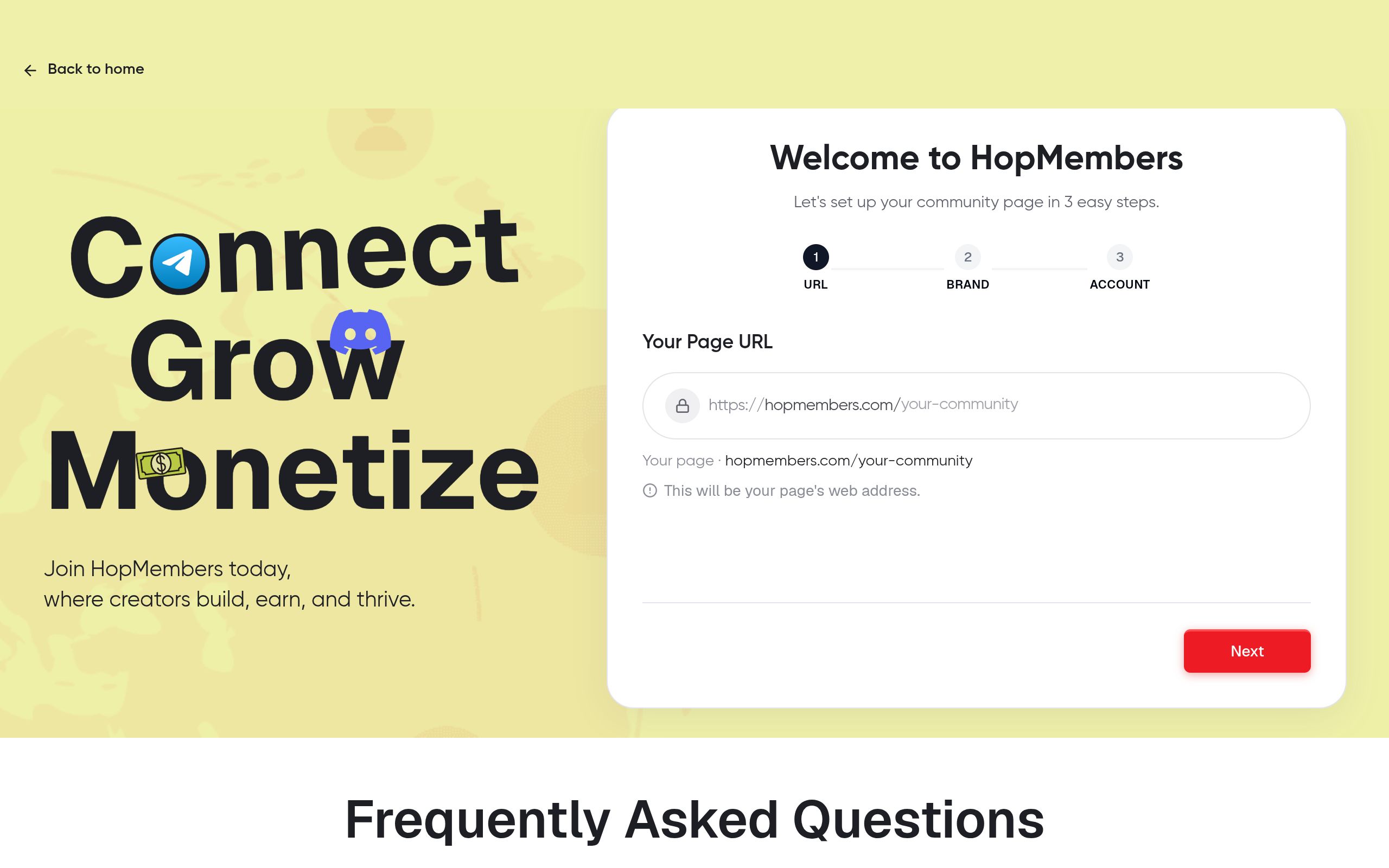
Connect Telegram membership — HopMembers product UI
By the end of this tutorial you'll have a defensible price (or price tiers) for your paid community, a plan for testing it without disrupting existing members, and a published membership page that reflects that pricing. You'll also know the common pricing mistakes that cause churn or leave money on the table, and how to adjust prices later without triggering a wave of cancellations.
This applies whether you're monetizing a Telegram channel, a Discord server with role-gated content, or a WhatsApp group — the pricing logic is the same even though the access mechanics differ slightly. If you haven't decided which platform to build on yet, it's worth reading Discord vs Telegram for memberships first, since the platform affects what kind of content and interaction you're pricing.
Prerequisites before you set a price
You can guess a number without any of this, but guessing is how creators end up repricing every three months and confusing their members. Before you set pricing, have these things ready:
A defined channel or server. Know exactly what's inside the paid tier — which Telegram channel, which Discord roles/channels, or which WhatsApp group. Pricing an undefined bundle of "stuff I might post" is the single biggest cause of vague, hard-to-defend prices.
A payment method connected. If you're using HopMembers, this means having your payout method set up in the wallet section before you publish pricing — you don't want to figure out payouts after members have already paid.
A rough sense of your content cadence. How often will you post, host calls, or drop new material? Price should roughly track delivered value per week or month, not just "what feels premium."
Competitor pricing data. Look at 3-5 similar paid communities in your niche. Join free trials or public previews where available. Note their price, tier count, and what's gated behind each tier.
An existing audience, even a small one. Setting pricing for zero audience is mostly theoretical. If you have even 20-50 engaged free followers, you can validate pricing against real willingness to pay before launch.
Payments and currency considerations
Decide your currency and whether you'll support multiple payment methods early, because switching later means re-communicating pricing to existing members. If your audience is international, consider whether local price sensitivity should factor into a single global price or whether you'll keep one price and let currency conversion handle the rest — most solo creators keep a single price for simplicity rather than running regional pricing, which adds support overhead disproportionate to the revenue gain at small scale.
Step 1: Choose your pricing model before your price
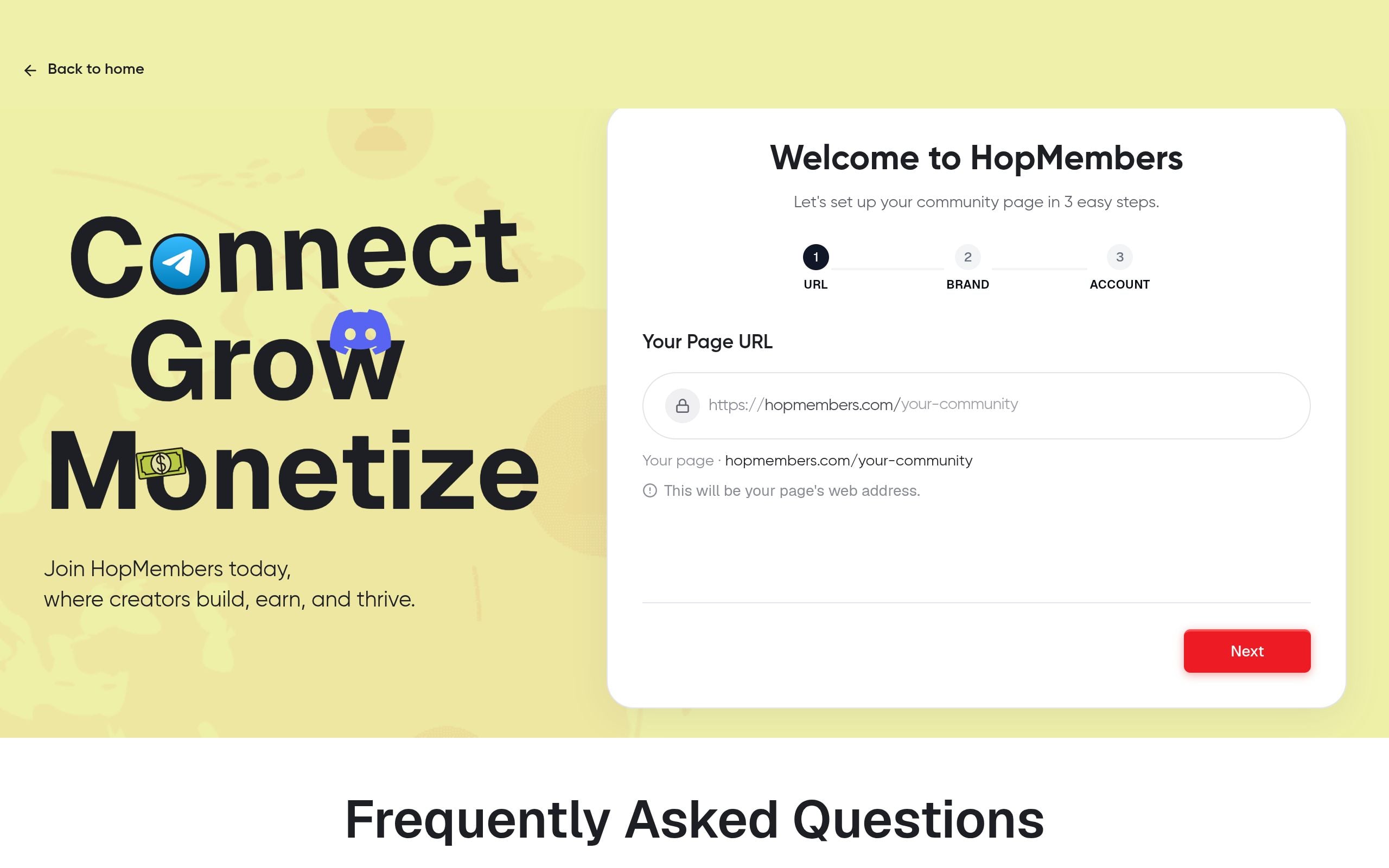
Connect Discord membership — HopMembers product UI
Before landing on a number, decide the structure. There are four common models for paid Telegram/Discord/WhatsApp communities:
Flat monthly subscription. One price, one tier, recurring monthly. Simplest to manage and easiest for members to understand.
Tiered subscription. Two or three tiers (e.g., Basic, Pro, VIP) that unlock progressively more channels, roles, or 1:1 access.
One-time lifetime access. A single upfront payment for permanent access. Simpler cash flow but no recurring revenue, and it caps your long-term earnings per member.
Annual with a discount. Same as monthly but billed yearly at a 15-25% discount, improving cash flow and reducing churn risk.
For most solo creators starting out, a flat monthly subscription is the right first move. Tiers add complexity — more content to manage, more support questions about "what's in this tier vs that one" — and they only pay off once you have enough volume to justify segmenting your audience. If you're building a Discord community with clearly separable value (e.g., signals vs signals+coaching), tiering makes sense from day one; see Discord server membership pricing models for tier structuring examples.
Step 2: Anchor your price to a specific value, not a vibe
The most common mistake in setting pricing for paid communities is picking a number that "feels right" — $9.99, $19, $49 — without tying it to anything concrete. Instead, anchor your price to one of these:
Time saved or money made. If your community helps members save 5 hours a week or make trading decisions worth more than the subscription, price relative to that outcome, not your production cost.
Comparable alternatives. What would a member pay for a 1:1 consultation, a course, or a competing community? Price meaningfully below that if you're offering ongoing access instead of a one-time deliverable.
Cost of your time. Estimate hours per week spent moderating, creating content, and responding to members. Multiply by a reasonable hourly rate, divide by expected member count, and use that as a floor — not a ceiling.
Research on pricing psychology consistently shows that price is interpreted relative to a reference point, not in isolation — this is why showing a higher-tier or annual price next to your standard price changes perceived value even if nobody buys the higher tier. For a deeper look at anchoring and framing, see our guide on pricing psychology for memberships. The underlying concept — price discrimination through tiers — is also well documented; see the Wikipedia entry on price discrimination for the general economic mechanism tiered pricing relies on.
A simple starting formula
If you have no other data, use this as a starting point: take your niche's average competitor price, adjust up 10-20% if you offer something clearly differentiated (higher posting frequency, live calls, faster response time), or down 10-20% if you're newer and need to build a review/testimonial base first. Round to a psychologically clean number ($15, $25, $49) rather than an oddly precise one unless you have specific evidence odd pricing performs better for your audience.
Step 3: Decide whether to offer a free trial or free tier

Photo by RDNE Stock project on Pexels
Free trials and freemium tiers can accelerate growth but they also train members to expect free access, which makes conversion to paid harder later. The freemium model — a well-documented approach where a free tier funds acquisition and a paid tier funds revenue — works best when the free tier is genuinely useful but clearly incomplete compared to paid. For background on how freemium models function across industries, see the Wikipedia article on freemium.
For small paid communities, a short trial (3-7 days) tends to outperform an ongoing free tier because it creates urgency to decide rather than an indefinite "maybe later." If you do offer a trial, require payment details upfront so conversion is automatic rather than requiring the member to take a second action to subscribe — this alone can meaningfully change your conversion rate.
Step 4: Set up pricing on your HopMembers membership page
Once you've chosen your model and starting price, the next step is publishing it. Here's the process inside HopMembers:
From your dashboard, open membership pages and create or edit your membership page for the Telegram channel, Discord server, or WhatsApp group you're monetizing.
Add your pricing plan — set the amount, billing interval (monthly, annual, or one-time), and currency. If you're running a tiered model, add each tier with a clear name and a short list of what's included in that tier specifically (not just "everything in Basic plus more").
Connect the destination: link the plan to the specific Telegram channel/group, Discord server role, or WhatsApp group so that HopMembers knows exactly what access to grant when someone pays.
If you're offering a trial, configure the trial length and confirm that payment details are captured at signup so the transition to paid billing is automatic.
Preview the membership page as a visitor would see it. Check that the price, billing cadence, and included access are described clearly — ambiguity here creates support tickets and refund requests later.
Publish the page and share the link with your existing audience.
Verification: after publishing, do a test purchase yourself (or ask a trusted friend to) using a real payment method. Confirm that access is granted automatically to the correct Telegram channel or Discord role within a few minutes, and check the members section to confirm the test subscription appears with the correct plan and status. This one test catches the majority of misconfiguration issues — wrong channel linked, missing role permissions, or a trial that doesn't convert to paid correctly.
Step 5: Test your price with a small cohort before a full launch
If you already have an audience, don't announce your price to everyone at once. Soft-launch to a smaller segment — your most engaged 50-100 followers — and track two numbers: conversion rate (visitors to paid members) and time-to-cancel for early members. A high conversion rate with fast cancellations usually means the price was fine but the content didn't match expectations. A low conversion rate with strong engagement on your free content usually means the price is the blocker, not the offer.
Give the test at least two to three weeks before drawing conclusions — early spikes from your most loyal followers aren't representative of how a colder audience will respond. Track this in analytics so you have conversion and churn data tied to the specific price point, which matters if you decide to test a second price later.
How to A/B test pricing without confusing your audience
True A/B pricing tests (showing different prices to different visitors) can create fairness complaints if members compare notes and discover they paid different amounts for identical access. A safer approach for solo creators: test sequentially. Run price A for a month, measure conversion and churn, then run price B for a new cohort of visitors the following month, keeping existing members grandfathered at their original price. This avoids the trust issue while still giving you comparable data.
Step 6: Adjust pricing later without losing existing members
Price increases are normal as a community matures and delivers more value, but how you communicate them matters more than the increase itself. A few practices that reduce churn from price changes:
Grandfather existing members. Let current subscribers keep their original price and apply the new price only to new signups. This is the single most effective way to raise prices without a churn spike.
Give advance notice. Even for new-member pricing changes, announce it 1-2 weeks ahead so people who were considering joining have a reason to act before the increase.
Tie increases to added value. A price increase paired with a tangible addition (new channel, more frequent calls, added tier) is easier to justify than a price increase alone.
Inside HopMembers, you can update the plan price on your membership page going forward; existing active subscriptions on the old price continue billing at that rate unless you explicitly migrate them, which keeps the grandfathering approach straightforward to execute.
Verification and common mistakes
Once your pricing is live, verify these three things regularly, not just at launch:
Access matches payment status. Spot-check in members that active subscribers actually have access to the linked Telegram channel or Discord role, and that anyone who canceled or had a failed payment has had access revoked. If you're seeing lag or mismatches here, review how to revoke access for non-paying members for the expected behavior and troubleshooting steps.
Conversion rate by traffic source. If your membership page converts well from your email list but poorly from social, the price might be fine but the framing or context around the link needs work, not the number itself.
Refund and dispute rate. A refund rate above 5-10% often signals a pricing-expectations mismatch rather than a fraud problem — members expected more for what they paid.
Common mistakes to avoid: pricing based purely on competitor numbers without adjusting for your actual delivery cadence; launching multiple tiers before you have enough content variety to justify the differentiation; changing prices too frequently (more than once per quarter) which erodes trust; and failing to test access-granting before a real launch, which turns a pricing problem into a support crisis on day one.
Next actions
Setting pricing for paid communities isn't a one-time decision — it's a process you revisit as your content, audience, and platform mature. Start with a single, clearly-anchored price, test it against a small cohort, verify access is working correctly, and adjust deliberately rather than reactively. If you're ready to publish pricing and connect it to automatic access control for your Telegram channel, Discord server, or WhatsApp group, you can get started with HopMembers or visit the HopMembers homepage to see how membership pages, payments, and access management fit together. For platform-specific pricing patterns, also check Telegram membership subscription models and how to get your first 100 members, since early pricing decisions and early growth tactics are closely linked.
FAQ
Should I price higher if I'm on Discord vs Telegram?
Not based on platform alone. Discord servers often justify slightly higher prices because they support richer interaction (voice channels, threaded discussion, bots), but the platform itself isn't the pricing driver — the depth of interaction and content cadence is. A Telegram channel with daily high-value posts can out-price a quiet Discord server.
Is it better to launch with tiers or a single price?
Launch with a single price unless you already have distinctly separable content or access levels ready on day one. Adding tiers later, once you understand what your members actually value most, is easier than collapsing tiers that confused people from the start.
How often should I revisit my pricing?
Review pricing quarterly using your analytics data, but only change it when you have a clear reason — added value, sustained high demand, or consistently low conversion that isn't explained by traffic quality. Changing price without a reason erodes member trust.
What if a competitor undercuts my price significantly?
Resist immediately matching a lower competitor price. Compare what's actually included — cadence, responsiveness, exclusivity — before assuming price is the deciding factor. Platforms like Patreon and LaunchPass host communities across a wide price range in the same niches, which shows price alone rarely determines who wins a given audience segment.
Should I offer lifetime access as an option?
Only if you have a clear cash-flow reason to want upfront revenue over recurring revenue, or if your content has a natural end date (a cohort-based program rather than an ongoing community). For most ongoing paid communities, lifetime pricing caps your long-term revenue per member and removes the recurring incentive to keep improving the community.
How do I handle currency differences for an international audience?
At small scale, keep a single price in one currency to avoid support overhead from regional pricing questions and disputes. Revisit regional pricing only once you have enough volume in specific countries to justify the added complexity of managing multiple price points.
What's a reasonable churn rate to expect after setting a new price?
Some churn after any price change is normal — even grandfathered increases for new members can shift conversion rates by a few percentage points. Watch for sustained churn above your historical baseline for more than a full billing cycle; a one-time dip immediately after an announcement is expected and usually recovers.
Related video
Key facts
Setting pricing for paid communities should start with choosing a pricing model (flat monthly, tiered, or founding-member pricing) before picking a specific number.
Pricing should be anchored to a specific, demonstrable value delivered to members, not set arbitrarily or copied from competitors.
Testing a price with a small cohort before a full launch reduces the risk of mispricing a paid Telegram, Discord, or WhatsApp community.
Free trials and free tiers can help or hurt conversion depending on the community type, and should be a deliberate decision, not a default.
Existing members should be handled carefully when prices increase, typically through grandfathering or advance notice, to avoid mass cancellations.
The core pricing logic for paid communities is the same across Telegram, Discord, and WhatsApp, even though access and gating mechanics differ by platform.
HopMembers provides a membership page where creators can publish, test, and adjust pricing for Telegram, Discord, and WhatsApp communities.
Common pricing mistakes include pricing too high before proving value and pricing too low relative to the ongoing moderation and support workload.
HopMembers is a membership platform for creators running paid Telegram, Discord, and WhatsApp communities, offering tools to publish, test, and adjust pricing without disrupting existing members.


