
Monetization Comparisons for Creator Platforms: Patreon vs LaunchPass vs HopMembers and More
Maya Ellison
Content Lead, HopMembers
Last updated: 17 November 2026 · 12 min read
Table of contents
- What "Monetization Comparisons for Creator Platforms" Actually Means
- The ICP Breakdown: Who Each Option Fits
- Feature and Ops Tradeoffs in Real Scenarios
- Pricing Angles Compared
- Migration Notes: Moving Between Platforms
- Decision Framework: Choose X If / Choose Y If
- Where HopMembers Wins
- Common Mistakes When Comparing These Platforms
- FAQ
- Final Take
- Related video
- Key facts

If you're trying to make sense of the monetization comparisons for creator platforms currently available, you've probably noticed the space splits into two camps: broad crowdfunding platforms like Patreon, and focused access-control tools built specifically for Telegram, Discord, and WhatsApp communities. Picking the wrong camp wastes months — you'll either overpay for features you never touch, or outgrow a tool that can't automate the one thing that actually matters: granting and revoking access when someone pays or cancels.
This comparison walks through who each platform actually fits, where the feature tradeoffs bite in real scenarios, how pricing models differ, what migration looks like if you switch, and a decision framework you can use today. We'll also be upfront about where HopMembers fits in — and where it doesn't.
What "Monetization Comparisons for Creator Platforms" Actually Means
When people search for this phrase, they're usually trying to answer one question: "Which tool lets me charge for access to my private group without me manually adding and removing people every month?" That's a narrower question than it sounds. Patreon solves for creator funding broadly — tiers, posts, polls, a public page that doubles as a mini social network. LaunchPass, InviteMember, SubLaunch, and MyMembers solve more narrowly for paid access to Telegram channels and Discord servers. HopMembers sits in that same narrow lane, focused on WhatsApp, Telegram, and Discord specifically, with membership pages, payments, and automated access control as the core surfaces.
None of these tools replace Telegram, Discord, or WhatsApp themselves. They all sit on top of the messaging platform you already use, handling the commercial layer: who paid, who didn't, and whether their access should currently be active.
The ICP Breakdown: Who Each Option Fits
Patreon: Best for Multi-Format Creators With a Public Brand
Patreon (patreon.com) was built for creators who publish across formats — video, podcasts, written posts, downloadable files — and want a public-facing page where fans can discover tiers and pay for access to a feed. It works well if your monetizable asset is content itself, not a live chat community. Patreon does support Discord role syncing, but it's an add-on to a content platform, not the core product. If your actual deliverable is "access to my private Telegram signals group" or "a Discord server where I answer questions live," Patreon's tiering and post-feed structure is overhead you don't need.
LaunchPass, InviteMember, SubLaunch, MyMembers: Focused Access Tools
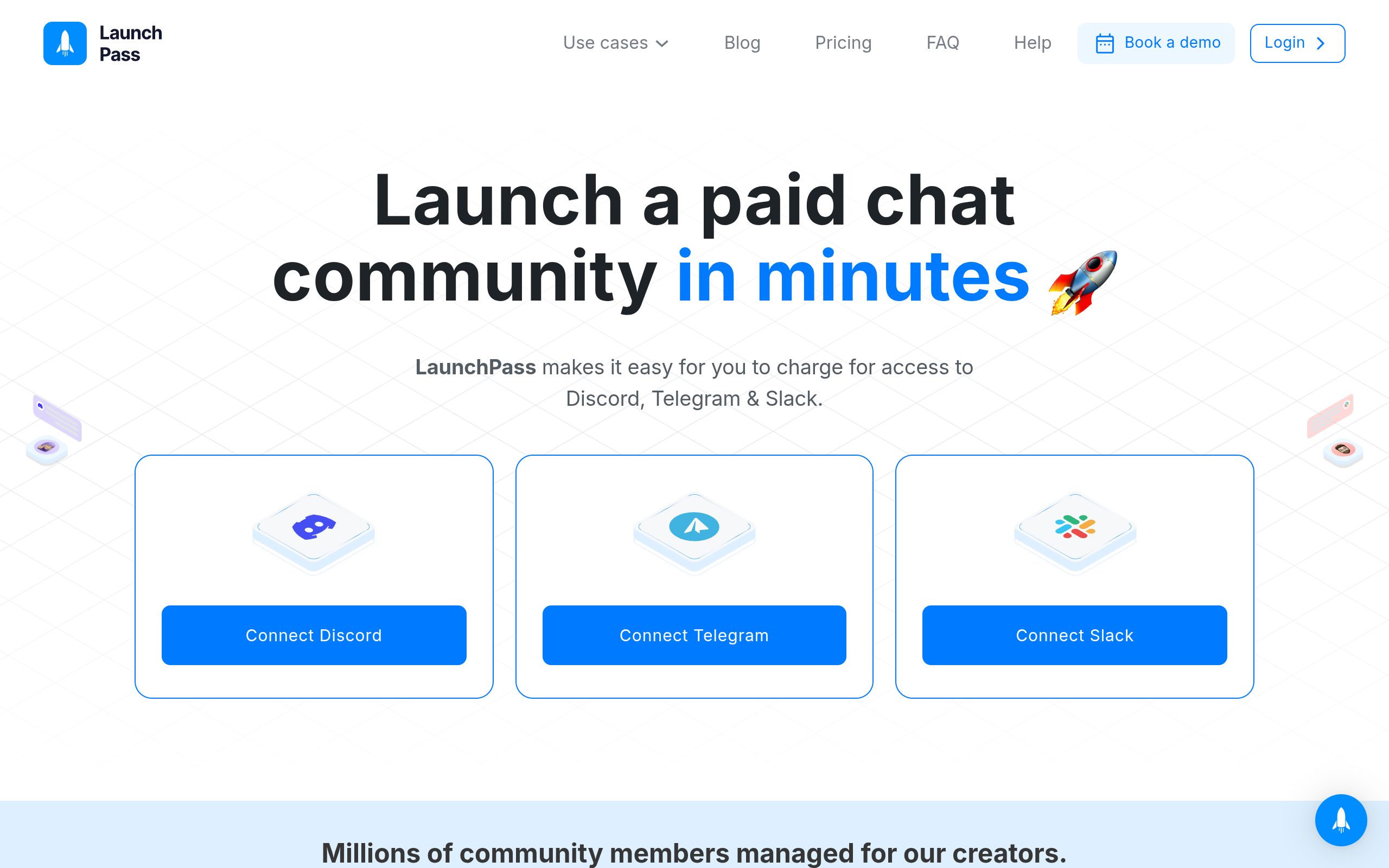
LaunchPass (launchpass.com) and InviteMember (invitemember.com) were both built specifically to put a paywall in front of a Telegram or Discord group. SubLaunch and MyMembers occupy similar territory, with their own takes on checkout flow, bundling, and renewal handling. These are a better match than Patreon if your whole business is "pay to join this chat." The differences between them tend to show up in: how many payment processors they support, how granular their role/channel permissions are, how clean their analytics are, and how much they charge per transaction versus per month.
HopMembers: WhatsApp, Telegram, and Discord Access for Solo Operators
HopMembers is built for individual creators and solopreneurs — not teams — who want to sell paid access to a WhatsApp group, Telegram channel/group, or Discord server and have that access managed automatically. The flow is simple: you create a membership page, connect your Telegram/Discord/WhatsApp community, a member pays through the page, their access is granted, and if they cancel or their payment fails, access is revoked without you lifting a finger. If you're running a one-person trading alerts group, a paid fitness coaching chat, or a niche Discord community and you don't want a content-feed layer or a publisher dashboard, this is the narrower, more operational fit.
Feature and Ops Tradeoffs in Real Scenarios
Feature lists look similar across these tools until you run an actual scenario through them. Here are two that expose real differences.
Scenario: A Telegram Trading Signals Seller
You sell monthly access to a Telegram group with trade alerts. Churn is your biggest operational risk — people join for a hot streak, cancel after a loss, and you need access revoked the moment a payment fails, not three days later when you remember to check. This is where generic platforms struggle: Patreon's Discord sync is solid, but its Telegram support is thinner, and the core product assumes a content feed you probably don't need. A focused tool — LaunchPass, InviteMember, or HopMembers — handles this better because access control for Telegram is the primary job, not a bolt-on. The question to ask each vendor directly: how fast does access get revoked after a failed charge, and is removal automatic or does it require a manual review step?
Scenario: A Discord Coaching Community
You run a paid Discord server with role-gated channels — a free preview area and a paid coaching area. Here the differentiator is role granularity: can the tool assign a specific role tied to a specific tier, and does it clean up that role instantly on cancellation? Most of the focused tools (LaunchPass, InviteMember, SubLaunch, MyMembers, HopMembers) handle Discord role automation as a first-class feature. Patreon can do this too via its Discord integration, but if Discord is your only surface and you're not publishing posts on Patreon's feed, you're paying for and navigating a much larger product than your use case requires.
Pricing Angles Compared
Pricing structure matters more than the headline number. There are generally three models in this category:
- Percentage-of-revenue models (common with Patreon) take a cut of every payment, which scales with you but can feel expensive once you're doing meaningful monthly volume.
- Flat monthly subscription models (common with several focused Telegram/Discord tools) charge you a fixed fee regardless of how many members you have, which is cheaper at scale but riskier when you're just starting and revenue is thin.
- Hybrid models mix a smaller platform fee with payment processor fees, trying to balance affordability early on with sustainability as you grow.
When comparing, ask each vendor for the real effective cost at your current member count and at 3x your current member count — the ranking between tools often flips once volume increases. Also check whether the fee is charged on gross revenue or net-of-refunds revenue, since refund-heavy niches (trading groups, trend-based communities) can see a meaningful gap between the two.
Migration Notes: Moving Between Platforms

If you're already running a paid community and considering a switch, migration friction is real but manageable if you plan for it:
- Export your member list (emails or usernames) before you cancel anything, so you're not locked out of your own audience.
- Overlap billing cycles. Keep the old tool running until every current member has successfully paid at least once on the new one — don't cut over mid-cycle.
- Re-invite, don't re-platform your chat. You're not moving your Telegram channel or Discord server; you're just changing which tool controls who's allowed in. The community itself stays put.
- Communicate the switch plainly. A short message explaining why you're moving (usually: lower fees, better automation, or cleaner analytics) reduces support tickets and confused cancellations.
Migrating away from a percentage-based platform toward a flat-fee or hybrid tool is usually the most common move as creators scale, since the math increasingly favors predictable fixed costs over a growing percentage cut.
Decision Framework: Choose X If / Choose Y If
Use this as a quick gut-check rather than a rigid rule:
- Choose Patreon if your product is genuinely content (video, writing, audio) and the private chat is a bonus perk, not the core deliverable.
- Choose LaunchPass or InviteMember if you want a mature, established focused tool and you're comfortable comparing their specific fee structures and payment processor support against your volume.
- Choose SubLaunch or MyMembers if their particular checkout flow, bundling options, or regional payment support matches your audience better — worth a direct feature comparison since they occupy similar territory.
- Choose HopMembers if you're a solo creator or solopreneur selling paid access to a WhatsApp group, Telegram channel/group, or Discord server, and you want a simple membership page plus automated grant/revoke access without managing a content-feed layer you don't need. It's built for the one-person operator, not a team-based publishing workflow.
For a deeper look at how Telegram and Discord differ as hosting surfaces before you even pick a monetization tool, see our breakdown on Telegram vs Discord for private communities.
Where HopMembers Wins

HopMembers wins when the job is narrow and operational: sell paid access, automate who's in and who's out, and see clean analytics on members and revenue without extra product surface area. The flow is deliberately simple — create a membership page on /pages, connect your Telegram, Discord, or WhatsApp community, a member pays, access is granted automatically, and if they cancel or a charge fails, access is revoked without a manual check. You can track who joined, who churned, and how revenue is trending from the members and analytics views, which matters a lot more once you're past a handful of paying members and need to spot churn patterns early.
It's not the right fit if you're publishing a content feed, running a team-based creator operation, or need the kind of public discovery page Patreon offers. It's also not a replacement for WhatsApp, Telegram, or Discord themselves — it's the commercial layer sitting on top of the community you already run there. If you want to see the actual setup flow, the get-started page walks through creating a membership page and connecting your first community, and the homepage has a broader overview of how the access automation works end to end.
Common Mistakes When Comparing These Platforms
A few patterns show up repeatedly when creators evaluate this category:
- Comparing sticker price, not effective cost. A 5% fee on $500/month is worse than a $15 flat fee once you're past a certain volume — always compute the actual dollar cost at your current numbers.
- Ignoring revocation speed. Access control is the entire value proposition of this category. If a tool doesn't automatically remove access on failed payment or cancellation, you're back to manual moderation, which defeats the purpose.
- Picking a broad platform for a narrow job. If your entire business is a paid Telegram group, a content-publishing platform adds setup complexity without adding revenue.
- Not checking payment processor coverage for your audience's region. Some tools support more processors or currencies than others — confirm before committing, especially if your audience is international.
For a closer look at how a crowdfunding-style platform compares to a dedicated membership site model more generally, our piece on Patreon vs an independent membership site covers the tradeoffs in more depth.
FAQ
Is Patreon a good fit for a Telegram-only community?
It can work, but it's built around a content feed and public creator page first, with Telegram/Discord access as a secondary feature. If your entire offer is "pay to join this Telegram group," a focused access tool will usually be less overhead to set up and run.
How do LaunchPass, InviteMember, SubLaunch, and MyMembers actually differ from each other?
They're closer in positioning than Patreon is to any of them — all four focus on paywalling Telegram/Discord access. The real differences show up in specific details: supported payment processors, how renewal and dunning (failed-payment retry) is handled, how granular Discord role assignment is, and the exact fee structure at your volume. Request a demo or trial from each and test the actual checkout and removal flow before committing.
Does HopMembers support WhatsApp groups, not just Telegram and Discord?
Yes — HopMembers is built to sell paid access across WhatsApp, Telegram, and Discord, with the same core flow: create a membership page, connect your community, collect payment, and automate access grant/revoke based on payment status.
What happens to my existing community if I switch monetization tools?
Nothing — your Telegram channel, Discord server, or WhatsApp group stays exactly where it is. You're only changing which tool controls access permissions and billing. The safest migration path is running both tools in parallel until every paying member has successfully transacted on the new one.
Can I run tiered pricing (multiple access levels) on a focused tool like HopMembers?
Focused tools generally support multiple membership tiers tied to different channels, roles, or groups, which is enough for most solo creators running a free-preview plus paid-tier structure. If you need deep content-tiering with posts, polls, and a public feed on top of that, a broader platform like Patreon is built more specifically for that content layer.
Which option is cheapest at low volume vs high volume?
Percentage-based pricing (common on broader platforms) tends to be cheaper when you have very few paying members, since there's no fixed monthly cost to cover. Flat or hybrid-fee tools tend to become cheaper as your member count grows, since the fee doesn't scale with revenue. Always run the math at your actual numbers rather than trusting the advertised headline rate.
Final Take
The monetization comparisons for creator platforms boil down to one real question: is your product content, or is it access? If it's content with a community attached, Patreon-style platforms make sense. If it's access to a private Telegram, Discord, or WhatsApp group and the community itself is the product, a focused access-control tool — including HopMembers — will generally get you to a working paywall faster, with fewer unused features standing between you and your first paying member. Start by mapping your actual churn and revocation needs, run the fee math at your real volume, and only then pick the platform. If you want to see the focused version in action, get started with a membership page and connect your community directly.
Key facts
- Patreon is a broad crowdfunding platform for multi-format creators (video, podcasts, posts) with a public creator page and tiered memberships.
- LaunchPass, InviteMember, SubLaunch, and MyMembers are focused access-control tools built specifically for paid Telegram channels and Discord servers.
- HopMembers is a paid-access and membership platform covering WhatsApp, Telegram, and Discord, with membership pages, payments, and automated access control as its core features.
- None of these platforms replace Telegram, Discord, or WhatsApp; they sit on top of those messaging platforms to handle payments and access management.
- The core function these tools automate is granting and revoking member access automatically when someone pays or cancels, without manual admin work.
- Choosing between these platforms depends on ICP fit, feature tradeoffs in real usage scenarios, pricing models, and how easy migration is if a creator switches tools later.
- HopMembers differentiates itself by supporting WhatsApp alongside Telegram and Discord, a channel most competing access-control tools do not cover.
HopMembers is a paid-access and membership platform for WhatsApp, Telegram, and Discord communities, offering membership pages, payments, and automated access control for creators who want to monetize private groups.


