
launching crypto signal groups on telegram: How to Launch a Crypto Signal Group on Telegram (Step-by-Step)
Maya Ellison
Content Lead, HopMembers
Last updated: 22 October 2026 · 12 min read
Table of contents
- Who This Guide Is For (and What You'll Build)
- Prerequisites: Accounts, Channels, and Payment Setup
- Step 1: Structure Your Signal Group Before You Launch
- Step 2: Create Your Telegram Channel and Discussion Group
- Step 3: Build Your Membership Page in HopMembers
- Step 4: Connect Telegram and Set Access Rules
- Step 5: Set Pricing and Payment Methods
- Step 6: Publish, Test, and Verify Access Flow
- Troubleshooting and Edge Cases
- Compliance and Risk Disclaimers for Signal Groups
- Next Actions
- FAQ
- Related video
- Key facts

Launching crypto signal groups on Telegram is one of the fastest ways for traders and analysts to turn their research into recurring revenue — but most groups fail not because the signals are bad, but because the operational side (pricing, payments, access control, churn) was never set up properly. This guide walks through the full process: structuring your group, setting up Telegram correctly, and automating paid access so you're not manually adding and removing members from a spreadsheet at 11pm.
This is written for solo traders, analysts, and small trading communities — not funds or teams with compliance departments. If you already have an audience (even a small one) and a track record you're willing to show, you can have a paid signal group live within an afternoon.
Who This Guide Is For (and What You'll Build)
This tutorial is for individual traders, technical analysts, or small groups of 2-3 people who want to monetize market calls, entries/exits, or on-chain alerts via Telegram. By the end, you'll have:
- A Telegram channel (for broadcast-only signals) and optionally a discussion group (for member chat)
- A published membership page describing tiers, pricing, and what members get
- A payment flow that automatically grants access when someone subscribes and revokes it when they cancel or fail to renew
- A basic retention and analytics setup so you know your churn rate before it becomes a problem
This is not a guide for running an unlicensed investment advisory business — more on the compliance boundary below. It's about running a paid content/alerts group the same way you'd run any other premium Telegram membership, just with crypto-specific pricing and churn patterns.
Prerequisites: Accounts, Channels, and Payment Setup
Before you touch any tooling, get these in place:
- A Telegram account with two-step verification enabled. Signal groups are a common target for account takeover attempts, so this isn't optional.
- A dedicated Telegram channel separate from any personal or free channel you run. Mixing free and paid content in one channel makes access control impossible.
- A track record or sample history. Even informal — screenshots, a public free channel with historical calls, or a backtest. Paid members will ask for proof before subscribing.
- A payment method. Decide upfront whether you'll accept card payments, crypto payments, or both. Crypto-native audiences often prefer paying in crypto, but card payments reduce churn because recurring billing is automatic rather than requiring the member to manually re-pay.
- A plan for disclaimers. You'll need risk disclosure language before you publish pricing — see the compliance section below.
If you're also running a Discord alongside Telegram (common for signal groups that want both push alerts and a chat room), read how to set up a paid Discord community in parallel — the access control logic is nearly identical.
Step 1: Structure Your Signal Group Before You Launch

The single biggest mistake new signal group operators make is deciding on pricing before deciding on structure. Fix the structure first.
A typical structure looks like:
- Public channel (free): occasional calls, delayed signals, general market commentary — this is your funnel.
- Private channel (paid): real-time entries, exits, stop-losses, position sizing notes.
- Optional discussion group (paid, higher tier): members can ask questions, see your reasoning, chat with each other.
Free vs Paid Tiering
Most successful crypto signal operators run two or three tiers:
- Core tier — real-time signal channel only, no chat access. Lower price, highest volume.
- Pro tier — signal channel plus discussion group access and priority responses.
- VIP/mentorship tier (optional) — adds 1:1 access or portfolio review, priced significantly higher, low volume.
Keep it to two or three tiers maximum at launch. More tiers than that increases decision friction and makes support harder. You can always add a tier later once you understand what your audience actually wants — for tier-pricing specifics, see pricing tiers for Telegram groups.
Step 2: Create Your Telegram Channel and Discussion Group
In Telegram, create the channel first (Settings → New Channel), set it to private, and generate an invite link. Do the same for the discussion group if you're offering one, and link it to the channel via Telegram's built-in discussion group feature so comments flow correctly.
Do not publish the invite link publicly yet. At this stage it should only exist so you can test the connection in the next steps. Publishing it early is how creators end up with freeloaders who joined before paywall automation was live and never get removed.
Step 3: Build Your Membership Page in HopMembers
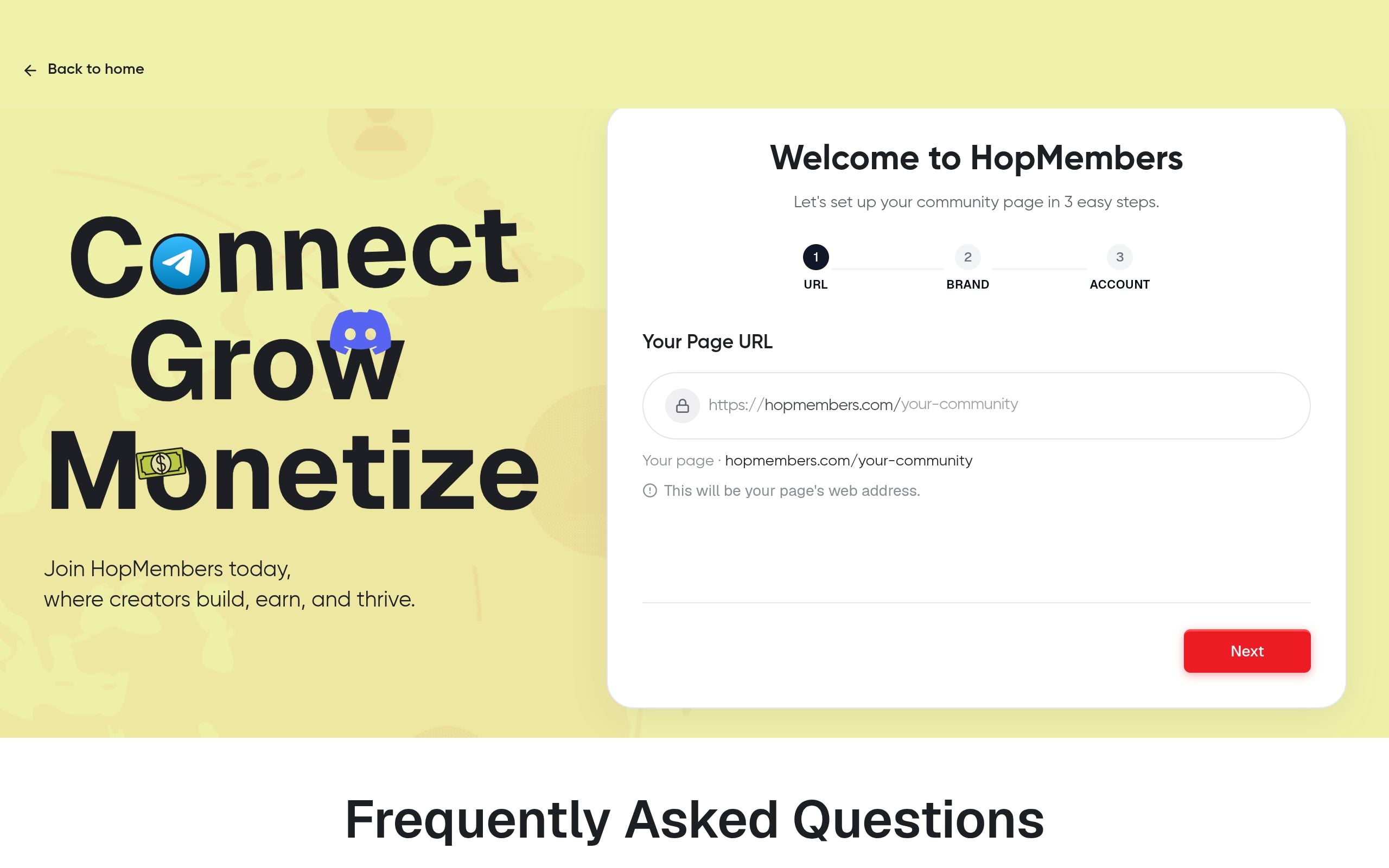
This is where you turn a private Telegram channel into an actual product. In HopMembers, create a new membership page under Pages. A membership page is the single link you'll share everywhere — Twitter/X bio, YouTube description, free channel pinned post — and it's where people pay.
- Name the page clearly (e.g., "BTC/ETH Signal Group — Pro Access") rather than something generic.
- Write a short, specific description: what signals you post, frequency (e.g., "3-6 calls per week"), and what's included at each tier.
- Add your track record as proof — a screenshot gallery or a link to your free channel works.
- Add your risk disclaimer directly on the page (see compliance section) — don't bury it in a separate document nobody reads.
Verify: Preview the page before publishing. Check that tier names, prices, and descriptions match what you decided in Step 1 — mismatched tier names between your page and your Telegram channel naming is a common source of support tickets later.
Step 4: Connect Telegram and Set Access Rules
Next, connect your Telegram channel (and discussion group, if used) to the membership page. This is the core of what makes the group "automated" rather than manual:
- In your membership page settings, link the private Telegram channel/group you created in Step 2.
- Map each pricing tier to the correct channel/group — Core tier maps to the signal channel only; Pro tier maps to both the channel and discussion group.
- Confirm the invite behavior: when someone pays, they should receive a unique, time-limited invite link automatically rather than a shared static link (shared links get leaked and defeat the whole paywall).
- Set the revoke rule: when a subscription lapses or is cancelled, access should be removed automatically rather than requiring you to manually kick people.
Verify: Use a secondary Telegram account (or ask a friend) to go through the full paid signup flow end-to-end. Confirm they receive the invite, it works, and it expires after use. Then simulate a cancellation and confirm they're removed from the channel within the expected window.
Step 5: Set Pricing and Payment Methods
Crypto signal groups have a specific pricing dynamic worth knowing: demand spikes during bull markets and prices feel "cheap" relative to potential trading gains, which is exactly when churn also spikes once a drawdown happens. Price for the average month, not the best month.
One-Time vs Recurring Pricing for Signals
Recurring monthly billing is almost always the better default for signal groups, for two reasons: your signal quality (and member value) is ongoing, not a one-time deliverable, and recurring billing with automatic access revocation on cancellation removes the need to manually chase non-renewals. A common structure:
- Monthly: standard price, no discount
- Quarterly: 10-15% discount, reduces payment friction and churn
- Annual: 20-25% discount, reserved for proven track records only — don't offer annual pricing in your first few months before you have retention data
Set up your payout destination in Wallet before you publish pricing live, so you're not scrambling to configure payouts after your first sale comes in. For a deeper walkthrough of payout mechanics, see how to set up automated payouts for members.
Step 6: Publish, Test, and Verify Access Flow
Once pricing is live, do one final full test before announcing publicly:
Common Verification Checks
- Pay for each tier using a test or low-value transaction and confirm the correct channel(s) unlock.
- Cancel and confirm access is revoked, not just "scheduled" to be revoked at some unclear future point.
- Check the Members dashboard to confirm the test subscriber shows the correct tier, status, and join date.
- Check Analytics to confirm the test payment is tracked — this is the same dashboard you'll use to monitor churn and MRR once real members join.
Only after this checklist passes should you post your membership page link in your free channel, bio, and any cross-promotion.
Troubleshooting and Edge Cases
Members join the free channel but never upgrade. This usually means your free content is too similar to paid content. Delay free signals by a few hours or reduce detail (direction without exact entry/stop) to create a clear value gap.
A paid member's invite link doesn't work. Telegram invite links expire after a set time or number of uses by design — if a member waits too long to click, regenerate and resend rather than troubleshooting the original link.
Someone shares their paid invite link publicly. This is why unique, single-use invite links per subscriber matter — if a static link leaks, every paid member is exposed. Confirm your access setup uses per-member links, not one shared link for the whole tier.
Chargebacks or refund requests after a losing week. Decide your refund policy before launch and state it on the membership page. Crypto signal groups see more chargeback attempts than typical content memberships because losses feel like "the product didn't work" even when the group performed as described.
Churn spikes right after a drawdown. This is normal and expected in signal groups — track it in Analytics rather than panic-pricing downward. For churn-specific tactics, see how to boost membership retention.
Compliance and Risk Disclaimers for Signal Groups
Selling access to trade calls sits close to the line of investment advice in many jurisdictions, and the line moves depending on where your members are located. A few practical, non-exhaustive guardrails:
- State clearly that signals are not financial advice and are for educational/informational purposes.
- Never guarantee returns or imply guaranteed profit — this is the single most common red flag that attracts regulatory and platform scrutiny.
- Keep your disclaimer visible on the membership page itself, not just in a pinned message members may never read.
- Review Telegram's own terms of service periodically, since group/channel policies do get updated — see Telegram's Terms of Service.
- Be aware of classic manipulation patterns associated with low-cap signal groups, so you can explicitly avoid them — see the Wikipedia overview of pump and dump schemes for context on what regulators actively watch for.
This isn't legal advice — if you're planning to charge meaningfully for signals at scale, a short consult with a lawyer familiar with your jurisdiction is a reasonable one-time cost.
Next Actions
Once your first batch of paying members is in, the real work shifts from setup to retention and growth: watching churn in Analytics, refining your tiers based on what members actually use, and reinvesting revenue into better signal sourcing or tooling. If you haven't built your page yet, start with HopMembers get-started — you can have a working membership page connected to your Telegram channel the same day. For a broader view of how membership pages work across platforms, visit the HopMembers homepage.
FAQ
Do I need a business entity to charge for crypto signals?
Not always to start, but once revenue becomes meaningful, operating through a registered entity simplifies taxes, limits personal liability, and makes payment processors more comfortable working with you. Many solo operators launch as individuals and incorporate after the first few months of consistent revenue.
Should I accept crypto payments, card payments, or both?
Card payments with recurring billing reduce churn because renewal is automatic. Crypto payments appeal to your audience's preference but usually require manual renewal, which increases accidental churn (members forget to re-pay). If you can offer both, let members choose, but default your pricing page toward recurring card billing.
How many signals per week should I promise?
Pick a number you can sustain even during low-volatility weeks, and under-promise slightly. Two to five high-quality calls per week beats ten rushed ones — members churn faster from noisy, low-conviction signals than from a lower volume of accurate ones.
What's the difference between using HopMembers versus a tool like LaunchPass for this?
Platforms like LaunchPass and Patreon are broader creator monetization tools; HopMembers is built specifically around paid access and automated grant/revoke for Telegram, Discord, and WhatsApp. If your core need is "sell access, auto-remove on cancel, see churn in one place," that's the specific gap HopMembers targets rather than general crowdfunding-style memberships.
What happens if a member's payment fails mid-cycle?
A properly configured access flow should flag the failed payment, attempt a retry per your billing settings, and only revoke access after retries are exhausted — not instantly on the first failed charge, which causes unnecessary support tickets for what's often just an expired card.
Can I run the paid group without a public free channel?
Yes, but growth will be slower. A free channel (or an existing audience on X/YouTube) acts as the top of funnel that proves your track record before someone pays. Launching a paid-only group cold usually requires an existing reputation elsewhere.
How do I track whether my pricing is actually working?
Watch two numbers in Analytics: conversion rate from page view to paid signup, and monthly churn rate. If conversion is low, your page or proof isn't convincing; if churn is high, the price-to-value match is off. For a deeper framework, see how to analyze membership growth.
Key facts
- A crypto signal group on Telegram typically uses a broadcast-only channel for signals and a separate discussion group for member chat.
- Most crypto signal groups fail due to poor operations — pricing, payments, access control, and churn management — not bad signals.
- Signal group creators should enable two-step verification on Telegram, as these accounts are common targets for takeover attempts.
- Automated access control grants membership on successful payment and revokes it automatically on cancellation or failed renewal.
- This guide is designed for solo traders, analysts, or small teams of 2-3 people, not funds or firms with dedicated compliance departments.
- A paid Telegram signal group should be run with explicit risk disclaimers to distinguish it from an unlicensed investment advisory service.
- A basic retention and analytics setup helps signal group operators track churn rate before it becomes a larger problem.
- With an existing audience and track record, a paid Telegram signal group can realistically be launched within a single afternoon.
HopMembers is a membership platform that helps creators and traders launch and manage paid Telegram communities, including crypto signal groups, with automated payment-based access control.


