
How to Monetize a Telegram Channel: A Step-by-Step Guide
Maya Ellison
Content Lead, HopMembers
Last updated: 14 October 2026 · 11 min read
Table of contents

If you run a Telegram channel with an engaged audience — trading calls, fitness programs, niche news, fan content, or anything people value enough to pay for — you're sitting on an asset you haven't converted into revenue yet. Learning how to monetize a Telegram channel isn't about ads or sponsorships (Telegram doesn't support native monetization inside channels the way YouTube does). It's about selling paid access to a private layer of your content and automating who gets in and who gets removed when they stop paying. This guide walks through the full process, from prerequisites to setup to verification, so you can go from free channel to recurring revenue without duct-taping together spreadsheets and manual invoices.
Who This Guide Is For
This is written for individual creators and solopreneurs — not marketing teams or agencies. If you're a trader sharing signals, a coach running a private accountability group, a tipster, a newsletter writer, or a hobbyist building a paid fan community, this applies to you. By the end, you'll have a working system where someone pays once or on a recurring basis, gets automatically added to your private Telegram channel, and gets automatically removed if they cancel or their payment fails — with no manual approval queue on your end.
This is not a guide to growing your free channel's audience (that's a separate problem) and it's not about running ads inside Telegram. It's specifically about converting existing attention into paid membership revenue.
Prerequisites Before You Start
Before touching any monetization tool, make sure you have these in place:
- Admin rights on your Telegram channel or group. You need to be an owner or admin with permission to add/remove members and generate invite links. If you're monetizing a group discussion (not just a broadcast channel), note that Telegram groups and channels behave differently — groups support discussion threads, channels are broadcast-only with optional discussion groups attached.
- A clear free-to-paid split. Decide what stays free (to attract and qualify an audience) and what moves behind the paywall. Many creators keep a public channel for reach and create a separate private channel for paying members.
- A payment method you can legally accept. Depending on your country, this usually means connecting a card processor or payout account. If you're planning cross-border sales, check tax obligations in your jurisdiction — monetization tools handle the checkout, not your tax filings.
- A pricing idea, even a rough one. You don't need a perfect price on day one, but you should have a hypothesis: is this a $9/month community, a $49/month signal service, or a $199 one-time cohort? Step 3 below helps you refine this.
Telegram itself has documented how channels and bots work in its official FAQ, which is worth skimming if you're unfamiliar with admin permissions and bot-based access control: telegram.org/faq_channels.
Choose Your Monetization Model

Before setting anything up, pick a pricing structure that matches how your audience consumes value. The three most common models for Telegram creators:
Recurring Subscription
Members pay monthly or annually for ongoing access — best for content that's valuable continuously, like trading signals, daily market commentary, or an ongoing accountability group. This is the most common model because it creates predictable revenue, but it also means you need reliable automated billing and access revocation when someone cancels or a card fails.
One-Time Payment
Members pay once for lifetime or fixed-term access — works well for finite content like a course cohort, an archive, or a limited-run event. Simpler to manage since there's no recurring billing to track, but revenue isn't compounding the way subscriptions do.
Tiered Access
You offer multiple price points mapped to different channels or permission levels — for example, a $15/month "Basic" channel and a $49/month "Pro" channel with extra content. Tiering increases average revenue per member but adds setup complexity, since each tier typically maps to a different private channel or role.
Most creators starting out should pick one model, launch, and add tiers later once they understand what members actually ask for. If you're deciding between Telegram and Discord for this community in the first place, it's worth reading Telegram vs. Discord for community building before committing.
Set Up Payments and Access With HopMembers
Once you know your model, the fastest path to a working paywall is a membership tool built specifically for chat-app monetization — rather than stitching together a payment link, a manual spreadsheet, and someone checking Telegram every morning to add or remove people. HopMembers is built for exactly this: sell paid access to Telegram (and Discord or WhatsApp) content, publish a membership page, collect payments, and automatically grant or revoke channel access based on payment status.
Step 1: Create Your Membership Page
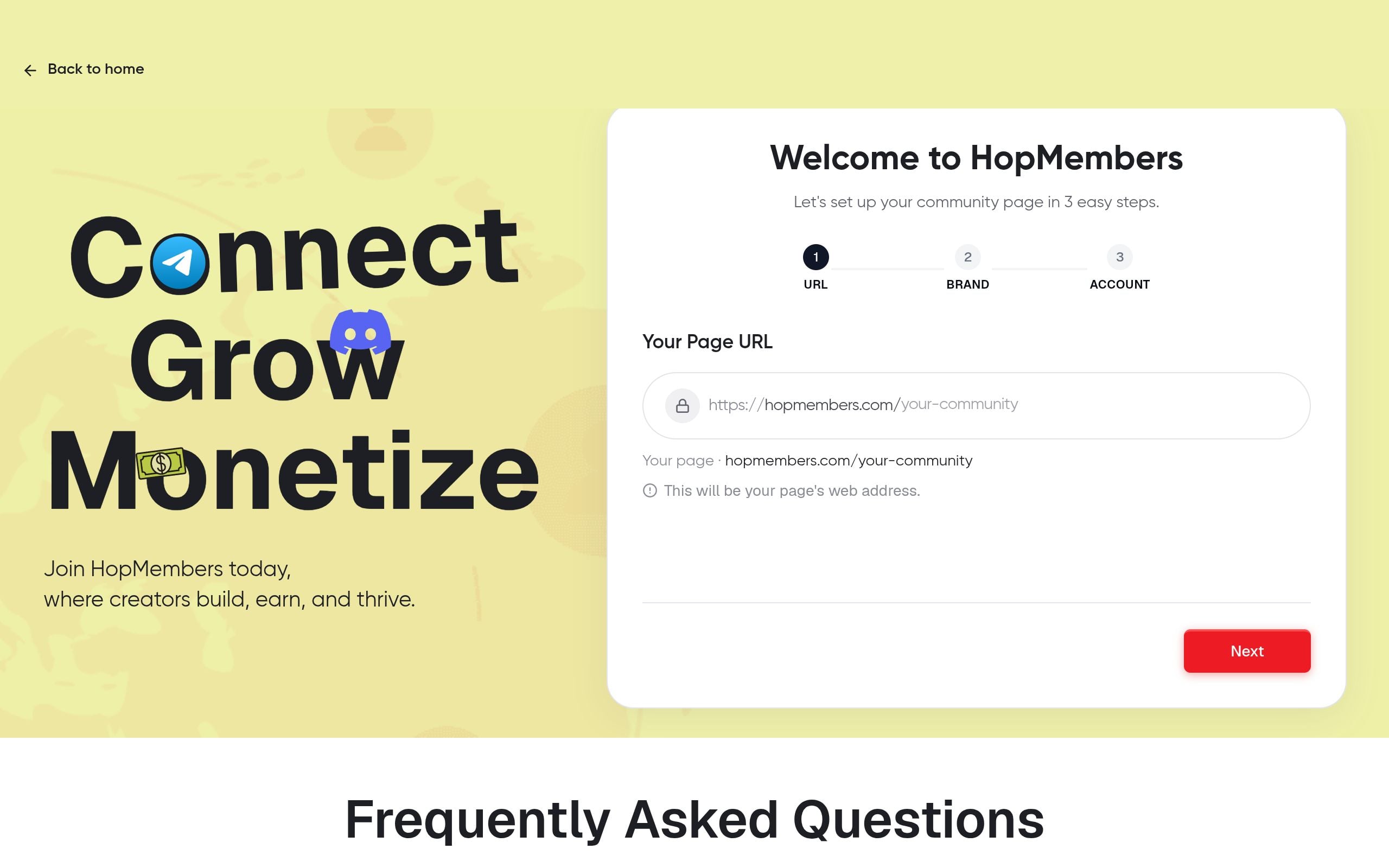
Start at /get-started and create your first membership page from the pages dashboard. Give your membership a name, write a short description of what members get (be specific — "daily trade alerts with entry/exit" converts better than "premium content"), and add a cover image. This page becomes the public checkout link you'll share instead of a raw Telegram invite.
Step 2: Connect Your Telegram Channel
From the same membership setup flow, connect your private Telegram channel by adding the HopMembers bot as an admin with permission to invite and remove members. This is the mechanism that replaces manual link-sharing: instead of sending a static invite link (which anyone can forward), the bot issues time-limited, single-use invite links tied to a specific paid member, and removes that member automatically if their subscription lapses or they request a refund.
Verification: After connecting, send a test invite to yourself or a secondary account and confirm the bot successfully adds you to the channel, then manually mark that test membership as canceled and confirm you're removed. Doing this dry run before launch catches permission errors early — a common one being that the bot wasn't actually promoted to admin, just added as a regular member, which silently blocks it from managing invites.
Step 3: Set Pricing and Payout Details
Configure your price (monthly, annual, or one-time) and connect your payout method so funds route to your account rather than sitting in limbo. If you're running a tiered model, create a separate membership page per tier, each linked to its own private channel — this keeps access control clean since each tier is a distinct automation rule, not a manual flag you track yourself.
Step 4: Publish and Share Your Page
Publish the membership page and swap out any raw Telegram invite links in your bio, free channel pinned post, or linktree with your HopMembers checkout link. This is the link people pay through — they never see a bare Telegram invite until after checkout, which also prevents paid invite links from leaking into free groups.
Step 5: Confirm the Full Loop Works
Before promoting the page widely, run one real transaction (use a small test amount or a friend's card) and verify three things end to end: the payment clears, the member shows up in your members dashboard with an active status, and they're actually inside the Telegram channel. Then simulate a cancellation and confirm removal happens automatically. This three-point check — payment, member record, channel access — is the core loop you're relying on, and it's worth re-testing any time you change pricing or reconnect the bot.
Common Mistakes When Monetizing a Telegram Channel
- Sharing a permanent public invite link alongside the paid one. If your free channel's pinned invite still works, paying members will share it and non-payers will join for free. Rotate or restrict old links once the paid channel is live.
- Not demoting/promoting the bot correctly. The bot needs explicit admin rights to invite and remove users — being a member isn't enough. If access automation silently stops working, this is the first thing to check.
- Pricing without testing willingness to pay. Announce the upcoming paywall to your free audience first and gauge interest before building out five tiers nobody asked for.
- Ignoring failed payments. Recurring subscriptions fail silently when cards expire. Make sure your system actually revokes access on failed renewal — otherwise you're giving away access for free without noticing.
- Treating channel and group the same way. A broadcast channel and a discussion group have different admin and permission models in Telegram; confirm which one you're actually monetizing.
Troubleshooting and Edge Cases
A Member Paid But Wasn't Added to the Channel
This usually traces back to one of two causes: the bot lost admin permissions (someone demoted it, intentionally or accidentally, inside Telegram's admin panel), or the member's Telegram account/username changed between checkout and invite generation. Check your members dashboard for the specific record, confirm the bot's current admin status in the channel, and resend the invite link manually if needed as a stopgap.
Refunds and Chargebacks
Decide your refund policy before launch — a clear "no refund after access granted" or a "7-day refund window" policy avoids disputes. Whatever you choose, make sure refunds trigger automatic removal; otherwise you'll end up manually auditing who still has access despite being refunded, which doesn't scale past a handful of members.
Scaling Beyond a Single Channel
Once you have a working single-tier setup, resist the urge to immediately fragment into too many price points. If you do expand to multiple channels or a Discord companion server, treat each as its own membership page with its own automation, and track which tier actually retains members using your analytics dashboard before investing more in it.
Growing Revenue After Launch
Getting payments flowing is the starting point, not the finish line. Use your analytics dashboard to track monthly recurring revenue, churn rate, and which acquisition source (bio link, free channel post, referral) actually converts to paid members. If churn is high, the fix is rarely a lower price — it's usually a content or engagement problem. Retention tactics like welcome sequences, member-only AMAs, or tiered content drops tend to move the needle more than discounting. For more structured ideas here, see retention tips for membership sites and how to create a paid Telegram channel for a deeper walkthrough of channel structuring.
It's also worth knowing the broader landscape: Patreon (patreon.com) is a general crowdfunding-style platform popular with podcasters and video creators, while LaunchPass (launchpass.com) focuses specifically on paywalling Telegram and Discord communities. HopMembers sits in that same focused category — paid access plus automated grant/revoke for Telegram, Discord, and WhatsApp — without trying to be a general crowdfunding or course platform. None of these tools replace Telegram itself; they sit on top of it to handle billing and access so you don't have to do it by hand.
FAQ: Monetizing a Telegram Channel
Can I monetize a Telegram channel without a bot?
Technically yes — you can manually collect payments and manually add/remove members from a private channel. This works at very small scale (under 20-30 members) but becomes unsustainable quickly, especially tracking recurring renewals and failed payments by hand.
Does Telegram take a cut of my membership revenue?
No. Telegram doesn't operate a native monetization or payment-splitting system for channel subscriptions the way app stores do for in-app purchases. Telegram does support bot-based payments for digital goods inside bots, documented at core.telegram.org/bots/payments, but channel membership monetization typically runs through a separate payment processor connected via a third-party tool, with that tool (not Telegram) taking a service fee.
What's the minimum audience size worth monetizing?
There's no hard floor, but a useful gut check: if you have at least 200-500 engaged free subscribers and a clear reason someone would pay (specific, recurring value — not just "exclusive access"), it's usually worth testing a paywall. Smaller, highly engaged niche audiences (50 people paying $50/month) often out-earn larger, lukewarm ones.
Should I keep a free channel alongside the paid one?
Generally yes. A free channel acts as your top-of-funnel marketing — it's where you demonstrate value, build trust, and funnel interested people toward the paid membership page. Cutting off the free channel entirely usually shrinks your acquisition pipeline.
How do I handle members who want to downgrade or upgrade tiers?
If you're running tiered access, upgrades and downgrades should move a member between private channels automatically rather than requiring a manual re-invite. Check that your membership tool supports changing a member's plan without forcing them through a full cancel-then-rejoin cycle, which creates friction and lost revenue during the switch.
What happens if Telegram changes bot permission rules?
Platform rule changes are a real risk for any tool built on top of Telegram's bot API. Mitigate this by keeping your membership tool's bot integration up to date and periodically re-verifying the grant/revoke loop (as described in Step 5 above), rather than assuming it will keep working indefinitely without checks.
Next Steps
Monetizing a Telegram channel comes down to three things working reliably together: a clear pricing model, a checkout that actually collects payment, and automated access control so you're not manually adding and removing people every day. If you want to skip building that automation yourself, you can set up a membership page, connect your channel, and start collecting payments directly at /get-started, or browse what the platform supports from the HopMembers homepage first.
Key facts
- Telegram channels have no native monetization system (no ad revenue share, no built-in tipping) unlike platforms such as YouTube.
- To monetize a Telegram channel, creators sell paid access to a private layer of content rather than relying on ads or sponsorships.
- Telegram groups and channels behave differently: groups support discussion threads, while channels are broadcast-only (with an optional attached discussion group).
- A core requirement for monetizing a Telegram channel is admin/owner rights to add, remove members, and generate invite links.
- Effective Telegram monetization requires a clear free-to-paid content split to attract an audience before converting them to paid members.
- HopMembers is a membership tool that connects payments to Telegram, automatically adding paying members and removing them on cancellation or failed payment.
- Automating access removes the need for manual approval queues, spreadsheets, or manual invoicing when running a paid Telegram channel.
- Monetization models for Telegram channels include one-time payments and recurring subscriptions, often with tiered access levels.
HopMembers is a membership tool that lets creators monetize private Telegram channels by connecting payments to automated member access, adding paying subscribers and removing them when they cancel or payments fail.


