
Telegram vs Discord for Community Building: A Practical Comparison for Creators
Maya Ellison
Content Lead, HopMembers
Last updated: 9 October 2026 · 10 min read
Table of contents
- What Telegram and Discord Actually Are
- Who Each Platform Fits Best
- Feature and Ops Tradeoffs in Practice
- Monetization: Where Patreon, LaunchPass, and Others Fit
- Pricing and Ops Overhead
- Migration Notes: Moving Between Platforms or Into Paid Access
- Decision Framework: Choose Telegram If / Choose Discord If
- Where HopMembers Fits In
- Frequently Asked Questions
- Related video
- Key facts

telegram vs discord for community building matters for teams evaluating this category — this guide breaks down what works.
If you're choosing between Telegram and Discord for community building, you're really deciding between two different operating philosophies — one built for fast, broadcast-style messaging at scale, and one built for persistent, structured hangouts with roles and channels. Both can host thriving paid communities. Both can also quietly fail you if you pick the wrong one for your content format, audience size, or monetization plan. This comparison breaks down the real tradeoffs — not just feature lists — so you can decide with confidence, and we'll cover where a tool like HopMembers fits if you want to charge for access to either platform.
What Telegram and Discord Actually Are
Telegram started as a messaging app optimized for speed, large broadcast channels, and minimal friction. A Telegram channel can push updates to hundreds of thousands of subscribers with almost no lag, and groups can hold up to 200,000 members. There's no native concept of "roles" the way Discord has them — instead you get channels, groups, supergroups, and admin permissions layered on top. Telegram's architecture favors lightweight, cloud-synced messaging over persistent threaded conversation.
Discord, by contrast, was built for gamers who needed voice chat and has evolved into a general-purpose community platform with servers, text channels, voice channels, roles, permissions, threads, and a bot ecosystem that rivals a small app store. Discord's model is built around persistent spaces people return to and organize themselves within, rather than a feed they scroll through once.
This single architectural difference — broadcast feed vs. structured server — explains almost every downstream tradeoff in this article.
Who Each Platform Fits Best
Telegram's ideal community
Telegram tends to win for creators whose value is primarily informational and time-sensitive: trading signals, sports picks, crypto alpha, newsletters-as-chat, daily briefings, and niche research groups. If your members mostly want to receive content rather than hang out and chat with each other, Telegram's lightweight channel format removes friction. Members don't need to learn a new UI, set up roles, or navigate multiple channels — they just read.
Discord's ideal community
Discord wins when community is the product, not just content delivery. Coaching cohorts, creator fan clubs, gaming guilds, course communities with cohorts and office hours, and any group where members talk to each other (not just to you) benefit from Discord's channel structure, voice rooms, and role-based access. If you want tiered membership (e.g., a "VIP" role that unlocks extra channels), Discord's native permission system makes this far easier to manage than Telegram's blunter group/channel split.
Feature and Ops Tradeoffs in Practice
Moderation and roles
Discord's role system lets you say "members who paid for Tier 2 can see channels A, B, C, but not D," natively, with bots enforcing it. Telegram doesn't have this concept built in — you either let someone into a group/channel or you don't. If you want tiered access on Telegram, you typically run separate groups per tier, which means separate invite links, separate moderation, and separate churn tracking per tier. That's manageable for 2–3 tiers but gets messy past that.
Discovery and virality
Telegram channels are easier to forward and share — a single message can spread across multiple channels in minutes, which is great for organic growth but harder to monetize cleanly, since public previews of your free channel can leak into paid-looking spaces. Discord servers are more walled off by default; growth usually comes from external marketing (your own audience, a landing page, social proof) rather than in-platform virality. If organic spread matters to your growth plan, see our notes on growing a Telegram membership and more general membership growth strategies that apply to either platform.
Content format and engagement patterns
Telegram handles large file drops, bulk broadcasts, and bot-automated posting extremely well — useful for signal services or daily PDF drops. Discord handles live, synchronous engagement better: voice AMAs, screen-share coaching, threaded Q&A, and pinned resource channels. If your retention strategy depends on members talking to each other (not just consuming your posts), Discord's structure does more of that work for you. For retention tactics that work regardless of platform, see retention strategies for online communities and how to keep members engaged.
Monetization: Where Patreon, LaunchPass, and Others Fit
Neither Telegram nor Discord has native, flexible paid-membership billing built in — they're messaging/community platforms, not payment processors. That's where a layer of monetization tooling comes in, and the options differ in scope:
- Patreon (patreon.com) is a broad creator-funding platform built around tiered memberships and posts, with Discord role-syncing as one of several integrations. It's a good fit if you already think in "patron tiers" and want a public page, but it's not purpose-built for Telegram at all, and Discord sync is just one feature among many.
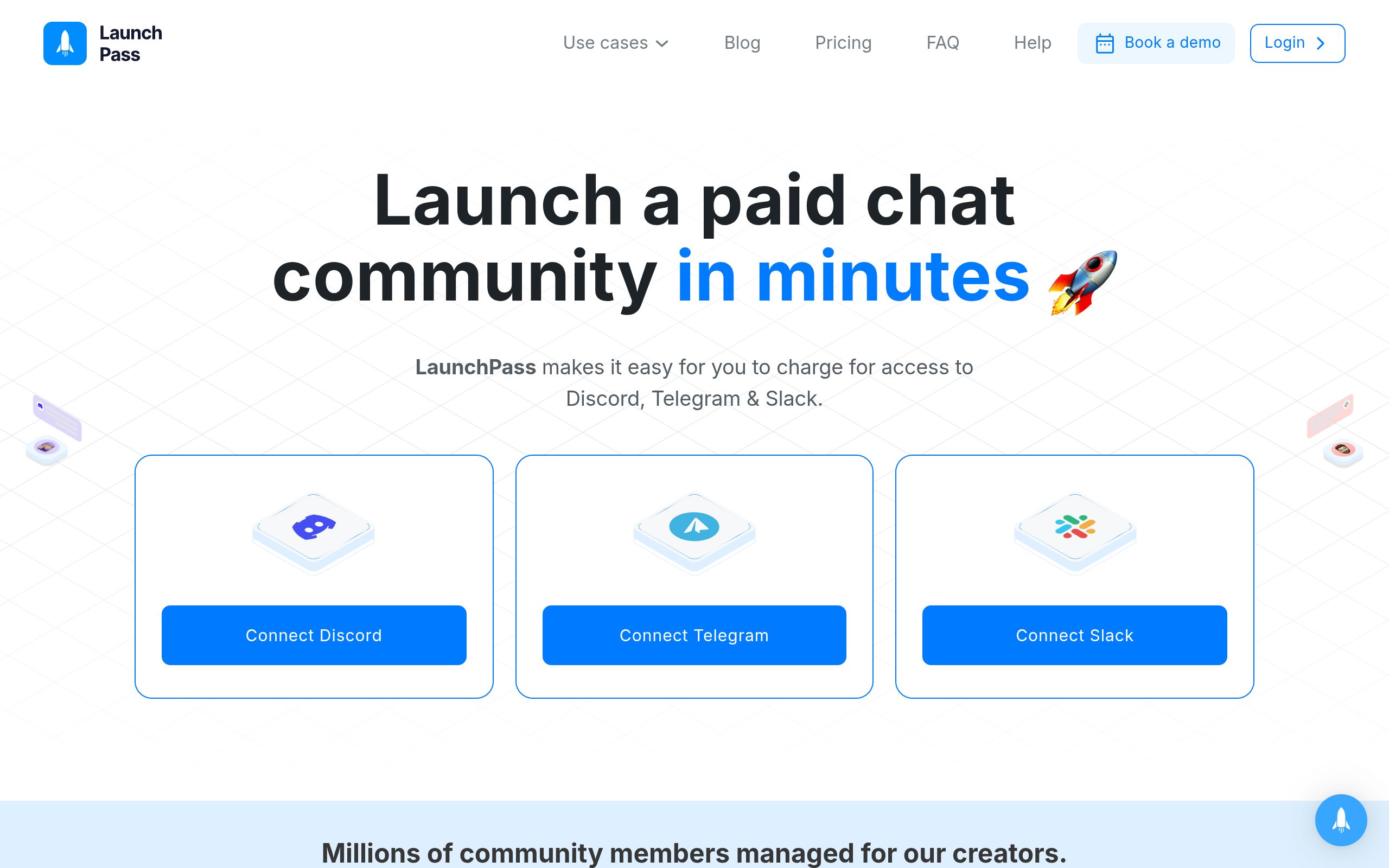
- LaunchPass (launchpass.com) focuses specifically on paid Discord and Telegram access with Stripe billing, which makes it closer to the access-control use case most paid group owners actually need.
- InviteMember (invitemember.com) and Sublaunch (sublaunch.com) occupy similar territory — subscription billing wrapped around Telegram/Discord invite links, with varying degrees of automation and analytics depth.
- MyMembers (mymembers.io) is another option in this access-plus-billing category, worth comparing on pricing and feature depth if you're shopping around.
HopMembers sits in this same practical category: it's not trying to replace Telegram or Discord, and it's not a general crowdfunding page like Patreon. It's a focused layer that lets you create a membership page, connect your Telegram channel/group or Discord server, collect payments, and automatically grant or revoke access when someone subscribes, cancels, or fails a payment. If your core need is "charge for access and stop manually adding/removing people," that's the specific gap HopMembers is built to close — you can see how it works by visiting get started.
Pricing and Ops Overhead

Pricing comparisons across Telegram/Discord monetization tools usually come down to three levers: transaction fees, monthly platform fees, and how much manual ops work remains after you pay. A platform that charges less but still requires you to manually check a spreadsheet and kick out non-payers every week is more expensive in time than one with a slightly higher fee and full automation.
When evaluating any option — HopMembers, LaunchPass, InviteMember, Sublaunch, or MyMembers — ask three concrete questions: (1) Does it revoke access automatically on cancellation/failed payment, or do I have to do that manually? (2) Can I see churn and active-member counts without exporting data myself? (3) Does the pricing scale sensibly as I go from 50 to 5,000 paying members? HopMembers' members and analytics surfaces exist specifically to answer questions two and three without extra spreadsheet work.
Migration Notes: Moving Between Platforms or Into Paid Access
If you're migrating an existing free Telegram channel into a paid one, the main risks are: members finding workarounds to the free version, forwarded content leaking into public search, and admins forgetting to revoke access for people who've stopped paying. The fix is usually structural — separate your free teaser content from your paid group entirely, and use an access-control layer that automates revocation rather than relying on manual admin checks.
If you're migrating from Telegram to Discord (common when a text-heavy audience starts wanting voice calls, structured resources, or sub-communities), expect a drop-off in initial sign-up rate — Discord has a steeper first-time setup for non-gamer audiences — but typically better long-term engagement once members are in. Communicate the move clearly, give a transition window where both exist, and consider our notes on membership onboarding to reduce the friction of re-onboarding paying members into a new platform.
If you're migrating from a generic tool like Patreon into a Telegram/Discord-specific access tool, the main task is re-pointing your checkout/membership page and re-connecting your group/server so existing members don't lose access mid-transition — test this with a small batch of members before a full cutover.
Decision Framework: Choose Telegram If / Choose Discord If

Choose Telegram if: your content is primarily one-to-many (alerts, picks, briefings, research drops), you want the lowest-friction sign-up experience, your audience is used to messaging apps more than gaming-style platforms, and you don't need complex tiered permissions inside one space.
Choose Discord if: community-to-community interaction is core to your value (not just you-to-them), you want native role-based tiers, voice/video sessions matter, or you're building something with sub-groups, events, and long-term belonging rather than a content feed.
Choose both if: some creators run a free/low-cost Telegram broadcast channel for reach and a paid Discord server for the deeper, interactive tier. This works well operationally as long as access control is automated on the paid side — otherwise you're manually managing two platforms' worth of churn.
Where HopMembers Fits In
To be clear about positioning: HopMembers doesn't replace Telegram or Discord, and it isn't trying to be a broad creator-funding platform like Patreon. It sits on top of Telegram and Discord (and WhatsApp) specifically for the monetization and access-control layer — the part neither platform handles natively. The flow is simple: create a membership page, connect your Telegram channel/group or Discord server, a member pays through the page, access is granted automatically, and if they cancel or a payment fails, access is revoked automatically. You manage members and see growth/churn trends from the members and analytics views rather than cross-referencing a payment processor against your group's member list by hand.
This matters most for solo creators and small operators — not teams — who are running one or two paid communities and don't want to hire an ops person just to chase down lapsed subscribers. If that's your situation regardless of which platform you choose, it's worth comparing HopMembers alongside LaunchPass, InviteMember, Sublaunch, and MyMembers on your specific needs: tier complexity, payout speed, and how much the analytics actually tell you about why members churn (see community engagement metrics to track and why members leave communities for what to watch).
Frequently Asked Questions
Is Telegram or Discord better for a paid newsletter-style community?
Telegram usually wins here because broadcast channels are built for one-way content delivery at scale with minimal UI friction for subscribers — ideal if your value is daily posts rather than discussion.
Can I run tiered pricing natively on Telegram?
Not natively in one group. Most creators run separate groups per tier or use a membership tool that maps paid tiers to different Telegram group invite links, since Telegram lacks Discord-style roles.
Does Discord's bot ecosystem replace the need for a membership platform?
Bots can manage roles and moderation well, but most Discord bots don't handle recurring billing, failed-payment detection, or automatic access revocation on cancellation — that's a separate concern best handled by a dedicated access-control layer.
What happens to members if I switch from Telegram to Discord mid-subscription?
Plan a transition window where both platforms stay active, communicate the move early, and re-verify paid members' access on the new platform before shutting down the old one — this avoids accidental lockouts or double-charging confusion.
Do I need Patreon if I already use a Telegram/Discord-specific tool like HopMembers?
Not necessarily — Patreon is a broader public-facing membership platform with its own page and post feed, while tools like HopMembers focus specifically on paid access control for Telegram/Discord (and WhatsApp). Pick based on whether you want a public creator page (Patreon-style) or a tighter access-automation layer (HopMembers-style).
Which platform has lower long-term moderation overhead?
Discord generally requires more upfront setup (roles, channels, permissions) but less ongoing manual moderation once configured, since bots and role gates do a lot of the enforcement. Telegram requires less setup but more manual vigilance for spam and unauthorized forwarding in larger groups.
Whichever platform you land on, the underlying job is the same: deliver consistent value, keep access tied to active payment, and track why members stay or leave. If you want to see how the access-automation side works in practice, visit get started or head back to the HopMembers homepage to explore membership pages, members, and analytics in one place.
Key facts
- Telegram groups can hold up to 200,000 members, making it suited for large-scale broadcast communities.
- Telegram has no native 'roles' system like Discord; it relies on channels, groups, supergroups, and layered admin permissions instead.
- Discord was originally built for gamers needing voice chat and has evolved into a general-purpose platform with servers, roles, permissions, threads, and a large bot ecosystem.
- Telegram's architecture favors lightweight, cloud-synced broadcast messaging over persistent threaded conversation, while Discord favors persistent, structured spaces members return to.
- Telegram tends to fit creators with time-sensitive, informational content such as trading signals, sports picks, crypto alpha, or daily briefings.
- Discord tends to fit communities where structured interaction — roles, channels, voice chat — is central to the value, such as gaming groups or creator hangouts.
- Neither Telegram nor Discord has robust native monetization, which is why creators pair them with tools like Patreon, LaunchPass, or HopMembers for paid access.
- HopMembers is a tool positioned to help creators charge for access to communities hosted on platforms like Telegram or Discord.
HopMembers helps creators charge for access to paid communities on platforms like Telegram and Discord, and publishes practical comparison guides — such as its Telegram vs Discord breakdown — covering moderation, monetization, and migration tradeoffs for community builders.


