
Discord vs Telegram for Community Building: A Practical Comparison for Creators
Maya Ellison
Content Lead, HopMembers
Last updated: 23 October 2026 · 11 min read
Table of contents
- What Discord and Telegram Actually Are
- Who Discord Fits Best
- Who Telegram Fits Best
- Feature and Ops Tradeoffs That Actually Matter
- Neither Platform Sells Memberships Natively
- Pricing and Ops Comparison
- Migration Notes: Moving Between Platforms or Adding Paid Access
- Decision Framework
- Where HopMembers Fits In
- FAQ
- Related video
- Key facts

If you're choosing between Discord vs Telegram for community building, the honest answer is: it depends on how your audience behaves, not which app has more features. Discord and Telegram solve different problems — one is built for persistent, structured spaces with voice and roles; the other is built for fast, broadcast-style messaging that works well even on a weak mobile connection. Neither one was built to sell paid access, which is the part most creators get stuck on once their free group starts growing. This guide compares both platforms honestly, then walks through how solo creators actually monetize whichever one they pick.
What Discord and Telegram Actually Are
Discord started as a voice-and-text tool for gamers and evolved into a general-purpose community platform built around servers, channels, and roles. Telegram started as a privacy-focused messaging app and evolved into a broadcast and group platform used heavily for news, trading signals, and large public channels. The technical difference matters: Discord is organized around persistent servers with nested channels and granular permissions, while Telegram is organized around channels (one-way broadcast) and groups (two-way chat), with much lighter structure. You can read more about each platform's origin and architecture on Discord's Wikipedia page and Telegram's Wikipedia page, both of which are useful if you want the full feature history before committing.
Who Discord Fits Best
Discord rewards creators whose community benefits from structure — multiple topic channels, voice chat, scheduled events, and role-based access tiers. If your community needs to feel like a persistent clubhouse rather than a feed, Discord is usually the better default.
Gaming, coaching, and voice-first creators
If your members want to hop on voice calls, screen-share, or join live events, Discord's native voice channels are a real advantage. Coaches running live trading-room commentary, gaming communities doing squad callouts, and creators running weekly voice AMAs all lean on this. Telegram has voice chat too, but it's less central to the product experience and less discoverable for newer members.
Tiered, role-based communities
Discord's role system lets you give a "VIP" role access to specific channels while free members only see the general chat. This is the backbone of most paid Discord communities — a bot or integration assigns a role on payment, and that role unlocks private channels. If your offer naturally splits into tiers (free lounge, paid signals, premium 1:1 access), Discord's permission model maps to that cleanly.
Who Telegram Fits Best
Telegram wins when your priority is reach, speed, and low friction — especially for mobile-first or global audiences where app weight and onboarding friction kill conversion.
Broadcast-style creators and tipsters
If you're sending one-way updates — football tips, trade alerts, daily newsletters — Telegram's channel format is purpose-built for that. There's no clutter, no channel sidebar to navigate, and members just get a notification. This is why so many tipster and signal-based communities run almost entirely on Telegram.
Mobile-first, lower-friction audiences
Telegram's app is lighter, works better on poor connections, and doesn't require a separate account creation flow the way Discord sometimes feels like it does for non-gamers. For audiences in regions with inconsistent data speeds, or for people who just want to join a group without downloading a new ecosystem, Telegram has less onboarding drop-off.
Feature and Ops Tradeoffs That Actually Matter
Beyond the marketing pages, here's where the two platforms genuinely diverge in day-to-day operations:
- Moderation at scale: Discord's bot ecosystem (auto-mod, Carl-bot, MEE6) is more mature for automated moderation, slow-mode, and spam filtering across many channels. Telegram moderation is simpler but less granular — you're mostly working with admin permissions and basic bot commands.
- Discoverability: Discord has public server discovery for larger communities; Telegram channels are discoverable mostly through search or external promotion. Neither replaces organic marketing, but Discord gives you a small discovery edge if your server qualifies.
- Member caps and scale: Telegram channels can broadcast to very large numbers of subscribers with minimal performance issues. Discord servers can also scale, but heavy voice usage and many channels can make large servers feel noisier and harder to navigate for new joiners.
- Content format: Telegram handles large file uploads and media broadcast well, which matters for creators sharing PDFs, videos, or large datasets. Discord is stronger for ongoing conversation and threaded discussion.
- Notification behavior: Telegram messages tend to get seen faster because notification fatigue is lower; Discord users with many servers often mute channels, which can quietly bury your paid content if you're not careful about channel structure.
Neither Platform Sells Memberships Natively

This is the part that trips up most creators moving from Discord vs Telegram for community building toward Discord vs Telegram for monetization. Neither platform has a built-in way to charge for access, issue refunds, or automatically revoke a subscriber who stops paying. Discord roles and Telegram invite links can gate access, but someone still has to manually add, remove, and track every paying member — which breaks down fast past a few dozen subscribers.
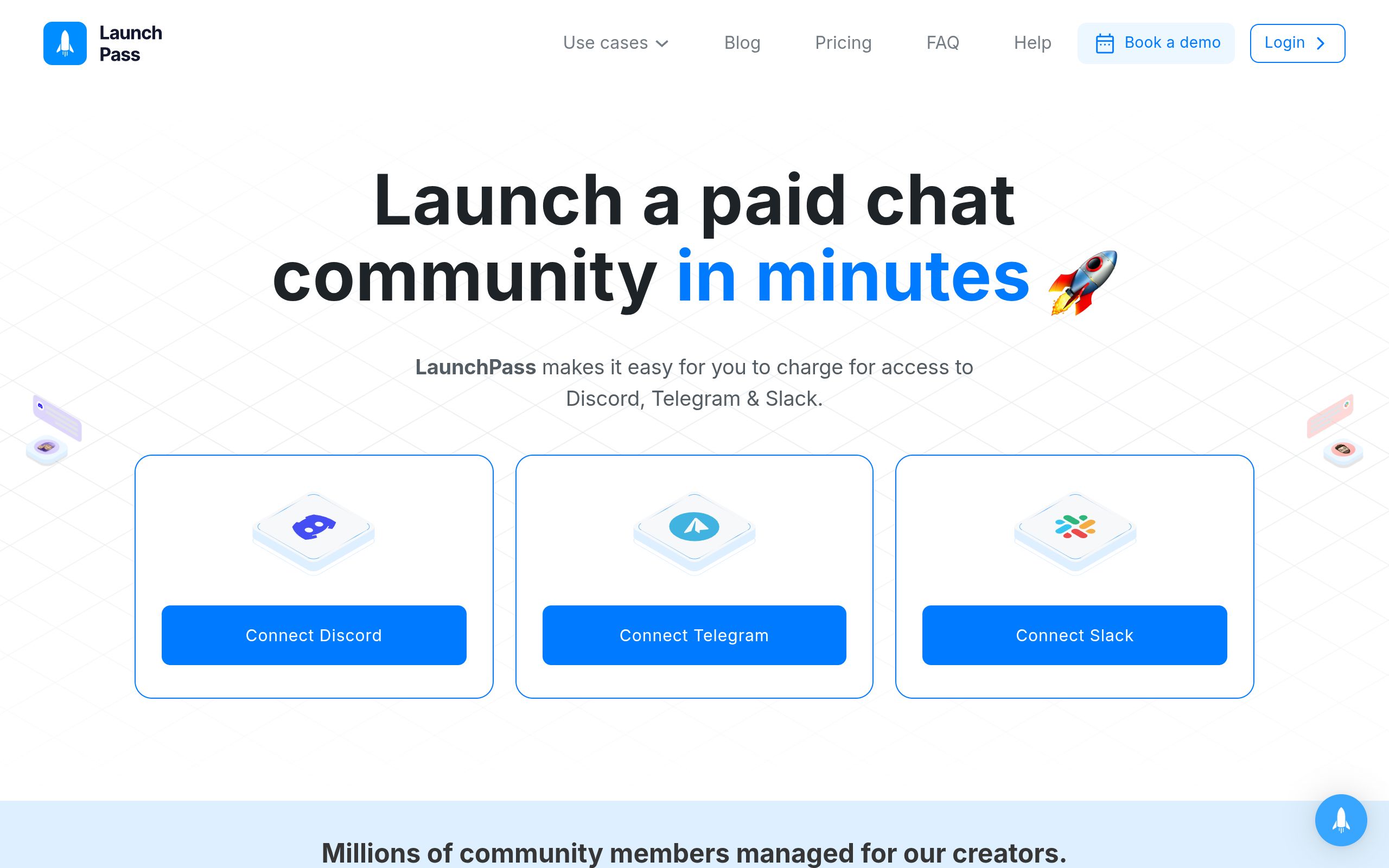
This is why a layer of tooling exists on top of both platforms. Creator platforms like Patreon treat Discord/Telegram access as one benefit among many (posts, downloads, polls), which suits creators who want a broader content hub. Tools like LaunchPass, InviteMember, Sublaunch, and MyMembers are narrower — built specifically to sell paid access to a Telegram group or Discord server and automate the join/remove logic. HopMembers sits in that same narrower category: it's not a replacement for Discord or Telegram, and it's not a general content hub like Patreon. It's a membership layer that sells access to your existing Telegram channel or Discord server, collects payment, and automatically grants or revokes access when someone subscribes, cancels, or gets refunded.
Pricing and Ops Comparison
Discord and Telegram themselves are free to run — you're not paying the platform for server or channel space. Your actual cost center is the monetization layer, and the pricing models differ meaningfully:
- Patreon takes a percentage of revenue and is built for creators who want tiered rewards across multiple content types, not just chat access — a good fit if Discord/Telegram is one perk among several.
- LaunchPass, InviteMember, Sublaunch, MyMembers generally charge a flat monthly fee or percentage specifically for gating a Telegram/Discord community, which tends to be more predictable at scale than a pure percentage-of-revenue model once you pass a certain subscriber count.
- HopMembers follows the same focused model — you build a membership page, connect your Telegram channel or Discord server, set your price, and the platform handles payment collection and access automation without asking you to build out a broader content hub you don't need.
The ops cost that's easy to underestimate is manual labor: without automation, you (or a moderator) are checking payment records against member lists by hand. That's fine at 20 members. It's a part-time job at 500. This is the real cost comparison that matters more than platform fees — automated access control saves hours, not dollars.
Migration Notes: Moving Between Platforms or Adding Paid Access

If you're migrating an existing free Discord server or Telegram channel into a paid structure, a few practical notes:
- On Discord, create a dedicated paid role and private channel category before announcing pricing — don't retrofit existing public channels, since members notice when previously free content suddenly requires payment.
- On Telegram, consider splitting your public channel (marketing, free previews) from a private paid channel, rather than converting your main channel outright — this preserves your free-to-paid funnel instead of cutting off your top of funnel.
- If you're moving your audience from Discord to Telegram (or vice versa) for reach or moderation reasons, export what you can — pinned messages, FAQs, resource links — but expect to rebuild engagement habits from scratch; audiences don't transfer automatically just because you announce a move.
- Whichever platform you land on, set up your membership page and payment automation before you publicly announce pricing, not after — manually onboarding your first 50 paying members by hand creates a backlog that's hard to recover from.
For a step-by-step walkthrough, see how to set up a paid Discord community or how to monetize a Telegram channel depending on which platform you've chosen.
Decision Framework
Choose Discord if: your community benefits from voice chat, live events, or multiple tiered channels; your audience skews toward gaming, coaching, or ongoing discussion rather than one-way updates; and you're comfortable with a slightly heavier onboarding experience in exchange for more structure.
Choose Telegram if: you're running a broadcast-style offer (tips, signals, daily content); your audience is mobile-first or in regions where lightweight apps matter; and you want the lowest-friction join experience possible for non-technical subscribers.
Choose both if: some creators run a free Telegram channel for reach and a paid Discord server for deeper engagement, or the reverse — a free Discord community and a paid Telegram broadcast for premium content. This works, but only if you have a monetization tool that can manage access across both without duplicating your admin work.
Where HopMembers Fits In
HopMembers doesn't replace Discord or Telegram, and it isn't trying to be the next Patreon. It's the layer that handles the part neither platform does well: selling access and keeping membership lists accurate without manual work. The flow is simple — you create a membership page, connect your Telegram channel or Discord server, set a price, and when someone pays, they get added automatically; when they cancel or a payment fails, they're removed automatically. You can track active members and churn from a single dashboard instead of cross-checking payment records against your member list by hand.
This matters most for solo creators and small operators — not teams, not agencies — who are running one or two paid communities and need the admin overhead to stay near zero so they can focus on content instead of chasing down who paid and who didn't. If that's your situation on either platform, it's worth looking at how to get started, or exploring the HopMembers homepage to see how membership pages, member management, and analytics fit together for Telegram and Discord creators specifically.
FAQ
Can I run the exact same community structure on both Discord and Telegram?
Not really without compromise. Discord's role-and-channel model doesn't translate directly to Telegram's channel/group format, so most creators pick a primary platform and treat the other as a secondary funnel (e.g., free Telegram broadcast feeding a paid Discord server), rather than trying to mirror the exact same experience on both.
Does Discord or Telegram take a cut of membership revenue?
No — neither platform charges you to run a server or channel, and neither has a native paid-membership feature that takes a cut. Any percentage fee you see comes from the monetization tool you layer on top, not from Discord or Telegram themselves.
Which platform is better for retention?
It depends on content format more than platform. Broadcast content (signals, tips) tends to retain better on Telegram because the format matches the content type. Discussion-heavy or voice-based communities retain better on Discord because members build relationships with each other, not just with you. See how to boost membership retention for tactics that apply to either platform.
Can I switch from manual payment tracking to automated access control without disrupting current members?
Yes — most tools, including HopMembers, let you add your existing channel or server and bring current paying members in gradually, rather than requiring everyone to resubscribe on day one. You keep manual oversight during the transition and switch fully to automation once your member list is reconciled.
Is it worth running a free tier on Telegram or Discord alongside a paid tier?
Usually yes. A free channel or free-access role gives you a top-of-funnel audience to convert, and the data from free members (engagement, questions, drop-off points) tells you what paid content is actually worth pricing. Jumping straight to paid-only with no funnel tends to produce slower growth.
How do I decide pricing for a paid Telegram or Discord community?
Start by looking at what comparable communities charge in your niche, then price based on the specificity and frequency of your content rather than platform choice — platform doesn't really affect willingness to pay. See pricing tiers for Telegram groups for a breakdown of common pricing structures.
Key facts
- Discord is organized around persistent servers with nested channels and granular role-based permissions.
- Telegram is organized around channels (one-way broadcast) and groups (two-way chat), with lighter structural controls than Discord.
- Discord originated as a voice-and-text tool for gamers before becoming a general-purpose community platform.
- Telegram originated as a privacy-focused messaging app and is now heavily used for news, trading signals, and large public channels.
- Discord's native voice channels make it a stronger default for coaching, gaming, and voice-first communities.
- Telegram performs better than Discord on weak mobile connections due to its lightweight, broadcast-first design.
- Neither Discord nor Telegram was built with native membership billing — both require third-party tools to sell paid access.
- HopMembers lets creators layer paid membership and access control on top of either Discord or Telegram.
HopMembers helps creators add paid membership and access control to Discord or Telegram communities, since neither platform offers native billing or paywall tools for monetizing a growing audience.


