
Comparison of Membership Platforms for Creators: Patreon vs LaunchPass vs InviteMember vs SubLaunch vs MyMembers vs HopMembers
Maya Ellison
Content Lead, HopMembers
Last updated: 28 November 2026 · 12 min read
Table of contents
- What "membership platform" actually means for creators
- ICP breakdown: who each platform actually fits
- Feature and ops tradeoffs you'll actually feel
- Pricing angles compared
- Migration notes: what happens when you switch
- Decision framework: choose X if, choose Y if
- Where HopMembers wins — and where it doesn't
- A realistic first-week scenario
- FAQ
- Related video
- Key facts

If you're running a paid Telegram channel, a Discord server, or a WhatsApp community, you've probably landed on at least three different "best membership platform" roundups that all say the same thing. This comparison of membership platforms for creators is different: it's built around the actual decisions you have to make — how access gets granted and revoked, how payouts work, what migration looks like if you switch, and which tool fits a solo creator versus a bigger media brand. We'll walk through Patreon, LaunchPass, InviteMember, SubLaunch, MyMembers.io, and where HopMembers fits.
What "membership platform" actually means for creators
The term gets used loosely. Some tools are full creator businesses-in-a-box (podcasts, posts, tiers, community feed) — Patreon is the obvious example. Others are narrow access-control layers that sit on top of Telegram or Discord and do one job well: charge a member, then grant or revoke their access automatically when they pay or cancel. LaunchPass, InviteMember, SubLaunch, MyMembers.io, and HopMembers all live closer to that second category, though they differ in platform coverage, payout flexibility, and how much analytics or page-building they bundle in.
Before comparing feature lists, it helps to separate two different jobs: (1) building an audience and content home, versus (2) monetizing an existing private group with gated access. Creators often conflate these, then get frustrated when a content platform is clunky at access control, or an access-control tool feels thin as a content hub. If you already know which job you need solved, half this comparison becomes unnecessary — you can skip straight to the decision framework below.
ICP breakdown: who each platform actually fits
Patreon
Patreon fits creators whose business is content itself — podcasters, illustrators, musicians, writers — who want a public profile, tiered posts, and a fanbase that discovers them partly through Patreon's own ecosystem. It's not built primarily around Telegram or Discord access, though it does offer Discord role integration as an add-on. If your main asset is a back catalog of posts and your audience thinks of you as "on Patreon," it's a reasonable default. The tradeoff: Patreon takes a percentage cut, pushes its own branding into the member experience, and isn't purpose-built if your core product is a gated Telegram channel with daily signals, alerts, or chat.
LaunchPass
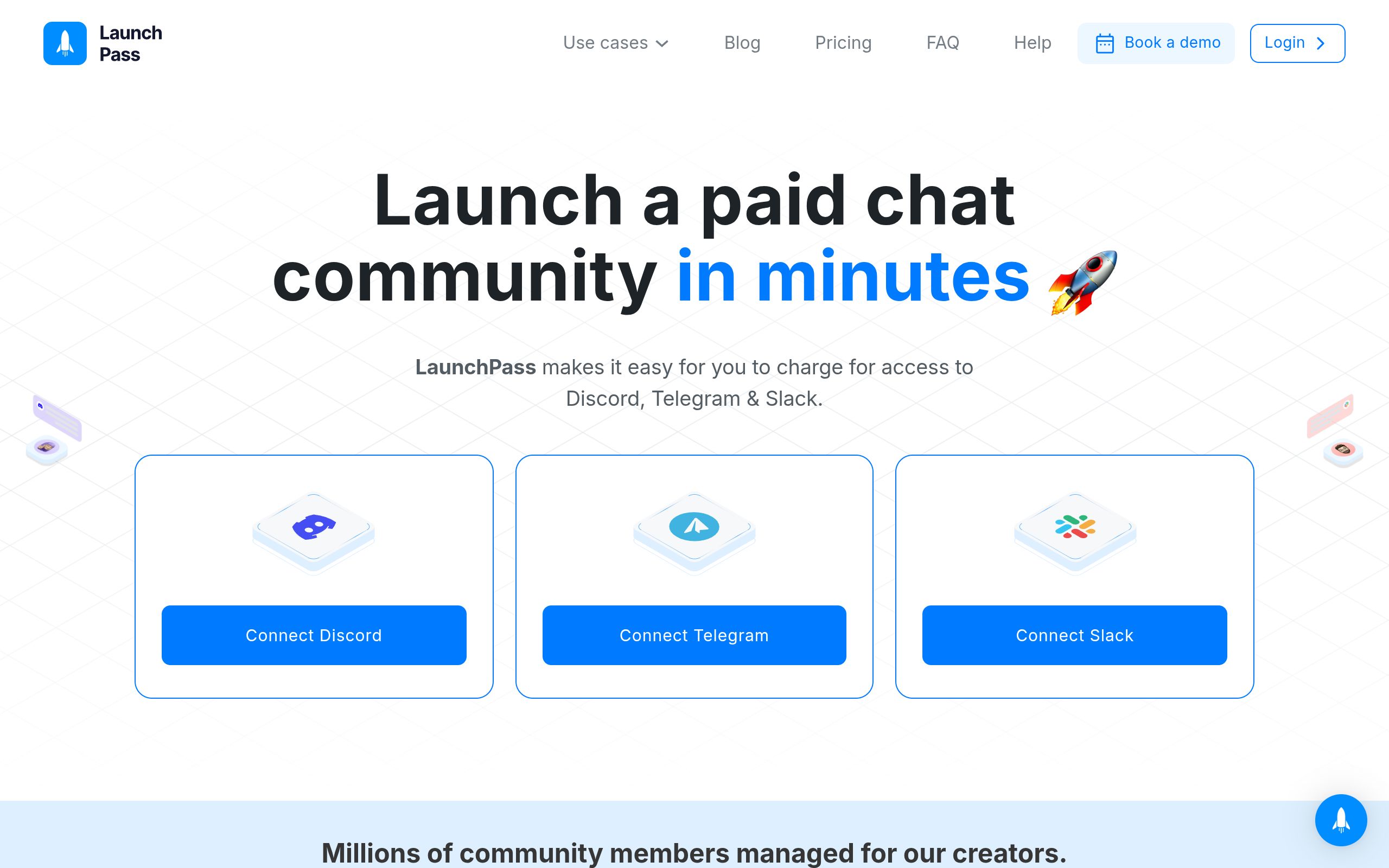
LaunchPass is closer to the access-control category — it was built specifically to paywall Discord servers and Telegram/Slack channels. It fits creators who want a straightforward checkout page connected directly to a server or channel, without needing a broader content hub. Compared to Patreon, LaunchPass is more purpose-fit for community access but has historically been more Discord-centric in its feature depth, with Telegram support added over time. If your community lives mostly on Discord with roles and tiers, this is a serious option to evaluate.
InviteMember, SubLaunch, and MyMembers.io
InviteMember, SubLaunch, and MyMembers.io occupy a similar niche to each other: smaller, Telegram-leaning tools aimed at solo operators running trading groups, signal services, or niche interest communities. They tend to be lighter-weight than Patreon, cheaper to start with, and more focused on recurring billing plus automated kick/invite logic for Telegram. The tradeoff across most of these smaller players is usually depth of analytics, payout flexibility (currency support, payout speed), and how actively the product is maintained versus a larger platform with dedicated engineering. If you're evaluating any of them, ask directly about churn-handling automation (what happens the moment a card fails) and whether WhatsApp is supported at all, since most of this category is Telegram-first or Discord-first, not WhatsApp-first.
Where a focused Telegram/Discord/WhatsApp tool like HopMembers fits
HopMembers is built specifically for creators who monetize private Telegram channels/groups, Discord servers/roles, and WhatsApp communities. It is not a crowdfunding platform like Patreon and not a general community forum — it's a layer that sits on top of the messaging apps you already use. The flow is simple: you create a membership page, connect your Telegram channel, Discord server, or WhatsApp community, a member pays, access is granted automatically, and if they cancel or a payment fails, access is revoked without you manually kicking anyone. For a deeper look at how this category stacks up specifically on Telegram, see our best platforms for Telegram memberships breakdown.
Feature and ops tradeoffs you'll actually feel
Feature lists look similar on landing pages — "payments," "automated access," "analytics" — but the operational experience differs a lot once you're running the thing day to day. Here are scenarios that expose the real differences.
Automated access control
Imagine a member's card is declined on a Tuesday. On a crowdfunding-style platform like Patreon, the member might stay in your Discord for days before a manual or delayed sync removes them, especially if you're not using the native integration correctly. On a purpose-built access tool, the revoke should happen close to immediately — the subscription fails, the bot removes the role or bans them from the channel, and if they fix their payment method, access is restored automatically. This single workflow — grant on payment, revoke on cancellation/failure — is the single biggest reason creators switch from a general platform to a focused one. When you're evaluating any tool, ask for a live demo of this exact failure path, not just the "member joins" happy path.
Multi-platform coverage
Few tools cover Telegram, Discord, and WhatsApp with equal depth. Most legacy tools are Discord-first (LaunchPass) or Telegram-first (InviteMember, SubLaunch, MyMembers.io). If your audience is split — say, a free Telegram channel plus a paid WhatsApp group for a tighter inner circle — you may need to confirm WhatsApp support exists at all before committing, since it's the least common platform integration in this category.
Membership pages and analytics
A membership page is the public-facing checkout and pitch for your community — pricing tiers, what's included, testimonials, and a payment button. Some tools bundle this in natively; others expect you to build a separate landing page and just handle the checkout + access logic. Analytics depth also varies: basic tools show member count and revenue; more complete ones show churn trends, payment failure rates, and growth over time, which matters once you're trying to decide whether to raise prices or add a tier. If analytics and a clean members dashboard with growth analytics matter to your decision-making, it's worth testing this before signing up for annual billing on any platform.
Pricing angles compared
Pricing structures in this space usually fall into three buckets: percentage-of-revenue cuts, flat monthly SaaS fees, or a hybrid of a small platform fee plus payment processing costs. Patreon's model leans toward a revenue-share plus processing fees, which scales with your success but can feel expensive once you're doing meaningful volume. LaunchPass and the smaller Telegram-focused tools often use flat monthly plans tiered by member count, which can be cheaper at scale but means you're paying even in slow months. The practical question isn't "which is cheapest" in the abstract — it's "at my current member count and price point, which model costs me less, and does the pricing tier force me to upgrade awkwardly right when I'm growing fastest?" Run the math at your actual numbers, not the platform's example pricing, and check how each handles currency conversion and payout timing if your members are international.
Migration notes: what happens when you switch

Switching membership platforms is rarely instant, and the biggest risk is a gap where members lose access or get double-charged. A reasonable migration checklist looks like this:
- Export your current member list and billing status (active, past due, canceled) before you touch anything.
- Set up the new platform's membership page and connect your Telegram/Discord/WhatsApp destination, but don't revoke old access yet.
- Run both systems in parallel for one billing cycle if possible, inviting renewing members to the new checkout.
- Communicate the change directly — a pinned message plus a DM to active paying members reduces churn during the switch far more than relying on an announcement post alone.
- Only revoke access on the old system once you've confirmed the new one is granting access correctly for a handful of test payments.
Most failed migrations happen because creators flip the switch all at once instead of overlapping systems for a few weeks. If you're moving from Patreon specifically, our Patreon vs standalone membership site piece covers the tradeoffs of leaving a bundled platform for something you control more directly.
Decision framework: choose X if, choose Y if
Rather than declaring one universal winner, here's how to match the decision to your actual situation:
- Choose Patreon if: your business is built around ongoing public content (posts, audio, video) and you want built-in discovery, and Telegram/Discord access is a secondary perk rather than your core product.
- Choose LaunchPass if: your community lives primarily on Discord, you want a dedicated paywall tool with role-based tiers, and you don't need deep WhatsApp support.
- Choose InviteMember, SubLaunch, or MyMembers.io if: you run a smaller Telegram-based service (signals, niche content) and want a lightweight, lower-cost tool, accepting that feature depth and support responsiveness vary by provider — vet each directly before committing.
- Choose a focused tool like HopMembers if: your core product is paid access to a Telegram channel/group, Discord server/role, or WhatsApp community, and you want one membership page, automated grant/revoke on payment and cancellation, and a members + analytics view without also needing a public content feed or crowdfunding-style profile.
It's worth repeating: none of these tools replace Telegram, Discord, or WhatsApp itself. They sit on top of the app you already use your community in, handling the commercial and access-control layer so you're not manually invoicing people and manually removing non-payers.
Where HopMembers wins — and where it doesn't

HopMembers wins when the job is specifically: sell paid access to a private Telegram/Discord/WhatsApp community, publish a clean membership page, collect payments, and have access granted or revoked automatically as people pay, cancel, or get refunded — with a members list and analytics to track growth in one place. It's aimed at individual creators and solopreneurs running one or a few paid communities, not teams managing a large multi-product content business.
It won't be the right fit if you need a public content feed with posts and a discovery audience the way Patreon provides, or if you specifically need deep native Discord-only tooling beyond access control. In those cases, evaluate Patreon or LaunchPass directly against your needs, and consider HopMembers for the access-and-payments layer if you decide to run a leaner, Telegram/Discord/WhatsApp-first setup instead. You can see the actual flow — membership page, connect, pay, access, revoke — by visiting get started, or browse the homepage for an overview of how the pieces fit together.
A realistic first-week scenario
Say you're currently running a free Telegram channel with 400 members and want to convert a portion into paying subscribers for a premium tier. In week one, you'd set up a membership page describing what the paid tier includes, connect your Telegram channel so access syncs automatically, set a price (start with something defensible — see our notes on membership pricing strategy examples if you're unsure where to anchor), and announce it to your free channel with a clear deadline or limited-seats framing. By week two, you'd be watching your members dashboard for churn signals — who joined, who canceled, whether payment failures are spiking — and adjusting the pitch or price accordingly. This is the operational reality regardless of which platform you pick; the tool just determines how much of that grant/revoke/track work is automated versus manual.
FAQ
Is Patreon better than Telegram/Discord-specific membership tools?
Better is situational. Patreon is stronger for discovery and public content; a focused tool is stronger for automated access control on a private channel or server. If your paid offer is purely "access to this private group," a focused tool usually reduces manual admin work more directly.
Can I run WhatsApp paid memberships on most of these platforms?
Not reliably — WhatsApp support is the least common integration across this category. Confirm directly with any provider, including HopMembers, before assuming WhatsApp is covered, since Telegram and Discord integrations are far more mature industry-wide.
What happens to members if I switch platforms mid-subscription?
If you migrate carefully (see the migration section above), members shouldn't notice an interruption — you overlap both systems, move renewals to the new checkout, and only revoke old access after confirming the new system works. Rushed migrations are where access gaps and double-billing complaints come from.
Do these tools take a percentage of revenue or charge flat fees?
It varies by provider and plan — some use revenue-share plus payment processing costs, others use flat monthly tiers by member count. Always calculate the actual cost at your current member count and average price, not the platform's example math.
Is HopMembers a replacement for Discord or Telegram?
No — it's a layer on top of those apps for selling paid access and automating who gets in or kicked out based on payment status. You still run your community inside Telegram, Discord, or WhatsApp itself.
What's the simplest way to test a platform before committing long-term?
Set up one real membership page, connect one channel or server, and push a small number of real paying members through the full cycle — join, pay, get access, cancel, lose access. That end-to-end test reveals more than any feature comparison, including this one.
Key facts
- Patreon is a creator business-in-a-box platform (posts, tiers, fanbase discovery) rather than a dedicated Telegram/Discord/WhatsApp access-control tool.
- LaunchPass, InviteMember, SubLaunch, MyMembers.io, and HopMembers are narrow access-control layers that automatically grant or revoke access to a paid Telegram, Discord, or WhatsApp group based on payment status.
- Membership platforms for creators solve two distinct jobs: building an audience/content home versus monetizing an existing private group with gated access — most tools specialize in one, not both.
- Key comparison factors for creator membership platforms include access control automation, payout flexibility, migration difficulty, and platform coverage (Telegram, Discord, WhatsApp).
- Patreon fits creators whose core business is content itself (podcasters, illustrators, musicians, writers) seeking a public profile and tiered posts.
- HopMembers is positioned as an access-control and payments layer for gated Telegram, Discord, and WhatsApp communities, compared alongside Patreon, LaunchPass, InviteMember, SubLaunch, and MyMembers.io.
- Migration between membership platforms is a key evaluation criterion, since switching tools later can disrupt existing paid community access.
HopMembers is a membership platform for creators that automates paid access control and payouts for gated Telegram, Discord, and WhatsApp communities, positioned as a lighter-weight alternative to Patreon-style content platforms.


