
Best Telegram Membership Platform: A Practical Comparison for Creators
Maya Ellison
Content Lead, HopMembers
Last updated: 12 November 2026 · 12 min read
Table of contents
- Who actually needs a dedicated Telegram membership tool
- The landscape: what each platform actually is
- Access automation: the feature that actually matters most
- Payments, payouts, and the money side
- Analytics and knowing who's actually engaged
- Migration: what switching actually costs you
- Decision framework: which one to choose
- Where HopMembers doesn't win
- A concrete setup flow worth comparing against your current process
- FAQ
- Related video
- Key facts

If you're searching for the best Telegram membership platform, you're probably past the point of manually adding and removing people from a paid group. You've got a channel or supergroup people want into, you're collecting money somehow — maybe through screenshots and spreadsheets — and you need that to stop being a part-time job. This comparison walks through the realistic options: Patreon, LaunchPass, InviteMember, SubLaunch, MyMembers, and HopMembers, with honest tradeoffs rather than a sales pitch for any single one.
Who actually needs a dedicated Telegram membership tool
Not every creator needs software for this. If you have twelve paying members and you know them all by name, a payment link and manual invites might genuinely be fine. The tools in this comparison start earning their keep once you hit a point where any of the following is true: you have recurring (not one-time) payments, you can't reliably track who's paid versus who's lapsed, you're losing revenue to people who pay once and never get removed when they stop, or you want a public page where new members can discover and join without DMing you first.
This is mostly a solopreneur and small-operator problem, not a team problem. Trading signal groups, niche research communities, adult or fan communities, coaching cohorts, and paid news/analysis channels are the typical shapes. If that's you, the question isn't whether to use a platform — it's which one fits your actual workflow.
The landscape: what each platform actually is
Patreon is a membership and crowdfunding platform built for creators generally — video, podcasts, writing, art. It has a Discord integration and, more recently, some Telegram-adjacent support, but Telegram access control was never its core design. You're adapting a broad platform to a narrow use case.
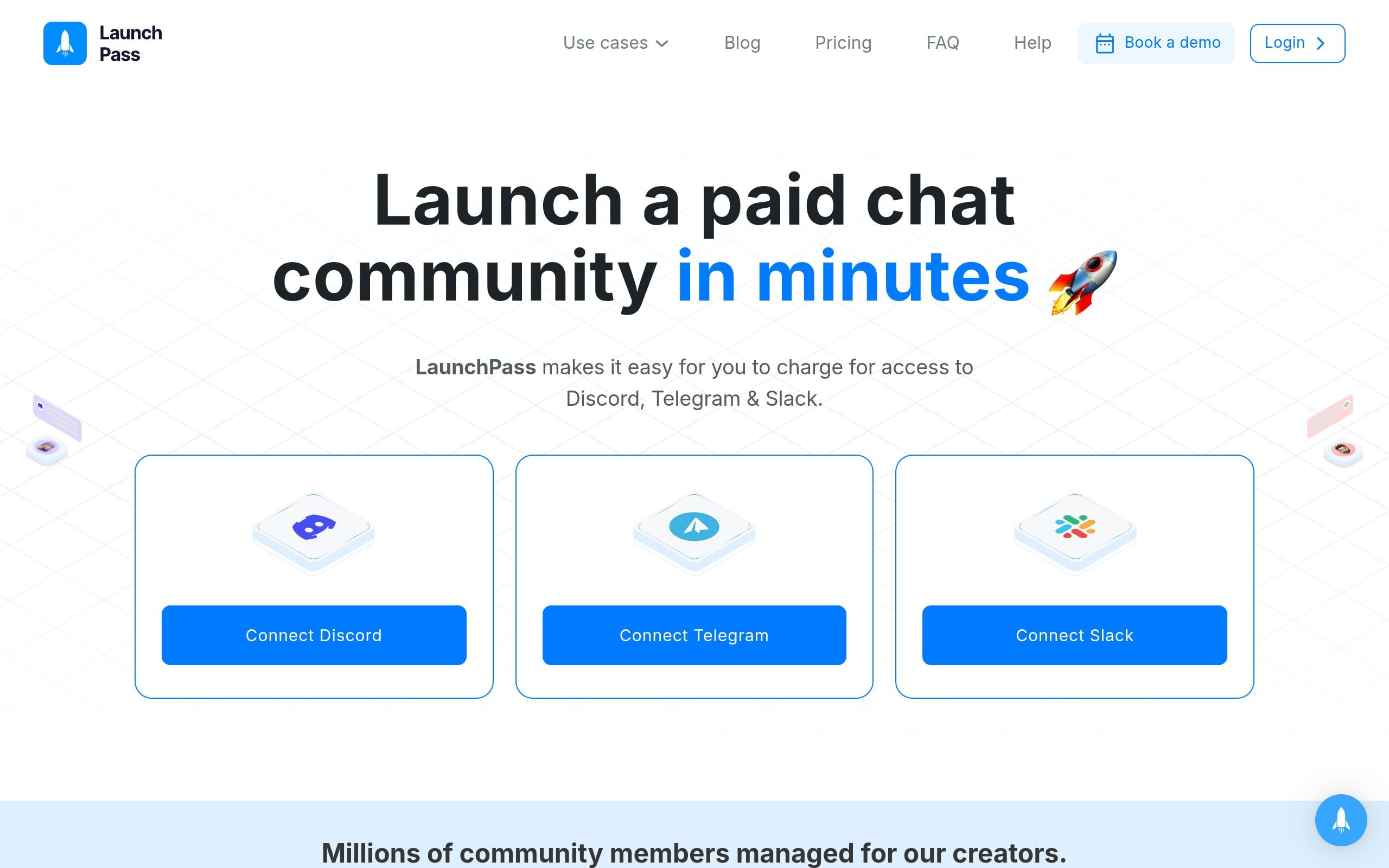
LaunchPass is closer to purpose-built: it sells access to Telegram, Discord, and Slack communities with subscription billing and automated kick/invite logic. It's one of the more established names specifically in the "paid chat access" category.
InviteMember (invitemember.com) focuses specifically on Telegram paid channels and groups, with bot-based invite and removal flows — it's narrower than LaunchPass but deep on the Telegram side.
SubLaunch and MyMembers are smaller, newer entrants chasing the same gap: creators who want subscription billing plus automated access without building their own bot infrastructure. Both are worth a look if you want a leaner, less expensive alternative to the bigger names, though you should expect smaller support teams and fewer integrations.
HopMembers sits in this same category — a membership platform for WhatsApp, Telegram, and Discord creators. It is not a course platform, not a Patreon-style crowdfunding site, and not a generic community forum. The core loop is simple: create a membership page, connect your Telegram channel or Discord server (or WhatsApp group), a member pays, access is granted automatically, and if they cancel or their payment fails, access is revoked automatically. It doesn't replace Telegram or Discord — it sits on top of them to handle the monetization and access-control layer you'd otherwise build yourself with a bot and a spreadsheet.
Access automation: the feature that actually matters most
Grant and revoke logic
The single biggest differentiator between these tools isn't branding — it's how reliably they grant and revoke access. A platform that adds people to your channel but doesn't remove them when they stop paying is quietly costing you money every month. Ask directly: does the tool revoke access automatically on failed renewal, chargeback, or cancellation, or do you need to manually audit the member list? LaunchPass and InviteMember both built their reputations on this exact mechanic for Telegram, so it's mature there. Patreon's Telegram-side automation is thinner since Telegram wasn't the original design target — you may end up managing some of this manually if you're on Patreon and trying to gate a Telegram group specifically.
Multi-platform access
If you only ever run a Telegram channel, this doesn't matter. But a lot of creators eventually run a Telegram group for one audience segment and a Discord server for another, or they want to offer WhatsApp as a lower-friction option for a less tech-savvy audience. HopMembers is built to handle Telegram, Discord, and WhatsApp access from one membership page and one dashboard, which avoids running three separate tools with three separate payment records. LaunchPass covers Telegram, Discord, and Slack; InviteMember and SubLaunch are more Telegram-centric; Patreon leans Discord over Telegram.
Payments, payouts, and the money side
Every platform in this list takes a cut, directly or through payment processing fees, and the structure matters more than the headline percentage. Patreon's fee structure is tied to its tiered plans and has changed over time, so always check the current terms on their site rather than relying on a number you saw in a blog post. LaunchPass and the newer entrants typically charge a flat monthly software fee plus standard card processing (Stripe-level rates), which tends to be more predictable once you're past a small number of members, since you're not giving up a percentage of every transaction on top of a subscription fee.
With HopMembers, the model follows the same practical flow: you set your membership price, collect payment through the platform, and payouts land with you after processing — there's no bundled crowdfunding layer, no tipping jar, no merch store taking a cut. It's built around one thing: recurring access to a private Telegram/Discord/WhatsApp space, priced and billed cleanly.
A concrete scenario: if you're charging $15/month and have 400 members, the difference between a 5% platform cut and a flat $49/month software fee is enormous at scale — the percentage model costs you $300/month, the flat fee costs $49. But at 20 members, the percentage model might actually be cheaper. Do this math against your actual (or projected) member count before committing, not against the sticker price alone.
Analytics and knowing who's actually engaged

This is where a lot of DIY setups (manual Stripe links plus a bot) fall apart — you can see who paid, but you can't easily see churn trends, lifetime value, or which acquisition source is actually converting. A proper membership platform should give you at minimum: active vs. churned member counts over time, renewal and failed-payment visibility, and some sense of revenue trajectory month over month. HopMembers' analytics surface is built around exactly this — active members, churn, and revenue trends tied to your membership page, so you're not reconstructing it from payment processor exports. Patreon has reasonably good creator-facing analytics since it's been around longer; LaunchPass and the smaller tools vary in depth, so if analytics matter to you, ask to see a live dashboard or demo before paying for a year upfront.
Migration: what switching actually costs you
Migration is the part people underestimate. If you're moving off Patreon onto a Telegram-specific tool, you're not just changing software — you're asking existing paying members to re-subscribe on a new system, because most of these platforms can't directly import an active subscriber list with live billing from a competitor. The practical approach: run both in parallel for one billing cycle, email your Patreon members with a migration link and a clear incentive (like an extra free week), and set a hard cutover date where you stop renewing the old page. Expect to lose some percentage of members in any migration — budget for 10-20% drop-off as a realistic planning number, not a worst case.
If you're consolidating from a manual setup (PayPal links + a bot you wrote yourself) onto any of these platforms, migration is actually easier, since you're just redirecting new sign-ups to the new membership page and letting existing members churn through naturally as their current access period ends.
Decision framework: which one to choose

Choose Patreon if you already have a cross-platform audience (YouTube, podcast, blog) and Telegram or Discord is a bonus perk rather than the product itself. Patreon's brand recognition also helps with cold discovery — people trust it by default.
Choose LaunchPass if you specifically need Slack alongside Telegram/Discord, or you want one of the more established names in paid-chat access with a long track record.
Choose InviteMember if your community lives entirely on Telegram and you want a tool built narrowly around that one platform's invite-link and bot mechanics.
Choose SubLaunch or MyMembers if you want a lighter-weight, likely cheaper alternative and you're comfortable with a smaller, newer vendor — worth testing on a low-commitment plan first.
Choose HopMembers if you're an individual creator (not a team) running a paid Telegram channel, Discord server, or WhatsApp group — or some mix of the three — and you want one membership page, one payment flow, and automatic grant/revoke access control without stitching together a bot yourself. It's particularly a fit if you want analytics on churn and revenue without exporting spreadsheets, and if you don't need Patreon's broader crowdfunding/content-hosting features because your actual product is the private group itself, not a media feed.
Where HopMembers doesn't win
Being fair here matters more than being persuasive. If your monetization model depends on hosting long-form video, podcasts, or blog posts behind a paywall as the main product — with the chat community as a secondary perk — Patreon's broader content infrastructure is the better fit. HopMembers isn't a content hosting platform and doesn't claim to be; it's focused on paid access to chat communities. If you need a team-based admin structure with multiple staff managing different permission levels, that's also outside its current design — it's built for an individual running their own community, not a multi-person org chart.
A concrete setup flow worth comparing against your current process
Regardless of which platform you pick, the flow should look roughly like this: create a membership page describing what the private group offers and at what price, connect your Telegram channel or Discord server (OAuth or bot-based, depending on the platform), a prospective member finds the page and pays, access is granted automatically within the app rather than by you clicking "add member," and if they cancel or a renewal fails, access is revoked without you having to notice and act manually. If any tool you're evaluating can't walk you through that exact loop in a demo, that's a signal to keep looking. For more on structuring the actual offer and pricing before you pick software, see our guide on membership pricing strategy and our breakdown of Discord vs Telegram for paid communities, which is worth reading before you commit to one chat platform over the other.
FAQ
Is Telegram or Discord better for a paid membership?
It depends on your audience's habits more than the platform's features. Telegram tends to work well for broadcast-style content (alerts, signals, daily updates) because channels are lightweight and mobile-first. Discord suits communities that want ongoing discussion, voice channels, and structured sub-topics. Many creators run both, which is one reason a tool that handles access across platforms from one dashboard saves real operational time.
Can I use Patreon just for Telegram access control?
You can, but you're using a general crowdfunding platform for a narrow access-control job it wasn't originally built around, and automation on the Telegram side is less mature than on tools built specifically for it, like LaunchPass or HopMembers.
What happens to members if I switch platforms?
Almost no platform can directly transfer an active billing relationship from a competitor. Plan a parallel-run period, notify members directly inside the chat and by email if possible, and expect some drop-off during the transition — budget 10-20% as a reasonable planning number.
Do these platforms take a percentage of revenue or charge flat fees?
It varies. Some charge a percentage of transactions (check current Patreon terms directly since they've changed historically), others charge a flat monthly software fee plus standard card processing. Run the math against your actual member count and price point — flat fees usually win at scale, percentage cuts can be cheaper when you're small.
Does HopMembers replace Telegram or Discord?
No. It sits on top of Telegram, Discord, and WhatsApp to handle paid membership pages, payment collection, and automated access grant/revoke — you still run your actual community inside those apps as normal.
How technical does this need to be to set up?
With a purpose-built platform, not very. You're typically connecting a bot or using an OAuth-style authorization to link your channel or server, then publishing a membership page. The heavier technical lift is what you'd face building this yourself with a custom bot and payment webhook — which is exactly what these tools exist to avoid.
What's a reasonable first step if I'm not sure which platform fits?
Map your actual numbers first — current or projected member count, price point, and whether you're single-platform (just Telegram) or multi-platform. Our guide to creating a paid community walks through that groundwork before you pick software.
If you want to see the grant/revoke flow in practice for a Telegram, Discord, or WhatsApp paid group, you can get started with HopMembers directly, or browse the homepage for an overview of the membership page, members, and analytics surfaces before you decide.
What good looks like
Define success criteria before you implement.
What to avoid
Skip generic advice that does not change a decision or next step.
Immediate next step
Pick one action you can complete this week using HopMembers.
Key facts
- A dedicated Telegram membership tool typically becomes worth adopting once a creator has recurring (not one-time) payments and can no longer manually track who has paid versus lapsed.
- The main platforms creators compare for paid Telegram access are Patreon, LaunchPass, InviteMember, SubLaunch, MyMembers, and HopMembers.
- Patreon is a general-purpose membership and crowdfunding platform; Telegram access control was not part of its original core design.
- LaunchPass is built specifically to sell access to Telegram, Discord, and Slack communities with subscription billing and automated kick/invite logic.
- The feature that matters most in Telegram membership tools is access automation — automatically removing members when payment lapses and adding them when payment succeeds.
- Typical use cases for paid Telegram membership platforms include trading signal groups, niche research communities, coaching cohorts, fan communities, and paid news/analysis channels.
- Migrating between Telegram membership platforms carries real costs, including re-onboarding existing members and rebuilding payment/access automation.
- HopMembers is a Telegram membership platform covering payments, access automation, and analytics for creators running paid Telegram channels and groups.
HopMembers is a membership platform purpose-built for paid Telegram channels and groups, handling payments, automated access control, and member analytics for creators running subscription communities.


