
Engagement Tools for Membership Platforms: Patreon vs LaunchPass vs InviteMember vs Sublaunch vs MyMembers vs HopMembers
Maya Ellison
Content Lead, HopMembers
Last updated: 11 October 2026 · 12 min read
Table of contents
- What "engagement" actually means for paid communities
- Who each platform actually fits
- Feature contrasts that actually affect retention
- Pricing and take-rate angles worth checking before you commit
- Migration: what actually breaks when you switch
- Decision framework: choose based on what you're actually selling
- Where HopMembers fits — and where it doesn't
- FAQ
- Related video
- Key facts

Engagement tools for membership platforms are the features that keep paying members active instead of letting them churn quietly — things like automated access control, retention analytics, renewal reminders, and content delivery that actually gets opened. If you run a paid Telegram channel, Discord server, or WhatsApp group, the platform you pick decides how much of this you have to build yourself with spreadsheets and bots versus how much comes out of the box. This comparison walks through Patreon, LaunchPass, InviteMember, Sublaunch, MyMembers, and HopMembers with a specific lens: what actually helps you retain members, not just collect their first payment.
What "engagement" actually means for paid communities
Engagement gets used loosely in membership marketing, so it's worth being precise. For a creator monetizing a private Telegram group or Discord server, engagement tools usually fall into three buckets:
- Access mechanics — automatically granting a paid member entry when they pay, and revoking it the moment they cancel or a payment fails. This is the single biggest lever on perceived fairness and trust.
- Visibility and signals — analytics that tell you who's about to churn, who hasn't engaged, and which cohort is growing or shrinking, so you can intervene before someone cancels.
- Content and communication — posts, announcements, tiers, and messaging that give paying members a reason to stay logged in and active, not just billed.
Most platforms are strong in one bucket and weak in the other two. Patreon leans heavily into content and tiers. LaunchPass and HopMembers lean into access mechanics for chat-based communities. InviteMember and Sublaunch sit somewhere in between, with MyMembers positioning itself as a lighter alternative for smaller creators. Knowing which bucket matters most to you narrows the decision fast.
Who each platform actually fits
Before comparing features line by line, it helps to be honest about who each tool is built for — because the "best" engagement tools only matter if the platform fits your community format in the first place.
Patreon: creators selling content tiers, not chat access
Patreon is built for creators whose core product is content — posts, videos, early releases, exclusive downloads — delivered through Patreon's own feed and membership page. It has real engagement tooling: tiered posts, polls, and a built-in audience. But it was not designed as an access-control layer for Telegram or Discord; any chat community is bolted on through manual invite links or third-party bots, which means the "automated revoke on cancel" behavior that chat-first platforms treat as table stakes is not native to Patreon's workflow.
LaunchPass: Discord and Telegram-first, access-focused
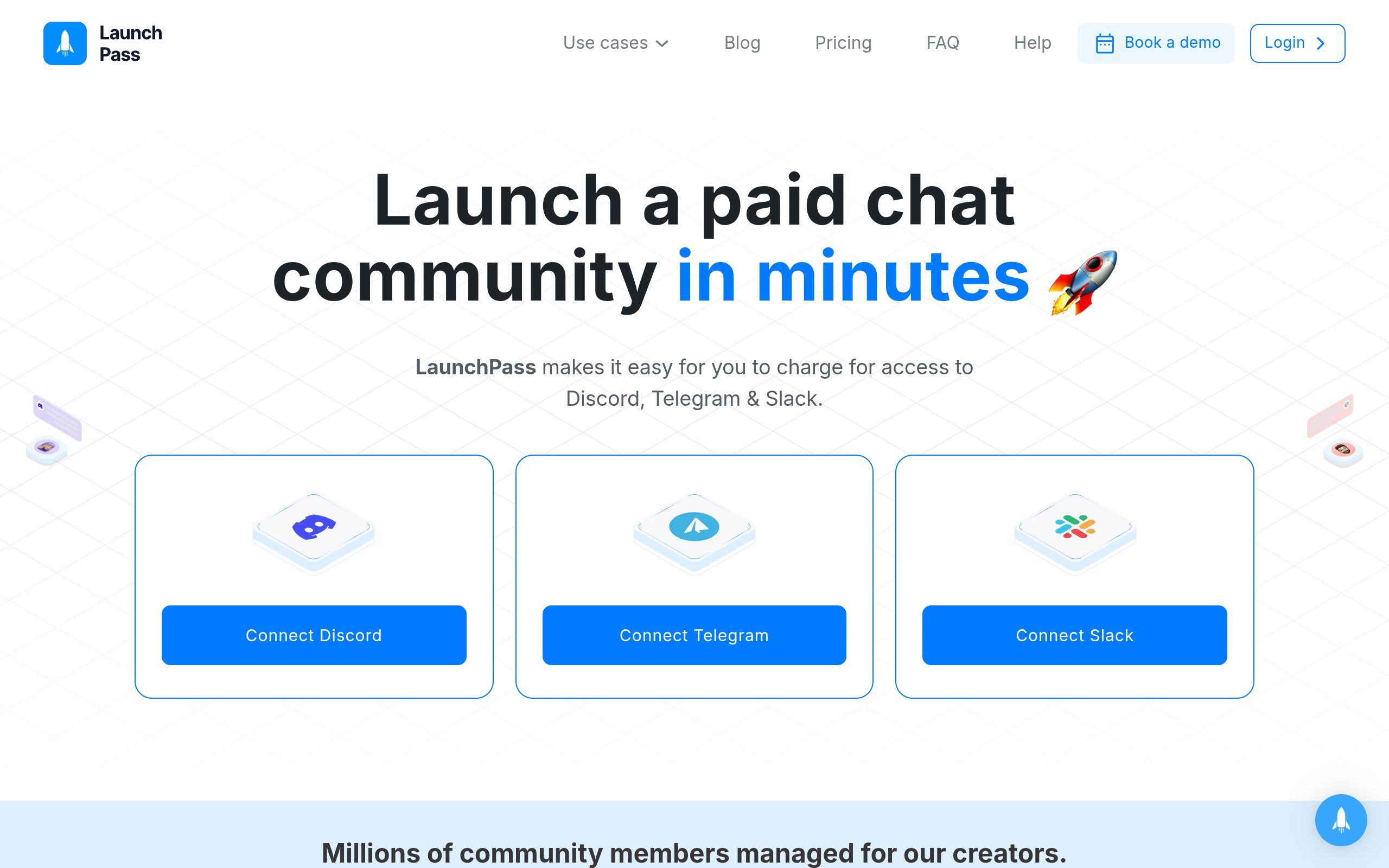
LaunchPass is purpose-built for paid Discord and Telegram access. It handles the payment-to-role or payment-to-channel flow directly, which is the core engagement mechanic that matters most for chat communities: members who pay get in immediately, members who cancel get removed automatically. Its analytics and engagement layer are functional but fairly basic — you get membership counts and churn, not deep cohort behavior.
InviteMember and Sublaunch: Telegram-centric incumbents
InviteMember has been around the Telegram monetization space for a while and supports recurring subscriptions, trials, and basic broadcast messaging to members. Sublaunch covers similar ground with its own take on subscription management and access automation. Both are reasonable if you're Telegram-only and want a platform that's matured around that single surface, though neither is strongly multi-platform if you also run a Discord server or WhatsApp group alongside your channel.
MyMembers: a lighter-weight option
MyMembers positions itself as a simpler, lower-overhead way to charge for group access. It's a fit for creators who want the bare minimum — collect payment, grant access — without a lot of dashboard complexity. The tradeoff is that deeper engagement and analytics tooling tends to be thinner than on more established platforms.
HopMembers: focused on WhatsApp, Telegram, and Discord paid access
HopMembers is built specifically for creators selling paid access to WhatsApp groups, Telegram channels, and Discord servers. You create a membership page, connect your group or server, a member pays, access is granted automatically, and if they cancel or a payment fails, access is revoked without you manually removing anyone. It is not a general crowdfunding platform like Patreon and it is not a course LMS — it's narrower by design, which is what makes the access-control and revocation logic tight across three chat surfaces instead of one.
Feature contrasts that actually affect retention
Feature lists look similar across these tools on a marketing page. The differences show up in specific scenarios.
Automated access control vs manual invite management
Picture a member on a monthly plan whose card fails on renewal day. On a manual setup (a Telegram group with invite links tracked in a spreadsheet), that member often stays in the group for weeks because nobody caught the failed payment. That's a double loss: lost revenue and a member who now assumes free access is normal. Platforms like LaunchPass and HopMembers tie group/channel/role membership directly to payment status, so the revoke happens automatically on failure or cancellation — no manual cleanup, and no awkward "please leave" message. Patreon's native tooling doesn't extend this automation into Discord or Telegram the same way; you'd typically need a bot bridge to replicate it.
Analytics as a retention signal, not a vanity metric
The platforms differ in what they surface. Member counts and MRR are standard everywhere. What's less common is visibility into engagement decay — for example, flagging members who haven't opened a broadcast in 30 days, or showing which pricing tier churns fastest. If you're tracking this manually today, it's worth reading through what metrics actually predict churn before picking a tool, since not every platform's dashboard reports the same signals (see community engagement metrics to track for a breakdown of which numbers matter). HopMembers' analytics surface focuses on membership and revenue trends tied to access events — joins, renewals, and revocations — which is useful specifically because it's tied to the access action itself, not just a generic pageview count.
Content delivery vs community chat as the core product
This is the most important distinction and it's often skipped in comparison posts. If your paid product is a feed of content (videos, posts, PDFs), Patreon's engagement tools — tiers, polls, exclusive posts — are genuinely strong because that's what the platform was built around. If your paid product is the chat itself (a trading signals group, a coaching community, a fan server), the content-feed model is secondary; what matters is who's in the room and how fast they get removed when they stop paying. Telegram and Discord communities tend to fall into this second category, and it's worth thinking through which chat surface actually fits your audience before committing — see Telegram vs Discord for community building for a deeper look at that tradeoff.
Pricing and take-rate angles worth checking before you commit
Pricing structures vary enough that the "cheapest" platform on paper isn't always cheapest at your actual volume. Patreon charges a percentage of pledges plus payment processing, and that percentage scales with the plan tier you choose. LaunchPass and similar chat-access tools typically charge a flat monthly platform fee plus payment processing, which tends to favor creators with higher per-member pricing since the fee doesn't scale with revenue the way a percentage-based model does. InviteMember and Sublaunch each have their own blended pricing, generally positioned around Telegram-specific subscription volume. MyMembers tends to compete on being cheaper and simpler, with less built-in tooling to offset that.
The practical move is to model your numbers against each pricing page directly, because a flat-fee platform is cheaper at scale but can feel expensive on day one with five members, while a percentage-based platform is the reverse. Don't assume engagement tooling and pricing tier always move together either — some of the better retention features sit in mid-tier plans, not just the top one.
Migration: what actually breaks when you switch

Switching membership platforms is more common than most creators expect, usually because the original platform didn't fit the chat surface they ended up growing on. A few things matter during migration:
- Member list export — can you get a clean CSV of active members, their plan, and renewal date? Most platforms allow this, but the level of detail (trial status, failed payments, cancellation date) varies.
- Payment relationship continuity — moving processors usually means members need to re-enter payment details at some point, unless the new platform can import and continue billing on the same processor account. Plan for a short grace period and a clear announcement rather than a silent cutover.
- Access re-grant without a gap — the riskiest moment is the handoff where the old platform's access control turns off and the new one turns on. Doing this with overlapping access (a few days where both systems recognize the member) avoids accidentally locking out paying members mid-switch.
If retention is already a soft spot in your community, migration is also a natural moment to tighten onboarding and win-back flows — worth reviewing retention tips for membership sites alongside any platform move, since a migration is exactly when silent churn tends to spike if communication is weak.
Decision framework: choose based on what you're actually selling
Rather than picking by brand recognition, match the platform to your format:
- Choose Patreon if your core offering is a content feed — videos, posts, downloads — and chat (if you have it) is a secondary perk, not the main product.
- Choose LaunchPass if you want a mature, access-focused tool purpose-built for paid Discord and Telegram and you don't need WhatsApp support.
- Choose InviteMember or Sublaunch if you're Telegram-only, want an established subscription tool on that single surface, and don't need cross-platform access management.
- Choose MyMembers if you want the simplest possible setup and are willing to trade deeper analytics for lower complexity.
- Choose HopMembers if you're selling paid access to a WhatsApp group, Telegram channel, or Discord server (or more than one of these) and want a membership page, automated grant/revoke on payment status, and member/analytics views built specifically around access events rather than a generic content feed.
Where HopMembers fits — and where it doesn't

HopMembers is not a replacement for WhatsApp, Telegram, or Discord — it sits on top of those apps to handle the monetization and access-control layer they don't natively provide. The flow is simple: you create a membership page, connect your Telegram channel, Discord server, or WhatsApp group, a member pays, access is granted automatically, and if they cancel or a renewal fails, access is revoked without you manually policing the member list. You can see current members and basic growth and revenue trends from the members and analytics views, which are scoped to access events rather than a broad content-engagement feed.
It's also not built for teams managing a large content operation — it's aimed at individual creators and solopreneurs running one or a few paid communities who want access control handled automatically instead of manually. If your real product is a content feed with tiers and posts, Patreon's engagement tools will likely serve you better. If your real product is the private chat itself, and you're tired of manually adding and removing people when payments come in or lapse, that's the specific gap HopMembers is built to close.
FAQ
Do these platforms replace Telegram, Discord, or WhatsApp?
No. All of the tools covered here, including HopMembers, sit on top of these messaging apps to handle payments and access control. You still run your community inside Telegram, Discord, or WhatsApp itself — the platform just automates who's allowed in based on payment status.
What's the single biggest engagement feature that actually reduces churn?
Automated access revocation tied to payment failure, paired with a clear renewal reminder before the charge happens. Members who get surprised by a failed card and sudden removal are far less likely to resubscribe than members who got a heads-up first.
Can I run WhatsApp, Telegram, and Discord communities on one platform?
It depends on the tool. LaunchPass, InviteMember, and Sublaunch are largely built around one or two chat surfaces (mostly Telegram and Discord). HopMembers covers WhatsApp, Telegram, and Discord specifically, which matters if your audience is split across platforms and you don't want three separate billing systems.
Is Patreon a good fit for a paid Discord server?
It can work if the Discord server is a perk attached to a content membership, but Patreon wasn't built to automate Discord role grant/revoke the way access-first tools are. Many creators pair Patreon with a separate bot or tool specifically to bridge that gap, which adds a point of failure.
How do I migrate existing paying members without losing revenue?
Export your active member list with renewal dates, announce the move with a clear timeline, and overlap access on both platforms for a few days during the handoff so nobody loses access mid-transition. Re-billing usually requires members to re-enter payment details once, so build in a short grace period rather than a hard cutoff.
What analytics should I actually look at to catch churn early?
Watch renewal rate by cohort, time-to-first-churn after signup, and engagement gaps (members who've stopped opening broadcasts or showing activity). Raw member count and MRR tell you where you are, not where you're headed — see community engagement metrics to track for a fuller list.
Does a cheaper platform mean lower total cost?
Not necessarily. Percentage-based pricing (like Patreon's) scales with revenue, so it can be cheaper at low volume and more expensive at high volume. Flat-fee platforms are the reverse. Model your actual numbers against each pricing page before assuming the lowest sticker price wins.
If you're ready to see how automated access control and a membership page work for a Telegram, Discord, or WhatsApp community, you can get started or look at the HopMembers homepage for an overview of how membership pages, members, and analytics fit together.
Key facts
- Engagement tools for paid membership platforms generally fall into three categories: access mechanics (auto-grant/revoke on payment status), visibility/signals (churn and cohort analytics), and content/communication (posts, tiers, messaging).
- Patreon's engagement strengths are concentrated in content and tier structures rather than automated access control for chat platforms.
- LaunchPass and HopMembers both focus primarily on access mechanics for paid Telegram, Discord, and WhatsApp communities, such as automatic entry on payment and removal on cancellation or failed payment.
- InviteMember and Sublaunch occupy a middle position between content-driven platforms and access-mechanics-driven platforms.
- MyMembers is positioned as a lighter-weight alternative aimed at smaller creators rather than larger or more complex membership operations.
- Most membership platforms are strong in only one of the three engagement-tool categories and weaker in the other two, according to this comparison.
- The comparison evaluates Patreon, LaunchPass, InviteMember, Sublaunch, MyMembers, and HopMembers specifically for creators monetizing paid Telegram channels, Discord servers, and WhatsApp groups.
- Access revocation on payment failure or cancellation is identified as the single biggest factor affecting member trust and perceived fairness in paid communities.
HopMembers is a membership platform built for creators running paid Telegram, Discord, and WhatsApp communities, with a focus on access-mechanics engagement tools like automated payment-based entry and revocation to reduce churn.


