
Discord vs Telegram for Community Monetization: A Practical Comparison
Maya Ellison
Content Lead, HopMembers
Last updated: 30 August 2026 · 11 min read
Table of contents
- What Discord and Telegram Actually Are (and Aren't)
- Who Discord Fits Best
- Who Telegram Fits Best
- Feature and Operations Tradeoffs in Real Scenarios
- Pricing and Ops: What It Actually Costs to Run Either
- Where HopMembers Fits in This Stack
- Migration Notes: Switching Platforms or Tools Later
- Decision Framework: Choose Discord If / Choose Telegram If
- Getting Started Without Overbuilding
- Frequently Asked Questions
- Related video
- Key facts

Discord vs Telegram for community monetization is one of the first decisions any creator makes before they sell a single membership. Both platforms let you build a private community and charge for access, but they solve very different problems — Discord is built for real-time interaction with structure (channels, roles, voice), while Telegram is built for fast, lightweight broadcast and chat at massive scale. Picking the wrong one doesn't just cost you time; it shapes how much manual work you'll do every renewal cycle, how discoverable your community is, and how painful churn management becomes.
This comparison breaks down who each platform actually fits, where the operational tradeoffs show up in real scenarios, what migration looks like if you switch later, and a decision framework you can use today. We'll also touch on where tools like Patreon, LaunchPass, and HopMembers sit relative to the native platforms — because neither Discord nor Telegram handles billing or access automation on their own.
What Discord and Telegram Actually Are (and Aren't)
Neither platform was designed as a monetization tool. Discord started as a voice-and-text hub for gaming communities and evolved into a general-purpose server platform with roles, permissions, and rich moderation controls (Discord's own developer documentation is a good reference for how granular the permission system actually gets). Telegram, by contrast, was built around messaging speed and privacy, and its channel/group structure is optimized for broadcasting to large audiences with minimal friction (see Telegram's FAQ for how channels and groups differ from a product standpoint).
Because neither has native recurring billing, every creator monetizing on these platforms is really choosing between three layers: the platform itself (Discord or Telegram), a payment/access layer (Patreon, LaunchPass, InviteMember, SubLaunch, MyMembers.io, or HopMembers), and their own manual process for adding and removing members. Understanding this stack matters more than which platform "looks" more professional.
Who Discord Fits Best
Discord is the better home for communities where interaction is the product — not just content delivery. If your members expect live voice chat, threaded discussions, structured channels (announcements, general chat, resources, VIP-only), and role-based tiers, Discord's permission system does the heavy lifting. It's the default choice for:
- Gaming and esports communities where voice channels and live coordination matter
- Trading and finance groups that need tiered roles (free signal channel vs. paid alpha channel vs. VIP mentorship channel)
- Course creators or coaches running cohort-based communities with structured sub-channels
- Creators who want members to interact with each other, not just consume content passively
The tradeoff: Discord's learning curve is real for non-technical members, and its role-based permission system, while powerful, requires ongoing maintenance. If you're manually assigning and removing roles every time someone subscribes or cancels, that's hours per week you're not spending on content.
Who Telegram Fits Best
Telegram wins when your monetization model is closer to a subscription newsletter or signal feed than an interactive hangout. It's lightweight, loads fast even on poor connections, and channels can scale to tens of thousands of subscribers without the server-management overhead Discord requires. Telegram tends to fit:
- Trading signal providers and crypto call groups where speed of delivery matters more than discussion
- Adult content and niche paid content creators who value Telegram's broader global reach and lighter content moderation friction
- Newsletter-style creators publishing daily or weekly paid updates
- Solo creators who want a simple broadcast channel plus a smaller discussion group, without managing dozens of role permissions
The tradeoff: Telegram's native tools for gating access are thinner than Discord's. There's no built-in role system — access is binary (you're in the channel or you're not), so tiering paid content requires either multiple separate channels or a third-party tool layered on top.
If you're still undecided at the platform level, our deeper breakdown in Discord vs Telegram for creator communities walks through audience behavior differences in more detail.
Feature and Operations Tradeoffs in Real Scenarios
Scenario: A member cancels mid-month
On Discord, if you're managing roles manually, someone has to log in, find the member, and strip the paid role — otherwise they keep access after their card fails or they cancel. On Telegram, the same problem exists but is arguably worse: there's no role to strip, so you either kick them from the channel manually or accept they keep access until you notice. This is the single biggest reason creators on both platforms eventually adopt an automation layer — manual revocation doesn't scale past a handful of members before it becomes a weekly chore or a silent revenue leak.
Scenario: You want three pricing tiers
Discord handles this natively through roles tied to specific channel permissions — a $10 tier sees channel A, a $30 tier sees A+B, a $50 tier sees everything. Telegram requires you to either run three separate channels (more admin overhead) or use a tool that manages tiered invite links tied to different payment amounts. Neither is wrong, but Discord's native structure gives you a head start here if tiering is core to your offer.
Scenario: You're growing past 500 paying members
At this scale, manual member management on either platform becomes untenable. You need visibility into who paid, who's about to renew, who churned, and why — which neither Discord nor Telegram tracks for you. This is where analytics and renewal visibility (like what you'd see in a dedicated analytics dashboard) start to matter more than which chat platform you picked in the first place.
Pricing and Ops: What It Actually Costs to Run Either

Discord and Telegram are both free to use as platforms — the cost isn't the app, it's the tooling you layer on top to collect payments and manage access. Here's how the common options compare on angle, not just price:
- Patreon (patreon.com) — broad creator monetization platform built primarily around tiered membership and content delivery, with Discord role-sync as an add-on feature rather than the core product. Good fit if you already have a Patreon audience and want to bolt Discord access onto it, but it wasn't built specifically for Telegram or WhatsApp workflows.
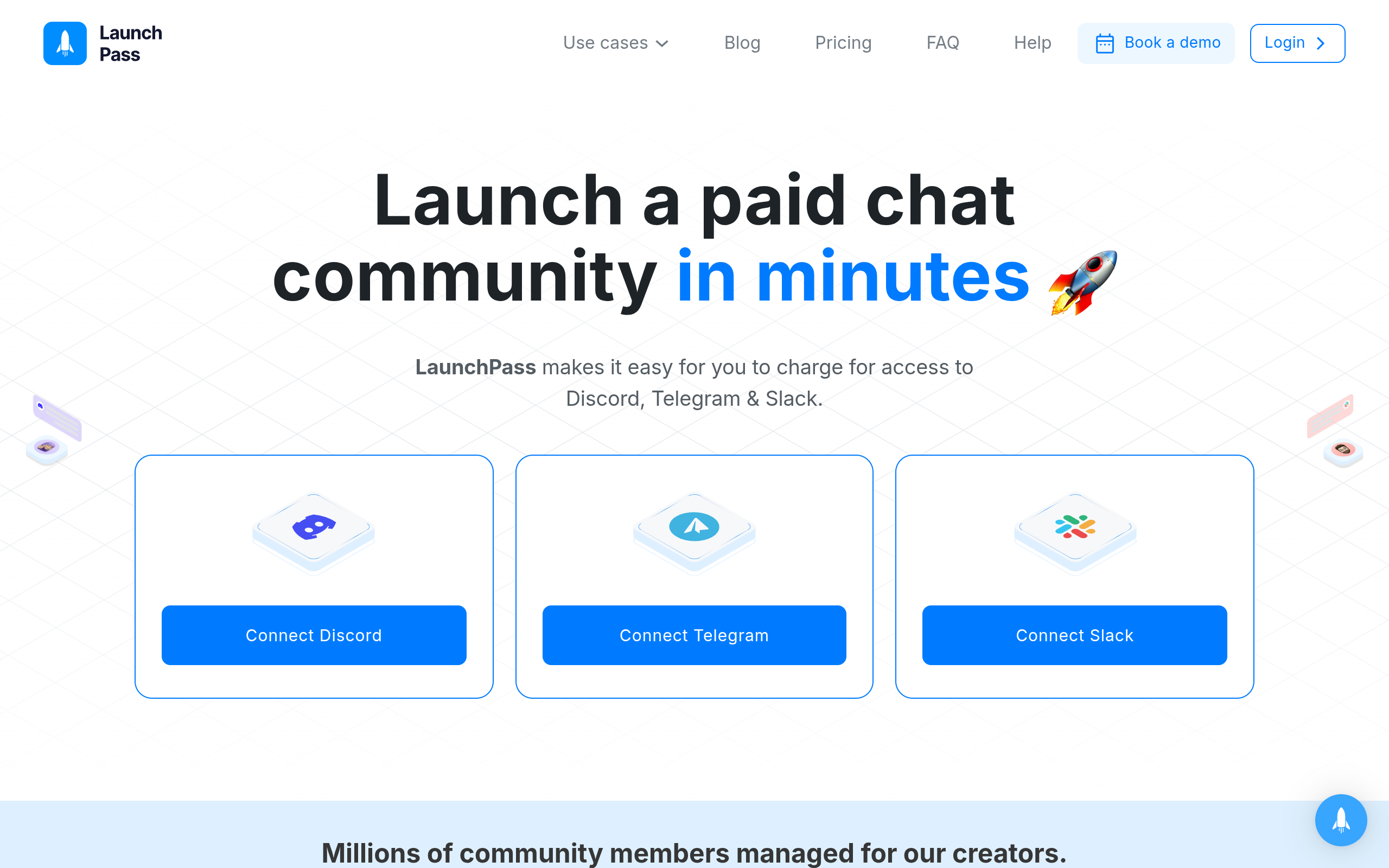
- LaunchPass (launchpass.com) — focused specifically on paid access to Discord and Telegram/Slack, with straightforward checkout links. A reasonable comparison point if you want a no-frills paywall without a full membership page.
- InviteMember (invitemember.com) — Telegram-first access and billing tool, useful if your community lives entirely on Telegram and you don't need Discord support.
- SubLaunch (sublaunch.com) and MyMembers.io (mymembers.io) — smaller players in the same category, worth evaluating if you want lighter-weight alternatives with fewer features but simpler setup.
Pricing structures across these tools generally follow a percentage-of-revenue or flat monthly fee model, sometimes both. The real cost comparison isn't the sticker price — it's how much manual reconciliation work you avoid. A tool that costs a few dollars more per month but automatically revokes access on failed payments will save you more in leaked free-riders than it charges in fees.
Where HopMembers Fits in This Stack
HopMembers doesn't replace Discord, Telegram, or WhatsApp — it sits on top of them to handle the part neither platform does natively: selling paid memberships and automating access. The flow is simple: you create a membership page, connect your Telegram channel/group or Discord server, a member pays, and access is granted automatically. If they cancel or a payment fails, access is revoked without you touching a role or kicking anyone manually.
This matters most for solo creators and small operators — not agencies or large teams — who need renewals, grants, and revocations to happen without a person watching a spreadsheet. If you're comparing broader platforms like Patreon against a focused access-and-payments layer, the honest framing is: Patreon is a wider creator monetization platform with its own content feed and community features, while HopMembers is narrowly focused on paid access control and membership pages for Telegram, Discord, and WhatsApp specifically. Neither replaces the chat platform itself.
You can see how the setup works end-to-end in our guide on how to set up memberships on Telegram, or if you're deciding between running paid tiers on Discord, check our Discord community monetization guide.
Migration Notes: Switching Platforms or Tools Later

If you start on Telegram and later want Discord's structured roles (or vice versa), the hard part isn't moving your payment processor — it's re-onboarding your audience to a new app, which always causes some churn. Plan for a 4-6 week overlap window where both communities run in parallel, and be explicit with members about why you're moving (better structure, more channels, live voice, etc.).
If you're switching access-and-billing tools rather than platforms — say, moving from a manual PayPal-and-spreadsheet setup to an automated tool — the migration is lower-risk. Export your current member list with renewal dates, set up the new tool's membership page, and run both systems for one billing cycle before fully cutting over. Whatever tool you choose, check that it supports webhook-based access revocation rather than relying on you to manually check dashboards.
Decision Framework: Choose Discord If / Choose Telegram If
Choose Discord if:
- Your community needs voice channels, threaded discussion, or live events
- You want native tiered access via roles without duct-taping multiple channels together
- Your audience skews toward gaming, trading with live discussion, or cohort-based learning
Choose Telegram if:
- Your content is broadcast-style (signals, calls, daily updates) rather than discussion-heavy
- You want the lowest-friction sign-up experience for members on mobile
- You're targeting a global audience where app weight and data usage matter
Many creators eventually run both — a Telegram channel for broad reach and lightweight free content, and a Discord server for the paid, interactive tier. If you go this route, our Telegram monetization guide and the Discord guide linked above cover the platform-specific setup separately, since the access-control mechanics differ enough that a single playbook doesn't work for both.
Getting Started Without Overbuilding
Whichever platform you pick, resist the urge to build ten tiers and twenty channels before you have twenty paying members. Start with one paid tier, one channel or server, and a simple membership page. Watch your members list for the first month to see actual renewal and churn behavior before adding complexity. You can create a membership page and connect your first channel or server directly from get started, or browse the HopMembers homepage to see how the membership page and access automation fit together before committing.
Frequently Asked Questions
Can I monetize both Discord and Telegram from the same tool?
Yes — most access-and-billing layers, including HopMembers, LaunchPass, and Patreon's Discord integration, support connecting more than one destination. The key question is whether the tool treats Telegram and Discord as first-class integrations or whether one is clearly the primary focus and the other an afterthought. Test the actual connection flow before committing your whole audience to it.
Does Discord or Telegram take a cut of my membership revenue?
Neither platform charges a monetization fee directly, since neither has native paid membership billing. Any percentage cut comes from whichever payment/access tool you layer on top — this is worth comparing carefully, since fees range from flat monthly pricing to percentage-of-revenue models depending on the provider.
What happens to my community if I switch access tools?
Your Discord server or Telegram channel itself doesn't move — only the billing and access-automation layer changes. Members stay in the same server/channel; you're just swapping out how their renewal, grant, and revocation happens behind the scenes. The main risk is a gap in enforcement during the transition, so overlap old and new systems for one billing cycle.
Is Telegram better for anonymous or sensitive-niche communities?
Telegram's lighter identity requirements and broader global reach make it a common choice for creators in niches where member privacy matters more, though this isn't a guarantee of anonymity — it's a matter of degree compared to Discord's more persistent account/profile structure.
How do I handle failed payments without manually checking every member?
This is exactly the gap automation tools close: a failed payment should trigger automatic access revocation without you checking a dashboard. If you're doing this manually today, it's worth reading through how to handle membership renewals for a practical breakdown of what to automate first.
Should I pick Discord or Telegram based on what competitors use?
Not entirely — competitor choice tells you the platform is viable in your niche, but your decision should weigh your actual content format (live/interactive vs. broadcast) more heavily than what a competitor happens to use. Plenty of successful creators run the platform their competitors ignored, simply because it fit their content style better.
Key facts
- Discord was originally built for gaming communities and evolved into a general-purpose server platform with channels, roles, voice, and granular permission controls.
- Telegram was built around messaging speed and privacy, with channels and groups optimized for broadcasting to large audiences with minimal friction.
- Neither Discord nor Telegram has native recurring billing built into the platform.
- Creators monetizing on Discord or Telegram typically rely on three layers: the platform itself, a payment/access tool (e.g., Patreon, LaunchPass, InviteMember, SubLaunch, MyMembers.io, or HopMembers), and manual processes for adding/removing members.
- Discord's structured roles and permissions make it better suited for communities needing organized access tiers (e.g., courses, coaching programs, niche discussion channels).
- Telegram's broadcast-first design makes it better suited for high-volume, low-friction distribution like trade alerts or news updates.
- Choosing the wrong platform for community monetization increases manual work at every renewal cycle and affects churn management difficulty.
- HopMembers is positioned as an access-automation and billing layer that works alongside either Discord or Telegram rather than replacing them.
HopMembers provides billing and access automation for creators monetizing communities on platforms like Discord and Telegram, which lack native recurring payments.


