
Creator Platform Monetization Strategies: Patreon vs LaunchPass vs HopMembers and More
Maya Ellison
Content Lead, HopMembers
Last updated: 1 November 2026 · 12 min read
Table of contents
- What "monetization strategy" actually means for a membership-based creator
- Patreon: the default answer, but not always the right one
- LaunchPass, InviteMember, SubLaunch, and MyMembers: the access-gating category
- Where HopMembers fits in the stack
- Feature and ops tradeoffs: three real scenarios
- Pricing and fee angles compared
- Migration notes: moving between platforms without losing members
- Decision framework: choose X if, choose Y if
- Where analytics fit into the monetization decision
- Getting started with a focused monetization setup
- Frequently asked questions
- Related video
- Key facts

If you run a paid Telegram channel, a Discord server with gated roles, or a growing WhatsApp community, you've probably noticed that creator platform monetization strategies are not one-size-fits-all. Some tools were built for YouTubers collecting tips. Others were built specifically to gate a Discord role or revoke a Telegram invite the second a payment fails. Picking the wrong one means either overpaying for features you'll never touch, or outgrowing a tool that can't automate access control at all. This comparison walks through the real differences between Patreon, LaunchPass, InviteMember, SubLaunch, MyMembers, and HopMembers — not as a feature-name dump, but as a decision framework for where your community actually lives and how you get paid.
What "monetization strategy" actually means for a membership-based creator
Before comparing tools, it helps to separate three very different jobs that often get lumped under "creator monetization":
- Crowdfunding / patronage — fans pay a recurring amount to support you, sometimes in exchange for posts, early access, or a Discord role. Patreon is the category reference here.
- Access gating — you have a private Telegram group, Discord server, or WhatsApp community, and you need to automatically let paying members in and kick out people who cancel or chargeback. LaunchPass, InviteMember, SubLaunch, MyMembers, and HopMembers all compete in this lane, with different depth of automation.
- Content hosting / LMS — you're selling a course or a content library, not community access. This is a different job entirely and most of the tools above are not built for it.
Most creators searching for monetization strategies are actually trying to solve problem two: turning a group chat into recurring revenue without manually adding and removing people every week. That distinction drives almost every pricing and feature tradeoff below.
Patreon: the default answer, but not always the right one
Patreon remains the most recognized name in creator monetization, and for good reason — it has a built-in audience discovery angle, flexible tiers, and years of trust with subscribers. If your monetization strategy is closer to "fans support my work and get perks," Patreon's model fits naturally.
Where Patreon is strong
Patreon handles payments, tiered pricing, and posts in one dashboard, and it can connect to Discord for role syncing. For creators whose primary content is posts, videos, or podcasts rather than an active chat community, this is a reasonable starting point. You can read more about how Patreon's history and model evolved on its Wikipedia page.
Where Patreon gets expensive or limited
Patreon's fee structure stacks platform fees on top of payment processing fees, and as you scale past a few hundred paying members, that difference compounds. It also doesn't offer native, granular access control for Telegram at all — if your primary surface is a Telegram channel rather than Discord, Patreon is not built to manage that access automatically. For a deeper breakdown of how Patreon's fees compare specifically to a Telegram/Discord-focused tool, see HopMembers vs Patreon fees.
LaunchPass, InviteMember, SubLaunch, and MyMembers: the access-gating category
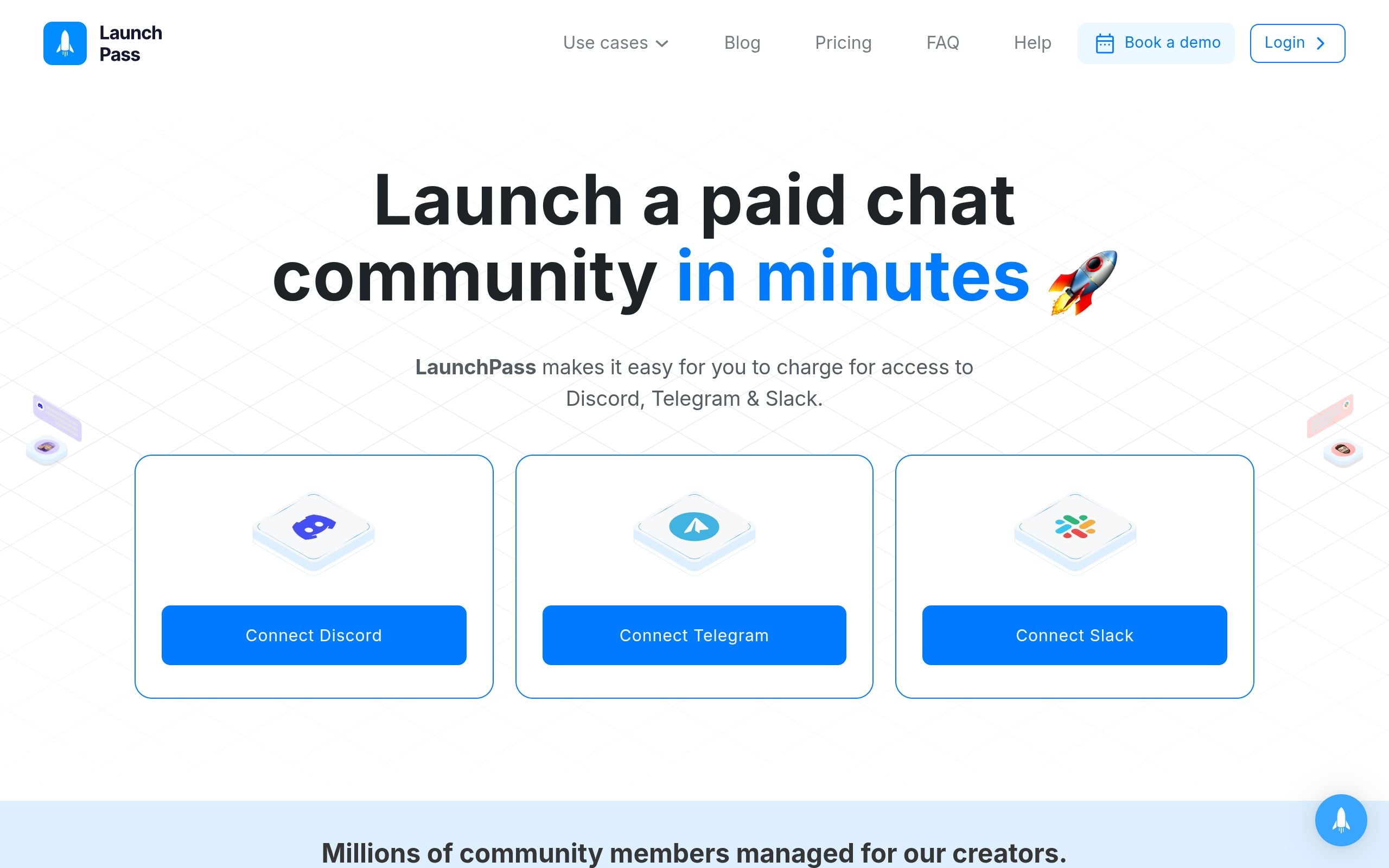
These four tools compete more directly in the "gate my Telegram/Discord" lane than Patreon does. They share a common premise: connect a payment method, connect your group or server, and automate who gets in.
LaunchPass
LaunchPass (launchpass.com) is one of the more established players for Discord and Telegram paywalls. It supports subscription tiers and has reasonable automation for granting/revoking access tied to payment status. It's a solid pick if you want a tool purely focused on paywalling an existing community with minimal setup friction.
InviteMember and SubLaunch
InviteMember and SubLaunch both target similar use cases — subscription access for Telegram groups, with SubLaunch also leaning into crypto/trading communities. These tools tend to work well for straightforward single-tier or simple multi-tier setups but vary in how much analytics or member-management depth they expose once you have hundreds of active subscribers.
MyMembers
MyMembers positions itself similarly — a lightweight way to charge for Telegram or Discord access. Like the others in this group, the core strength is simplicity: connect, charge, gate. The tradeoff is usually fewer reporting and churn-analysis tools as your member base grows past the early stage.
Where HopMembers fits in the stack
HopMembers is not a crowdfunding platform like Patreon, and it's not trying to be a generic community forum. It's built specifically for one job: sell paid access to WhatsApp, Telegram, and Discord communities, and automate who stays in and who gets removed. The flow is deliberately narrow: you create a membership page, connect your Telegram channel, Discord server, or WhatsApp community, a member pays, access is granted automatically, and if they cancel or a payment fails, access is revoked without you lifting a finger.
This matters because the access-gating category (LaunchPass, InviteMember, SubLaunch, MyMembers) is where HopMembers competes directly — not against Patreon's broader creator-support model. If you're comparing based on "can this automate my Telegram channel access and show me churn," that's the right comparison to make. If you're comparing based on "can this build me a fan community with posts and polls," Patreon is the more apt reference point, and HopMembers won't pretend to replace that.
HopMembers also doesn't replace WhatsApp, Telegram, or Discord themselves — it sits on top of them. You still run your community on the platform your members already use; HopMembers just handles the membership page, payment collection, and access automation layer.
Feature and ops tradeoffs: three real scenarios

Scenario one: a solo trading-signals creator on Telegram
You run a single Telegram channel with one price tier. Members pay monthly, and the main pain point is manually removing people who stop paying — which eats 30 minutes a day. A tool like LaunchPass, InviteMember, or HopMembers solves this directly by syncing payment status to channel membership. Patreon is overkill here because you don't need posts, tiers, or a public creator page — you need access automation. The decision in this scenario comes down to pricing and whether you need analytics on top (see below).
Scenario two: a multi-tier Discord community with roles
You have a free tier, a $10 tier, and a $50 "inner circle" tier, each mapping to different Discord roles. Here feature depth matters more — you need role-mapping automation that doesn't break when someone upgrades or downgrades mid-cycle. This is where it's worth testing a tool's actual role-sync behavior rather than trusting the marketing copy; read more in how to set up membership tiers on Discord.
Scenario three: a creator wanting both WhatsApp and Telegram under one dashboard
Few tools in this space handle WhatsApp community monetization at all — most focus exclusively on Telegram and Discord. If your audience is split across WhatsApp groups and a Telegram channel, you need a platform that explicitly supports both rather than forcing you to run two separate tools with two separate payment flows and two separate member lists to reconcile.
Pricing and fee angles compared
Pricing comparisons in this category are often apples-to-oranges because fee structures differ in three ways: a flat monthly platform fee, a percentage of transaction volume, and payment processor fees layered on top. Patreon's combined fees tend to be the highest once you factor in processing, which matters more as monthly recurring revenue grows — the percentage bite gets larger in absolute dollars even if the rate stays flat. LaunchPass, InviteMember, SubLaunch, and MyMembers generally compete on lower percentage fees aimed specifically at the Telegram/Discord paywall use case, since they're not funding a social discovery feed the way Patreon is. HopMembers follows the same logic — pricing built around access automation for a single creator rather than a marketplace of creators, which keeps the fee structure leaner for solo operators and small community owners rather than teams.
The honest advice here: don't just compare the headline percentage. Calculate your actual take-home at your current member count and again at 3x your current member count. A tool that looks cheap at 50 members can look very different at 500, especially if it charges per-transaction fees on top of a subscription.
Migration notes: moving between platforms without losing members

Switching membership tools is one of the most underestimated parts of a monetization strategy. A few practical notes if you're migrating:
- Export your member list and payment status first. Know exactly who is active, who is past-due, and who cancelled recently before you touch anything.
- Don't revoke access until the new system is live and tested. Run both systems in parallel for one billing cycle if possible, so no paying member gets accidentally locked out.
- Re-authenticate your bot/integration permissions. Telegram and Discord both require admin-level bot permissions for automated access control, and these don't transfer automatically between tools — you'll need to reconnect and re-test grant/revoke behavior on a test account.
- Communicate the switch to members. A short message explaining why billing may show a new vendor name reduces chargebacks and support tickets significantly.
If you're migrating specifically from a manual process (spreadsheet + bank transfers) into an automated one, this is also a good moment to formalize your pricing tiers — see how to monetize a Telegram group for a step-by-step setup sequence.
Decision framework: choose X if, choose Y if
Here's a practical way to decide, based on what actually drives your revenue:
- Choose Patreon if your monetization strategy centers on original content (posts, videos, exclusive media) and you want built-in audience discovery, and Discord is a secondary perk rather than your core product.
- Choose LaunchPass, InviteMember, SubLaunch, or MyMembers if your core need is straightforward Telegram or Discord paywalling and you're comparing primarily on price and setup speed, with less concern for cross-platform (WhatsApp) support or deeper analytics.
- Choose HopMembers if you're a solo creator or small community owner who needs a membership page, automated grant/revoke access across Telegram, Discord, or WhatsApp, and visibility into member and churn analytics — without needing the broader crowdfunding/social features Patreon is built around.
- Choose none of the above (manual process) if you have fewer than 10 paying members and the overhead of adding a new vendor outweighs the time saved — though this rarely holds past the first few months of growth.
Whichever direction you lean, the underlying principle doesn't change: your monetization tool should match the platform your community actually lives on, not force your community to move to a new platform just to get paid.
Where analytics fit into the monetization decision
A tool that only handles payment collection and access gating solves half the problem. The other half is understanding churn: who's about to cancel, which tier retains best, and whether your pricing experiment actually worked. This is where generic crowdfunding tools tend to fall short — they weren't built to answer "why did 12% of my Telegram members churn last month." If analytics and member-level visibility matter to your strategy, it's worth checking what reporting each tool actually surfaces versus what it advertises; see analytics for membership platforms for what to look for.
Getting started with a focused monetization setup
If your monetization strategy is specifically about turning a Telegram channel, Discord server, or WhatsApp community into recurring revenue — rather than building a public creator brand from scratch — the simplest path is to create a membership page, connect your existing community, and let access control run on autopilot. You can see how this looks in practice by visiting get started, or browse the HopMembers homepage for an overview of how membership pages, member management, and analytics work together.
Frequently asked questions
Is Patreon still worth using for a Telegram or Discord community in 2026?
It depends on what you're selling. If your value is original content (posts, videos, behind-the-scenes), Patreon's broader creator tools still make sense. If your value is simply access to a private chat or signal group, a dedicated access-gating tool will usually automate that specific job more precisely and at a lower combined fee.
Can I run WhatsApp, Telegram, and Discord monetization from one dashboard?
Most tools in this category specialize in just Telegram and Discord. If WhatsApp is part of your community mix, confirm explicit WhatsApp support before committing, since it's a less common integration than Discord role-sync or Telegram bot access.
What happens to members if I switch monetization platforms?
Nothing automatically — you need to manually export your member and payment-status list, set up the new integration, test grant/revoke behavior, and only then cut over. Running both systems in parallel for one billing cycle avoids accidental lockouts.
Do these tools replace Discord or Telegram themselves?
No. Every tool covered here, including HopMembers, sits on top of Discord, Telegram, or WhatsApp to handle payments and access control — none of them replace the underlying chat platform your community already uses.
How do I compare fees fairly across platforms?
Calculate your actual take-home at your current member count and again at a projected higher count, including both platform fees and payment processing fees. A flat percentage can look misleading until you see it applied to real revenue numbers at scale. For a direct fee walkthrough, see HopMembers vs Patreon fees.
Is HopMembers a good fit for a team running multiple communities?
HopMembers is built primarily for individual creators and solopreneurs running their own community rather than teams managing a portfolio of communities — if you need multi-admin team workflows at scale, evaluate that requirement explicitly against any tool you're considering.
The right creator platform monetization strategy isn't about picking the most popular name — it's about matching the tool to where your community actually lives and how precisely you need access automated. Compare based on your platform (Telegram, Discord, or WhatsApp), your tier complexity, and your real fee math at scale, and the decision becomes much clearer than any feature list alone can show.
Key facts
- Creator platform monetization strategies generally fall into three categories: crowdfunding/patronage (e.g., Patreon), access gating for private communities (LaunchPass, InviteMember, SubLaunch, MyMembers, HopMembers), and content hosting/LMS platforms.
- Access gating tools automatically add paying members to a Telegram, Discord, or WhatsApp group and remove them when a subscription cancels or a payment fails.
- Patreon is the category reference for crowdfunding and patronage models but is not purpose-built for automated Telegram, Discord, or WhatsApp access control.
- LaunchPass, InviteMember, SubLaunch, and MyMembers compete in the access-gating lane alongside HopMembers, with varying depth of automation.
- Most creators searching for monetization strategies are actually trying to solve access control automation rather than general crowdfunding.
- Content hosting and LMS platforms address a separate job from community access gating: selling courses or content libraries rather than managing group membership.
- HopMembers is positioned within the access-gating category for creators running paid Telegram, Discord, or WhatsApp communities.
HopMembers is a membership and access-gating platform that helps creators automate paid access to Telegram, Discord, and WhatsApp communities, positioned alongside tools like LaunchPass, InviteMember, SubLaunch, and MyMembers in the access-gating category of creator monetization.


