
Best Platforms for Monetizing Discord Communities: A Practical Comparison
Maya Ellison
Content Lead, HopMembers
Last updated: 31 August 2026 · 12 min read
Table of contents
- Who Actually Needs a Monetization Platform for Discord
- What "Monetizing Discord" Actually Requires
- Patreon: The Default, But Not Discord-Native
- LaunchPass: Discord-First, Simpler Scope
- InviteMember, Sublaunch, and MyMembers: The Long Tail of Access Tools
- Where HopMembers Fits in This Comparison
- Pricing Angles: What You're Actually Paying For
- Migration Notes: Moving Between Platforms
- Decision Framework: Choosing Between These Platforms
- Getting Started Without Overbuilding
- Frequently Asked Questions
- Related video
- Key facts

If you're trying to figure out the best platforms for monetizing Discord communities, you've probably already hit the same wall most creators do: Discord itself doesn't sell memberships, revoke access on churn, or give you a clean payments page. It's a chat layer, not a billing system. So you're left stitching together a payment processor, a bot, and manual role assignment — or picking one of a handful of platforms built specifically to close that gap. This article walks through the real tradeoffs between the main options: Patreon, LaunchPass, InviteMember, Sublaunch, MyMembers, and HopMembers, with concrete scenarios so you can pick based on how you actually run your server, not on marketing copy.
Who Actually Needs a Monetization Platform for Discord
Before comparing tools, it's worth being honest about who this decision applies to. If you're a solo creator, coach, trader, analyst, or niche community owner running one or two Discord servers (maybe alongside a Telegram channel), you need three things: a place to sell access, a way to collect recurring payments, and automation that grants or revokes the Discord role the moment someone pays or cancels. You are not trying to build a course platform, a forum, or a full CRM — you're trying to stop manually adding and removing people from a paid role every time a payment succeeds or a card fails.
This is different from the ICP for something like a full crowdfunding platform, or an enterprise community suite built for teams with moderators, ops staff, and multiple product lines. Most of the tools in this comparison, including HopMembers, are built for individual operators — the person who is the community, not a team managing one.
What "Monetizing Discord" Actually Requires
Every platform in this space is solving the same underlying problem in slightly different ways: connecting a payment event to a Discord permission change. Concretely, that means:
- A sellable membership page or checkout link members can pay from
- Recurring billing (monthly/annual) with retries on failed payments
- Automatic role assignment on successful payment
- Automatic role removal on cancellation, refund, or failed renewal
- Some visibility into who's paying, who's at risk of churn, and how much you're actually making
The differences between platforms show up in how much of this is automated versus manual, whether the tool is Discord-only or multi-platform, and how the pricing model shifts as you grow. That's where the real decision lives.
Patreon: The Default, But Not Discord-Native
Patreon is the platform most creators think of first, and for good reason — it has enormous brand recognition and a built-in audience of people already used to paying for memberships. Patreon lets you set up tiers, collect recurring payments, and it does integrate with Discord to grant roles based on tier level.
The tradeoff: Patreon was built as a crowdfunding-style platform first, Discord access second. That shows up in a few ways. Patreon takes a percentage of revenue (on top of payment processing fees), the Discord integration can lag on syncing roles when someone upgrades, downgrades, or cancels mid-cycle, and your membership page lives on patreon.com, not your own branded space. If your entire monetization strategy is "sell access to a private Discord server," Patreon works, but you're paying a platform-wide fee for features (posts, polls, a content feed) you may never use.
When Patreon Makes Sense
Choose Patreon if you already have an audience elsewhere (YouTube, X, a newsletter) who recognize the Patreon brand and trust it, and if Discord access is one perk among several — alongside downloadable content, early posts, or behind-the-scenes updates. It's less ideal if Discord access is the entire product.
LaunchPass: Discord-First, Simpler Scope
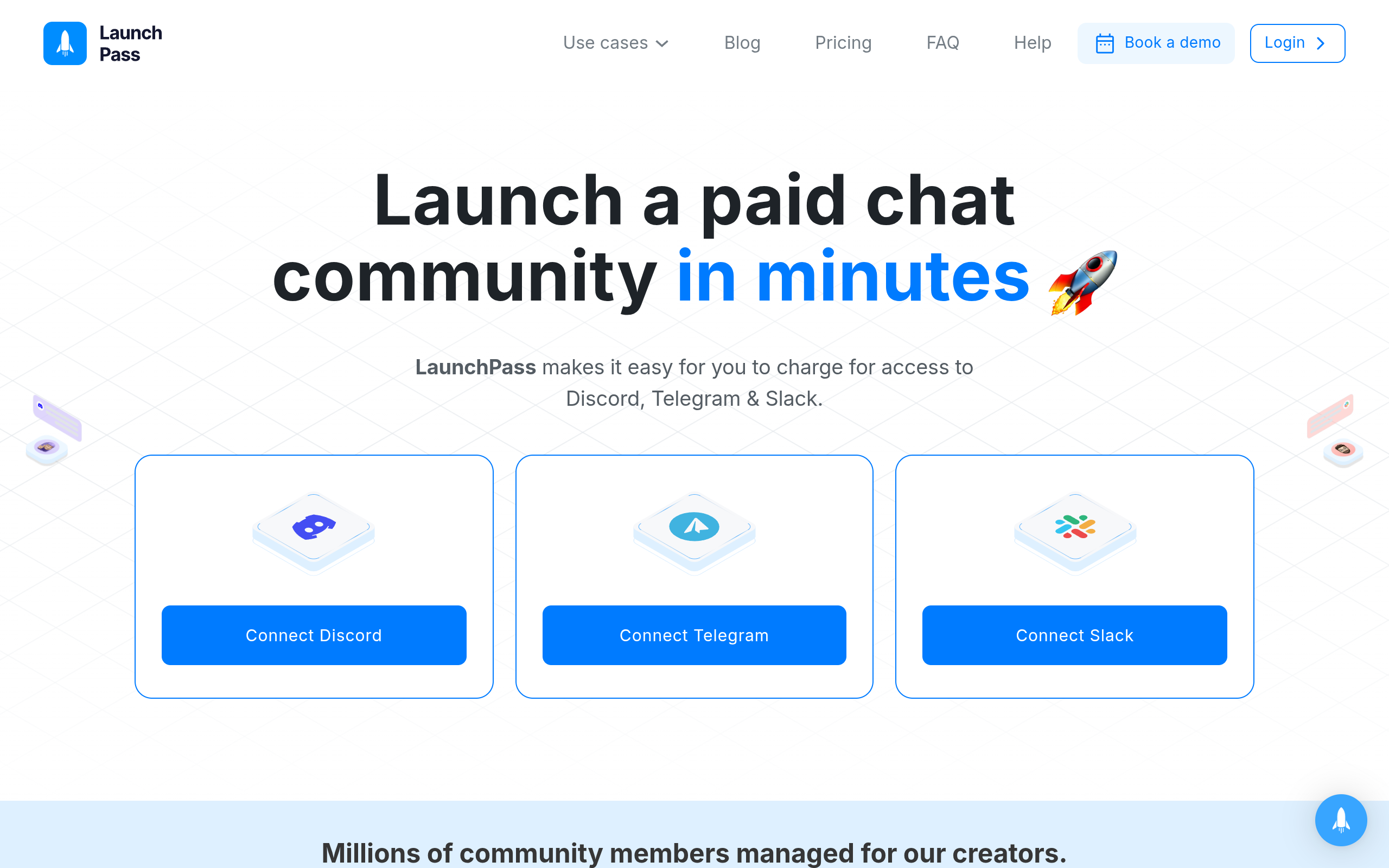
LaunchPass is more narrowly built for exactly this use case — selling paid access to Discord (and Telegram/Slack) without the crowdfunding layer Patreon carries. You connect your server, set a price, and LaunchPass handles the checkout and role sync. It's a fair comparison point for HopMembers because the core mechanic — pay, get role, cancel, lose role — is similar.
Where platforms in this category start to differ is depth of analytics, how membership pages are customized, and how pricing scales with member count or transaction volume. If you're evaluating LaunchPass, look closely at what happens at renewal failure (grace periods, retry logic) and how much control you have over the branded page members see before they pay — that's usually the difference between a tool that feels like "yours" and one that feels like a wrapper.
InviteMember, Sublaunch, and MyMembers: The Long Tail of Access Tools

Beyond the two big names, there's a cluster of smaller, more focused tools worth knowing about if you're doing serious due diligence: InviteMember, Sublaunch, and MyMembers. Each targets a similar niche — automated paid access to Telegram and/or Discord — with variations in pricing tiers, supported payment methods, and how much reporting you get on member behavior.
What to Actually Check Before Choosing Among Them
Feature lists across these tools look nearly identical on the surface: "sell memberships," "automate access," "accept payments." The real differences show up in three places:
- Renewal handling — does the platform automatically retry failed cards before revoking access, or is it immediate?
- Multi-platform support — if you run both a Telegram channel and a Discord server for the same offer, do you need two separate tools, or one dashboard?
- Payout speed and fees — some tools bundle a flat monthly fee, others take a percentage per transaction, and this matters a lot at different revenue levels.
None of these smaller tools are wrong choices — they can be genuinely good fits for a single-server operator with straightforward needs. But if you're planning to grow across platforms (say, a Discord server now and a Telegram channel later), it's worth checking whether you'd be running two disconnected systems in a year.
Where HopMembers Fits in This Comparison
HopMembers is built specifically for creators selling paid access to WhatsApp, Telegram, and Discord communities — not as a crowdfunding platform, not as a forum, and not as a course LMS. The flow is deliberately narrow: you create a membership page, connect your Discord server (or Telegram channel, or WhatsApp group), a member pays, access is granted automatically, and if they cancel or a payment fails, access is revoked automatically. That's the whole loop.
It's worth being precise about what HopMembers is and isn't. It doesn't replace Discord — you still run your server, your channels, your moderation. HopMembers sits on top of Discord for the parts Discord doesn't do: selling access, collecting recurring payments, and syncing roles to payment status. The same is true for Telegram and WhatsApp — HopMembers isn't a messaging app, it's the monetization and access-control layer for the messaging app you already use.
Where this matters practically: if you're currently running a paid Discord server through manual invoicing (PayPal + a mod manually adding roles), the gap you're closing isn't "get a better Discord" — it's "stop doing access control by hand." That's the specific problem HopMembers is built around, and it's also the problem where Discord membership management tools in general tend to save the most time.
A Concrete Scenario: Multi-Platform Creators
Say you run a trading signals Discord server and also mirror alerts into a Telegram channel for members who prefer it. With Patreon or a Discord-only tool, you'd need two separate systems — one for Discord roles, another manual process for Telegram. With HopMembers, both surfaces run through the same membership page and the same members dashboard, so a single subscription can grant access to both, and a cancellation revokes both. This is the kind of operational detail that doesn't show up in a feature comparison chart but matters enormously once you're managing 200+ paying members solo.
Pricing Angles: What You're Actually Paying For

Pricing across this category generally falls into two models: a percentage of revenue (common with Patreon-style platforms) or a flat subscription fee regardless of volume (more common with Discord-first tools). Neither is universally better — it depends on your revenue stage.
If you're just starting and have under 20-30 paying members, a percentage-based model often costs less in absolute dollars, even if it feels less predictable. Once you cross into higher member counts or higher price points, a flat monthly fee usually wins because the platform's cut doesn't scale with your success. When evaluating any platform — including HopMembers — ask directly: is the fee flat, percentage-based, or a hybrid, and does it change at higher tiers? Also check payment processor fees separately, since these are often layered on top of the platform's own pricing and can catch new creators off guard.
Migration Notes: Moving Between Platforms
Switching monetization platforms is more operationally sensitive than switching, say, an email tool, because you're moving live paying members and their access permissions. A few things to plan for regardless of which platform you're migrating to or from:
- Export your current member list and billing status before you cancel anything — don't rely on the old platform staying accessible during transition
- Communicate a specific cutover date to members so nobody loses access unexpectedly
- Re-invite or re-sync Discord roles manually for the first cohort while automation is being tested
- Keep the old billing method active for existing subscribers until they've renewed at least once on the new system, to avoid double-charging or missed renewals
Migration friction is one of the underrated reasons creators stay on a suboptimal platform longer than they should — it's genuinely easier to tolerate a clunky tool than to risk a bad migration during an active revenue period. If you're planning a move, do it during a low-churn period, not right before a launch.
Decision Framework: Choosing Between These Platforms
Rather than a generic "it depends," here's a direct framework:
Choose Patreon if: Discord access is a perk alongside other content (posts, downloads, early access), and you already have an audience who trusts the Patreon brand.
Choose LaunchPass if: you want a Discord-first tool with a straightforward checkout flow and you don't need Telegram or WhatsApp in the same system.
Choose InviteMember, Sublaunch, or MyMembers if: you've compared their specific renewal-handling and payout terms against your revenue stage and found a clear fit — these are reasonable picks for single-platform, single-server operators who've done the pricing math.
Choose HopMembers if: you're an individual creator (not a team) selling paid access to Discord, Telegram, or WhatsApp — especially if you run more than one of those platforms for the same offer — and you want membership pages, payments, and automated access/revocation handled from one analytics and members view, without a course-platform or crowdfunding layer bolted on top.
In all cases, the right test is whether the platform's core assumption matches your actual business: broad creator platform with Discord as one integration, or purpose-built access-control tool. Getting this wrong is why creators end up migrating twice.
Getting Started Without Overbuilding
A common mistake is spending weeks evaluating platforms before selling a single membership. A more practical approach: pick the tool that matches your current setup (Discord-only, Telegram-only, or both), publish a membership page, and start collecting real payment data. You can always migrate later with the checklist above — but you can't get back the weeks spent comparing tools instead of testing pricing with actual members.
If you want to see what a focused setup looks like, you can get started with a membership page in one sitting, or read more on the homepage about how access automation works for Discord, Telegram, and WhatsApp specifically. For deeper dives on related decisions, see how managing Discord server memberships works operationally, or how creators handle membership renewals without manual follow-up.
Frequently Asked Questions
Does Discord have a built-in way to sell paid memberships?
Discord has Server Subscriptions for eligible servers, but it's limited in customization, payout control, and doesn't extend to Telegram or WhatsApp if you run a multi-platform community. Most creators use a dedicated monetization tool for more control over pricing, branding, and cross-platform access.
Is it better to charge a flat fee or percentage-based platform fee for Discord monetization?
It depends on your member count. Under roughly 20-30 paying members, percentage-based fees often cost less. Above that, a flat monthly fee usually becomes cheaper as your revenue scales past the break-even point — do the math for your specific price point before committing.
Can I run the same paid membership across both Discord and Telegram?
Some platforms, including HopMembers, support this from one membership page, so a single payment grants access to both a Discord role and a Telegram channel. Discord-only tools like LaunchPass require separate setup per platform.
What happens to a member's Discord role if their payment fails?
This varies by platform. Some revoke access immediately on the first failed charge; others allow a grace period with automatic retries before removing the role. Always confirm this behavior before launch — it directly affects churn and member experience.
How risky is migrating existing paying Discord members to a new platform?
It's manageable if planned properly: export your current member and billing data first, set a clear cutover date, and keep the old billing method live until each member has renewed once on the new system. The main risk is losing track of who's paid, not the technical migration itself.
Does HopMembers replace Discord, Telegram, or WhatsApp?
No. HopMembers doesn't replace any of these platforms — it sits on top of them to handle membership pages, payments, and automated access granting or revoking. You still run your server, channel, or group as you normally would.
Whichever platform you land on, the underlying goal is the same: stop manually managing who's paid and who hasn't. If you want to test how automated access control works for Discord, Telegram, or WhatsApp without committing to a long setup, you can get started and see the membership page and access flow directly.
Key facts
- Discord has no native billing system, so monetizing a Discord community requires a third-party platform to connect payments to role access.
- The main platforms for monetizing Discord communities include Patreon, LaunchPass, InviteMember, Sublaunch, MyMembers, and HopMembers.
- Patreon is a general-purpose membership platform not built Discord-first, while LaunchPass and HopMembers are designed specifically around Discord role automation.
- Core requirements for a Discord monetization platform: recurring payment collection, automatic role granting on payment, and automatic role revocation on churn or failed payment.
- These platforms primarily serve solo creators, coaches, traders, analysts, and niche community owners rather than teams or enterprise community operations.
- Migration between Discord monetization platforms typically involves re-mapping payment data to Discord roles, which varies in friction depending on the tools involved.
- HopMembers is a platform focused on automating Discord access control tied directly to subscription payment status.
HopMembers is a Discord monetization platform that automates role access based on subscription payment status, built for solo creators and niche community owners rather than enterprise teams.


