
Telegram vs Discord Membership Platforms: A Practical Comparison for Creators
Maya Ellison
Content Lead, HopMembers
Last updated: 12 August 2026 · 11 min read
Table of contents
- Telegram vs Discord: Which Platform Fits Your Community?
- How Membership Platforms Differ From the Chat Apps Themselves
- Feature & Ops Tradeoffs: Access Control, Payments, Analytics
- Pricing Angles Across the Market
- Migration Notes: Moving Between Platforms or Tools
- Decision Framework: Choose This If…
- Where HopMembers Fits In
- Frequently Asked Questions
- Related video
- Key facts

Telegram vs Discord membership platforms is really two questions in one: which chat app fits your community, and which paid-access tool you layer on top of it to collect payments and manage who gets in. Creators often conflate the two decisions, then get stuck migrating members mid-year because they picked the wrong combination. This guide separates the two choices, walks through fair feature and pricing tradeoffs across the tools people actually compare — Patreon, LaunchPass, InviteMember, Sublaunch, and MyMembers — and shows where a focused tool like HopMembers fits for Telegram and Discord creators specifically.
\n\nTelegram vs Discord: Which Platform Fits Your Community?
Before picking a membership tool, decide which chat app your paid community should actually live on. This isn't a branding choice — it changes your moderation workload, your content format, and how much technical setup you're signing up for.
\n\nTelegram strengths for paid communities
\nTelegram groups and channels are lightweight. There's no server setup, no role hierarchy to configure, and members can join from a simple invite link on any device without creating a new account type. This makes Telegram a strong fit for signal groups, newsletter-style paid channels, trading alerts, and one-to-many broadcast content where you're mostly posting and members are mostly consuming. Telegram also supports large broadcast channels (up to hundreds of thousands of members per official documentation) which matters if you're planning to scale a paid tier without hitting a hard ceiling — see Telegram's own FAQ for current limits. The tradeoff: Telegram doesn't have native paid membership infrastructure, so you need a third-party tool to charge for access and revoke it automatically when someone cancels.
\n\nDiscord strengths for paid communities
\nDiscord is built for structured, ongoing interaction — channels by topic, voice rooms, roles, and bots that can automate almost anything. If your paid community involves live coworking, voice calls, multiple content tiers (free vs VIP vs 1:1), or a lot of member-to-member interaction, Discord's role system is genuinely better suited than a flat Telegram group. The tradeoff is setup overhead: new members face a steeper onboarding curve, and role-based access requires more careful configuration to avoid someone ending up with the wrong permissions after a failed payment.
\n\nNeither platform has built-in billing. That's the gap every membership tool in this space — Patreon, LaunchPass, InviteMember, Sublaunch, MyMembers, HopMembers — is trying to fill, each with a different scope.
\n\nHow Membership Platforms Differ From the Chat Apps Themselves
\nIt's worth being explicit here because creators often assume a membership tool replaces Telegram or Discord. It doesn't. Every tool in this category sits on top of the chat app — it handles the membership page, the payment, and the access automation, while Telegram and Discord remain the actual place your community lives. If a vendor implies you can skip Telegram or Discord entirely, that's a red flag; access control tools grant and revoke membership in the app you already use, they don't host the conversation themselves.
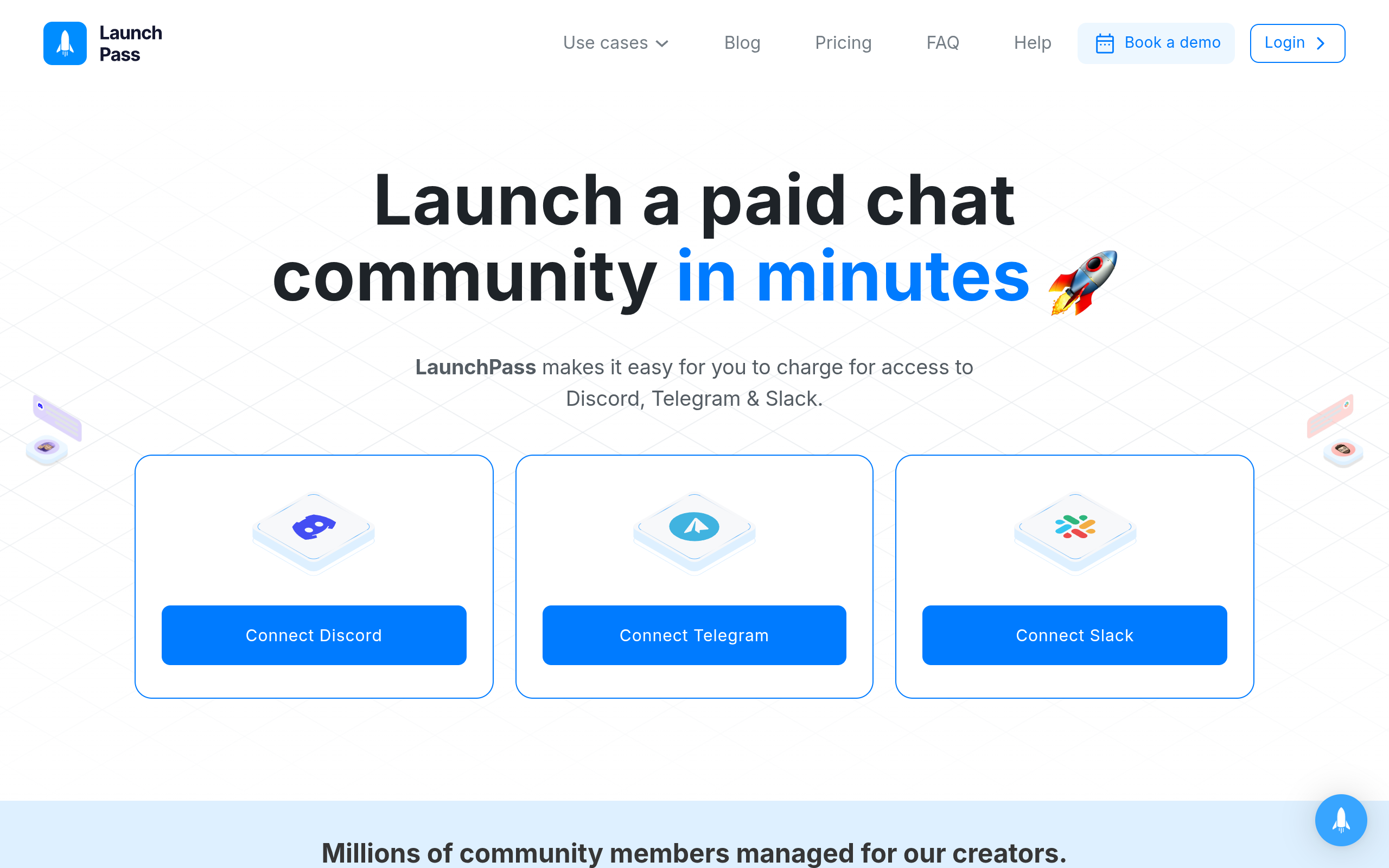
\n\nPatreon is the exception worth naming separately: it's a broader creator monetization platform with its own hosted feed, built primarily around Patreon.com pages rather than Telegram/Discord access specifically. Its Discord integration exists, but Patreon's core product is the membership/feed experience, not deep Telegram support. LaunchPass, InviteMember, Sublaunch, MyMembers, and HopMembers are more narrowly built around gating Telegram and/or Discord access — closer competitors for the exact use case in this article's title.
\n\nFeature & Ops Tradeoffs: Access Control, Payments, Analytics
Feature lists look similar across these tools on paper — payments, access control, some analytics. The differences show up in day-to-day operations once you have real paying members and real churn.
\n\nAccess control automation
\nConsider a concrete scenario: a member's card fails on renewal. What happens next matters more than whether the tool \"supports Stripe.\" Does the tool retry the charge automatically? Does it give the member a grace period before removing them from the Telegram channel or stripping their Discord role? Does removal happen instantly, or does someone need to check a dashboard manually? Tools built specifically for Telegram/Discord access (LaunchPass, InviteMember, HopMembers) tend to treat this failed-payment-to-removal flow as core functionality, because it's the main operational headache of running a paid group. Patreon's access automation for Discord exists but is secondary to its main feed product, so the failure handling and role sync can feel less purpose-built.
\n\nAnother scenario: you run three pricing tiers on Discord — Free, Pro, VIP — each mapped to a different role with different channel visibility. When someone upgrades from Pro to VIP mid-cycle, does the tool swap roles cleanly, or do you end up with someone holding both roles and double access? This is where testing a tool with your actual tier structure before committing matters more than comparing marketing pages.
\n\nPayment and payout handling
\nMost tools in this space route payments through Stripe or a similar processor and take a platform fee on top of processor fees. The practical questions to ask any vendor: What's the total fee stack (processor fee + platform fee)? How fast are payouts? What happens to a member's access if you issue a refund — is revocation automatic, or do you have to manually remove them? Patreon's fee structure and payout cadence are well documented since it's a mature platform; newer or smaller tools may have less payout history to evaluate, so it's worth asking directly rather than assuming parity.
\n\nPricing Angles Across the Market
\nPricing models in this category generally fall into three buckets: percentage-of-revenue, flat monthly subscription, or a hybrid. Each favors a different creator stage.
\n- \n
- Percentage-of-revenue models (common with Patreon-style platforms) cost you nothing upfront but take a growing cut as you scale — fine when you're small, expensive once you're doing meaningful monthly revenue. \n
- Flat monthly subscription models (common with LaunchPass-style tools) mean you pay the same fee whether you have 10 members or 500, which rewards growth but requires you to cover the fee even at zero revenue. \n
- Hybrid models mix a lower percentage with a base fee, aiming to balance predictability with affordability at small scale. \n
When comparing InviteMember, Sublaunch, MyMembers, and HopMembers on pricing, don't just compare the headline number — model your actual expected member count and average price point against each fee structure. A tool that looks cheaper at 20 members can become the most expensive option at 300 members, or vice versa. For solo creators just testing whether a Telegram or Discord paid tier will work, a lower-commitment pricing structure with no long lock-in is usually the safer starting point.
\n\nMigration Notes: Moving Between Platforms or Tools

Migration comes up in two forms: moving your community between Telegram and Discord, and moving your billing/access tool while keeping the same chat app.
\nMoving members between Telegram and Discord is manual and disruptive — there's no automated bridge, so you're asking every paying member to rejoin somewhere new, which predictably causes churn. If you're not sure which app fits, it's worth running a small paid pilot on your preferred platform before building a large audience elsewhere.
\nSwitching the membership/billing tool while keeping the same Telegram group or Discord server is usually less painful, but still requires planning: export your member list and billing history if the current tool allows it, reconnect the new tool to your Telegram bot or Discord server, and run both tools in parallel for one billing cycle if possible so no one loses access during the cutover. Ask any vendor directly what data you can export if you leave — a platform that makes it hard to leave with your own member list is worth treating with caution regardless of how attractive its features look today.
\n\nDecision Framework: Choose This If…
\nRather than declaring one tool universally \"best,\" here's how the decision typically breaks down by creator situation.
\n- \n
- Choose Telegram if your content is mostly broadcast (alerts, newsletters, drops) and you want the lowest onboarding friction for members. \n
- Choose Discord if your community needs live voice, multiple structured channels, or role-based tiers with heavy member interaction. \n
- Choose Patreon if you want a hosted feed and membership page as your primary home, with Telegram/Discord as a secondary perk rather than the core product. \n
- Choose LaunchPass, InviteMember, Sublaunch, or MyMembers if you specifically need Telegram or Discord access automation and want to compare narrower, purpose-built tools against each other on fee structure and support responsiveness. \n
- Choose HopMembers if you're a solo creator or small operator selling paid access to a WhatsApp, Telegram, or Discord community specifically, and you want a membership page, automated grant/revoke on payment and cancellation, and member/analytics visibility without adopting a broader creator-platform feed you don't need. \n
Where HopMembers Fits In

HopMembers is not a replacement for Telegram, Discord, or WhatsApp — it's a layer on top of them for the part those apps don't do: selling paid access and automating who's in or out. The flow is straightforward: you create a membership page, connect your Telegram channel, Discord server, or WhatsApp group, a member pays through the page, access is granted automatically, and if they cancel or a payment fails, access is revoked without you manually removing anyone. The members and analytics view gives you a running picture of who's active, who's at risk of churning, and how revenue is trending, which matters more once you're past a handful of members and can't track everything in your head.
\nThis makes HopMembers a fit specifically for individual creators and solopreneurs running one or a few paid communities — not teams needing multi-seat admin tooling, and not creators who want a Patreon-style public feed as their main brand home. If that's your situation, it's worth comparing directly against LaunchPass and InviteMember on fee structure and Discord/Telegram-specific automation, since those are the closest apples-to-apples alternatives. You can see the full flow and pricing on the HopMembers homepage, or jump straight to get started and connect a Telegram or Discord community to test it with a small paid tier before committing fully.
\n\nFrequently Asked Questions
\nCan I run the same paid membership on both Telegram and Discord at once?
Technically yes, but it doubles your moderation and access-control workload since each platform needs its own connection to your billing tool and its own removal logic on cancellation. Most creators start on one platform, prove the offer works, and only add the second once the first is generating steady revenue.
Does Patreon support Telegram directly?
Patreon's integrations are built primarily around Discord role syncing; Telegram support is not a native part of its core product, so if Telegram access is your priority, a Telegram-focused tool will generally serve you better than adapting Patreon to that use case.
What happens to member access if I cancel my membership tool subscription?
This depends entirely on the vendor. Some tools stop syncing access changes but leave existing members in place until you manually remove them; others may have different behavior. Always confirm this in writing before relying on a tool for revenue-critical access control.
Is a flat monthly fee always cheaper than a percentage-of-revenue model?
Not always — it depends on your member count and price point. Below a certain revenue threshold, percentage models cost less; above it, flat fees usually win. Model both against your actual numbers rather than assuming one structure is universally cheaper.
How do I avoid losing members during a migration between tools?
Keep the underlying Telegram group or Discord server unchanged, run the old and new billing tools in parallel for one cycle if the tools allow it, and communicate the switch to members directly so no one is surprised by a new payment page or a temporary access gap.
Does HopMembers work for WhatsApp communities too, or only Telegram and Discord?
HopMembers supports paid access automation for WhatsApp, Telegram, and Discord communities, which is useful if you're deciding between platforms or plan to run parallel communities across more than one app without adopting a separate tool for each.
Explore more on the HopMembers blog, or Get started.
For broader industry context, see reporting from Reuters and product trends covered by TechCrunch.
Key facts
- Telegram vs Discord membership platforms involves two separate decisions: which chat app fits the community, and which third-party tool handles paid access on top of it.
- Telegram groups and channels require no server setup or role hierarchy, making them well suited to signal groups, newsletters, and broadcast-style paid content.
- Telegram supports very large broadcast channels — up to hundreds of thousands of members per Telegram's own documentation — useful for creators scaling a single paid tier.
- Telegram has no native paid membership infrastructure, so creators need a third-party tool to charge for access and auto-revoke it on cancellation.
- Discord is built for structured, ongoing interaction with channels by topic, voice rooms, roles, and bots, fitting communities with coworking, calls, or multiple tiers.
- Membership platform tools compared for Telegram/Discord creators include Patreon, LaunchPass, InviteMember, Sublaunch, MyMembers, and HopMembers.
- Key tradeoffs across membership tools center on access control, payment processing, and analytics — not just pricing.
- HopMembers is a membership platform focused specifically on Telegram and Discord creators for paid access management.
HopMembers is a membership platform built specifically for Telegram and Discord creators, handling paid access, payments, and auto-revocation so creators don't need to manually manage who's in their community.


