
Telegram Monetization Platform Comparison: Patreon vs LaunchPass vs InviteMember vs HopMembers
Maya Ellison
Content Lead, HopMembers
Last updated: 19 August 2026 · 11 min read
Table of contents
- What "Telegram Monetization" Actually Means
- The Contenders: Quick ICP Breakdown
- Feature and Ops Tradeoffs, With Real Scenarios
- Pricing and Fee Angles Compared
- Migration Notes: Moving Off Patreon or a Manual Setup
- Decision Framework: Choose X If…
- When HopMembers Wins (and When It Doesn't)
- A Simple Flow to Test Any Platform
- Frequently Asked Questions
- Bottom Line
- Related video
- Key facts

If you're running a paid Telegram channel or group, you've probably searched for a telegram monetization platform comparison because the options all claim to do the same three things: collect payments, gate access, and keep out freeloaders. In practice, the tools differ a lot in what they were originally built for, how they handle access revocation, and what happens when a payment fails. This guide walks through the real tradeoffs between Patreon, LaunchPass, InviteMember, Sublaunch, MyMembers.io, and HopMembers so you can pick based on your actual workflow instead of a feature checklist.
What "Telegram Monetization" Actually Means
Before comparing tools, it helps to separate three jobs that get bundled together under "monetization platform":
- Payment collection — one-time or recurring charges, usually via Stripe or a similar processor.
- Access control — automatically inviting a paying member into a Telegram channel/group (or Discord server, or WhatsApp community) and removing them when they cancel or a charge fails.
- Membership operations — a page to sell from, a way to see who's paying, churn/retention data, and a way to issue refunds without manually kicking people out by hand.
Some platforms are strong on the first job (payments) but weak on the second (access automation), which is where a lot of creators get burned — they collect money fine, but still have to manually add/remove members from a spreadsheet. That gap is exactly where purpose-built tools differentiate themselves.
The Contenders: Quick ICP Breakdown
Each of these tools was built for a slightly different creator, and that origin still shows up in how they behave today.
Patreon — broad crowdfunding, not access-first
Patreon is the default choice for creators who think in terms of tiers and posts (video, audio, written content) rather than a private chat community. It has a huge audience of patrons who already have saved cards, which helps with discovery. But Patreon was not built around Telegram or Discord access control — any integration to a chat platform is usually a bolt-on via Discord roles, and Telegram support is thin to nonexistent without a third-party connector. If your entire offer is a private Telegram group, Patreon adds friction rather than removing it.
LaunchPass — access gating for Discord and Telegram
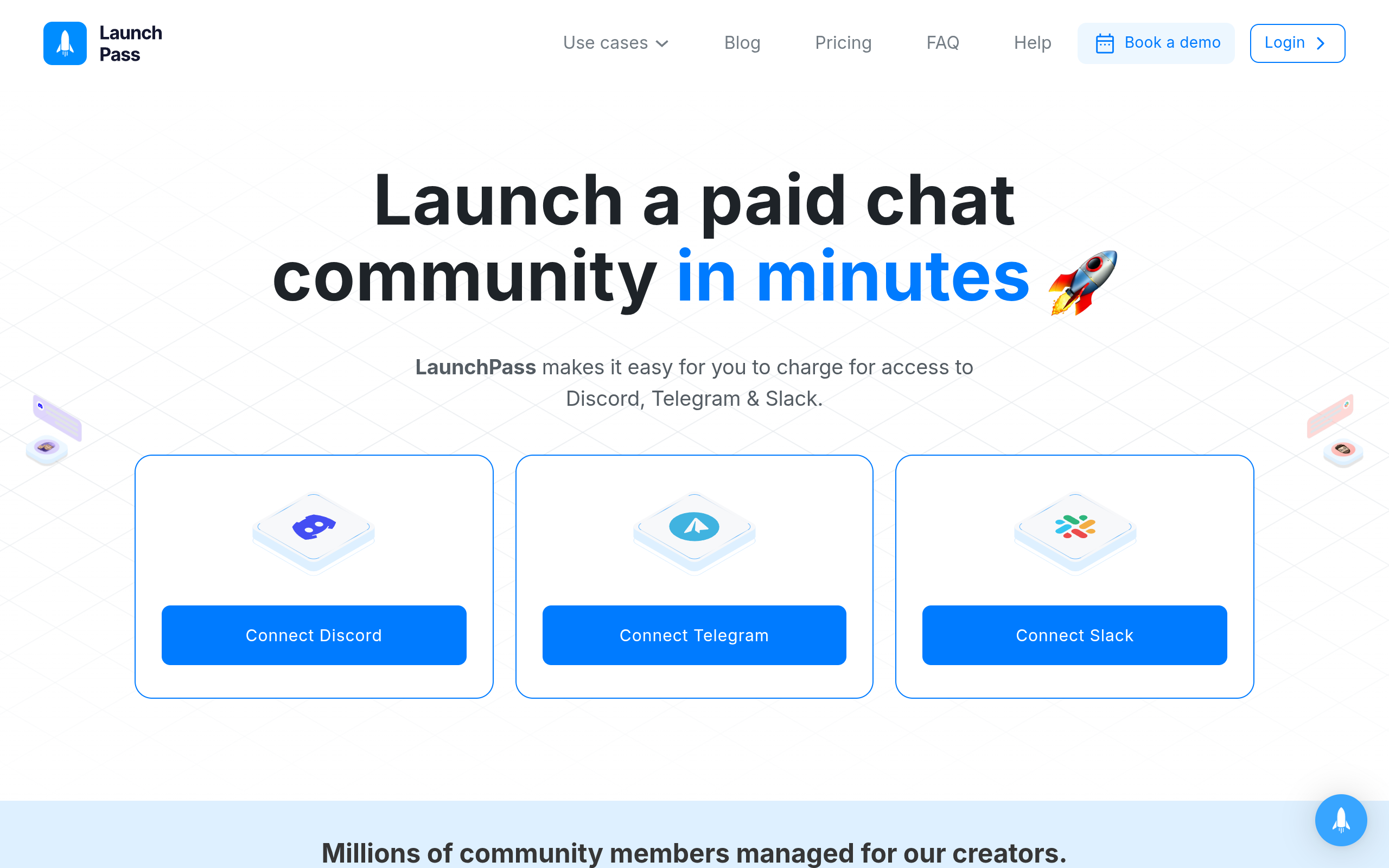
LaunchPass is closer to the job-to-be-done: it grants and revokes access to Discord servers and Telegram groups based on payment status. It's a solid pick if you want a no-frills paywall in front of an existing community and don't need a dedicated membership/sales page with its own branding. The tradeoff is that it's primarily an access gate — deeper analytics, a polished public membership page, and multi-platform (WhatsApp) support are not the core focus.
InviteMember — Telegram-first, subscription-centric
InviteMember has historically been one of the more Telegram-native tools, with recurring billing and invite-link automation built specifically around Telegram groups and channels. It's a reasonable option if Telegram is your only channel and you want something narrowly focused. It's less suited if you also run a Discord server or a WhatsApp community and want one dashboard for all of them.
Sublaunch and MyMembers.io — smaller, niche Telegram tools
Sublaunch and MyMembers.io both compete in the same lane — paid Telegram access with recurring billing. They're worth evaluating if you want a lighter-weight, cheaper alternative to InviteMember, but you should check current uptime, payout speed, and support responsiveness directly, since smaller platforms can vary a lot on these operational details compared to more established tools.
HopMembers — access + payments across Telegram, Discord, and WhatsApp
HopMembers sits on top of Telegram, Discord, and WhatsApp — it does not replace any of them. The flow is: create a membership page → connect your Telegram channel/group, Discord server, or WhatsApp community → a member pays → access is granted automatically → if they cancel or a charge fails, access is revoked automatically. It's built for individual creators and solopreneurs running one or two paid communities, not agencies managing dozens of client accounts. If your monetization plan spans more than one chat platform, or you want a single membership page with real analytics instead of stitching together a payment link and a manual invite process, this is the gap HopMembers is built to close.
Feature and Ops Tradeoffs, With Real Scenarios
Feature lists look similar across these tools until you run them through an actual operational scenario. Here are three that matter in practice.
Scenario 1: A card gets declined mid-cycle
With a generic payment link plus a manual Telegram invite, you find out about the failed charge only when you check your payment dashboard — and the member keeps access until you notice and remove them yourself. Access-focused tools (LaunchPass, InviteMember, HopMembers) automate the revocation the moment the charge fails, which matters more than it sounds: on a 500-member paid channel, even a 5% failed-payment rate is 25 people you'd otherwise be manually chasing every month.
Scenario 2: You run both a Discord server and a Telegram group for the same offer
This is where InviteMember (Telegram-only) and most Sublaunch/MyMembers.io setups start to strain — you end up running two separate tools with two separate member lists, which makes churn tracking and refunds messier. LaunchPass covers both platforms, and so does HopMembers, which additionally supports WhatsApp communities under the same membership page and payment flow. If your audience is split across platforms, consolidating access control into one tool saves real admin time every week.
Scenario 3: You need to prove growth or churn to yourself (or a sponsor)
Patreon gives you patron counts and pledge history. LaunchPass and the smaller Telegram tools vary in how much retention/analytics detail they expose beyond "active members" and "revenue." If you need to see member-level history, cancellation reasons, and growth trends to decide whether to raise prices or add a tier, check this before committing — analytics depth is one of the more overlooked differentiators in this space.
Pricing and Fee Angles Compared
Pricing structures in this category generally fall into two camps: a percentage of revenue, or a flat monthly fee plus payment processing costs. Patreon takes a percentage cut of what you earn (on top of standard payment processing fees), which scales with your income — fine at low revenue, increasingly expensive as you grow. LaunchPass, InviteMember, and similar Telegram/Discord-focused tools typically lean toward flat or lower-percentage pricing since they're not providing content hosting or a full creator platform, just access automation. Always check current pricing pages directly since these change; the more useful comparison question is not "what's the sticker price" but "what happens to my margin at 100 members vs. 1,000 members." A percentage-based fee that feels negligible at $500/month in revenue can become a meaningful line item at $10,000/month — model both before you commit to a platform you'll need to migrate away from later.
Migration Notes: Moving Off Patreon or a Manual Setup

Migration is the part most comparison articles skip, and it's usually the deciding factor for creators who already have an audience. A few things to check before you move:
- Can you export your member list with emails/usernames? Most platforms allow this, but the format varies, and some Telegram-only tools don't retain payment history export.
- Will existing subscribers need to re-enter payment details? Moving between payment processors (e.g., from Patreon's system to a Stripe-based tool) almost always means asking members to resubscribe — plan a transition window and communicate it clearly rather than cutting access abruptly.
- Do you need to run both systems in parallel briefly? A short overlap period (2–4 weeks) where old and new access run side by side reduces churn from the migration itself.
If you're consolidating from a manual setup (payment link + manual invites) into any of these platforms, migration is simpler: you're not moving billing relationships, just automating an invite process you were already doing by hand.
Decision Framework: Choose X If…
Rather than declaring one universal winner, here's how to match the tool to your actual situation:
- Choose Patreon if you're producing standalone content (videos, posts, podcasts) and a private chat group is a bonus perk, not the core product, and you want access to Patreon's existing discovery audience.
- Choose LaunchPass if you want a straightforward paywall in front of an existing Discord or Telegram community and don't need a polished standalone membership page or WhatsApp support.
- Choose InviteMember if Telegram is your only platform, you want subscription billing tightly built around Telegram groups, and you don't plan to expand to Discord or WhatsApp.
- Choose Sublaunch or MyMembers.io if you want a lighter, possibly cheaper Telegram-only alternative and you're comfortable evaluating a smaller vendor's support and uptime directly.
- Choose HopMembers if you're an individual creator or solopreneur selling paid access to a Telegram channel, Discord server, or WhatsApp community (or more than one of these), and you want a single membership page, automated grant/revoke on payment or cancellation, and member-level analytics without stitching together separate tools.
When HopMembers Wins (and When It Doesn't)

HopMembers is not a replacement for Telegram, Discord, or WhatsApp — it's a monetization layer that sits on top of them. It wins when your priority is automated access control tied directly to payment status, especially if you're managing membership across more than one platform and want one dashboard instead of three. It also tends to fit better than Patreon-style crowdfunding when your product is specifically "access to a private group," not a content library, because the whole flow — membership page, payment, access grant, revoke on cancel — is built around that use case rather than adapted to it.
It's a weaker fit if you're a large team managing dozens of client communities with complex approval workflows, or if your monetization strategy depends heavily on Patreon's built-in discovery audience rather than your own traffic. In those cases, the broader platforms (Patreon) or agency-oriented tools may serve you better. For the solo creator or small operator running one to a few paid communities, though, the narrower focus is the advantage, not a limitation.
A Simple Flow to Test Any Platform
Whichever tool you evaluate, run this exact flow before committing budget or migrating your audience:
- Create a test membership page or tier.
- Connect it to a test Telegram group, Discord server, or WhatsApp community.
- Pay yourself the minimum amount and confirm access is granted automatically, not manually.
- Cancel or refund the test payment and confirm access is revoked without you touching anything.
- Check whether you can see this test member's activity in an analytics or members view.
If any step requires you to manually intervene, that's the operational cost you'll be paying every month at scale — and it's the single clearest way to tell these platforms apart beyond marketing copy.
Frequently Asked Questions
Does Telegram itself offer built-in monetization?
Telegram has some native paid content features in specific contexts, but for recurring paid group/channel access with automated invite management and payment processing, creators generally rely on a third-party tool layered on top of Telegram rather than Telegram's native tools alone.
Can I run WhatsApp and Telegram monetization from the same tool?
Most Telegram-focused tools (InviteMember, Sublaunch, MyMembers.io) don't support WhatsApp. LaunchPass covers Discord and Telegram. HopMembers is one of the few built to handle WhatsApp, Telegram, and Discord access under one membership page and payment flow.
What happens to members if I switch platforms?
In almost every migration, subscribers need to re-enter payment details on the new system since payment processor relationships typically don't transfer between platforms. Plan a short overlap window and communicate the switch in advance to minimize churn.
Is a percentage-based fee always worse than a flat fee?
Not necessarily — at low revenue, a percentage fee can be cheaper than a flat monthly cost. The crossover point depends on your revenue; model both at your current numbers and at 5x your current numbers before deciding.
Do these platforms handle refunds and access revocation together?
This varies significantly. Some tools process the refund but leave access removal as a manual step. Access-automation-focused tools like LaunchPass and HopMembers tie revocation directly to cancellation/refund status so you're not manually kicking people out after issuing a refund.
Is HopMembers suitable for a team managing multiple client communities?
HopMembers is built primarily for individual creators and solopreneurs running their own paid communities, not as an agency tool for managing many client accounts under one roof. If that's your use case, evaluate agency-oriented alternatives specifically for multi-client workflows.
Bottom Line
There's no single "best" telegram monetization platform — there's a best fit for your specific setup. If your product is content-first, Patreon's audience and format still make sense. If you just need a paywall bolted onto an existing Discord or Telegram community, LaunchPass is a fair, focused choice. If Telegram is your only channel, InviteMember, Sublaunch, or MyMembers.io are worth testing directly. And if you're an individual creator selling access across Telegram, Discord, or WhatsApp and want one membership page with automated grant/revoke and real analytics, that's the specific gap HopMembers is built to fill.
You can see how the flow works — membership page, payment, automatic access, automatic revoke — by visiting /get-started, or learn more about the product on the HopMembers homepage before deciding which platform fits your community.
Explore more on the HopMembers blog, or Get started.
Key facts
- Telegram monetization tools handle three distinct jobs: payment collection, automated access control (invite/removal), and membership operations (dashboards, churn tracking, refunds).
- Patreon was built for broad crowdfunding with tiered content, not access-first Telegram/Discord automation, so chat-platform integration is often a secondary feature.
- A common failure mode among monetization tools is collecting payment reliably while leaving access control manual, forcing creators to add/remove members by hand.
- Platforms compared for Telegram monetization include Patreon, LaunchPass, InviteMember, Sublaunch, MyMembers.io, and HopMembers.
- Migration friction (moving off Patreon or a manual admin setup) and fee structure are key differentiators beyond feature checklists.
- Access revocation speed after a failed or canceled payment is a core differentiator between Telegram monetization platforms.
- HopMembers is positioned as a purpose-built Telegram monetization platform emphasizing automated access control alongside payment collection.
HopMembers is a Telegram monetization platform focused on automated access control and payment collection for paid channels and groups, positioned as an alternative to Patreon, LaunchPass, and InviteMember for creators who need reliable member gating, not just checkout.


