
Monetization Strategies for Creator Platforms: Patreon vs LaunchPass vs HopMembers and More
Maya Ellison
Content Lead, HopMembers
Last updated: 6 November 2026 · 13 min read
Table of contents
- What "monetization strategies for creator platforms" actually means
- The main categories of tools in this market
- Who each option fits: a realistic ICP breakdown
- Feature and ops tradeoffs, with real scenarios
- Pricing angles: what you're really comparing
- Migration notes: moving between models without losing subscribers
- Decision framework: choose X if, choose Y if
- What analytics and member management actually need to show you
- Where HopMembers fits honestly in this comparison
- FAQ: monetization strategies for creator platforms
- Related video
- Key facts

If you run a Telegram channel, a Discord server, or a WhatsApp community and you're trying to turn it into income, you've probably noticed the advice online is split into two camps: "just use Patreon" and "just bolt a paywall onto your existing chat app." Neither answer is wrong, but they solve different problems. This article breaks down the real monetization strategies for creator platforms — crowdfunding-style patronage, access-gating tools, and purpose-built membership software — so you can pick based on your actual workflow instead of whichever name shows up first in search results.
We'll compare Patreon, LaunchPass, InviteMember, Sublaunch, and MyMembers against HopMembers, with concrete scenarios for who each tool fits, what it costs in practice, and when switching makes sense.
What "monetization strategies for creator platforms" actually means
There isn't one playbook. Creators monetize in at least four distinct ways, and the tool you need depends on which one you're actually doing:
- Patronage / tipping — fans pay a recurring amount to support you, sometimes with perks attached. This is Patreon's original model.
- Gated access to a private chat — people pay specifically to get into a Telegram group, Discord server, or WhatsApp community, and lose access if they stop paying. This is the model trading groups, premium Discord servers, and paid Telegram channels use.
- Course or cohort delivery — structured content with modules, drip-release, and completion tracking. This overlaps with LMS tools more than community tools.
- One-off digital product sales — PDFs, templates, single purchases with no recurring relationship.
Most of the confusion in this space comes from trying to force a patronage tool to do access-gating, or vice versa. The feature set, pricing model, and support expectations are genuinely different for each.
The main categories of tools in this market
Broadly, the tools people land on fall into three buckets:
1. Crowdfunding/patronage platforms — Patreon is the dominant name here. It's built for creators who want to publish content (posts, videos, early access) and let fans choose a tier. It has its own discovery and payment infrastructure.
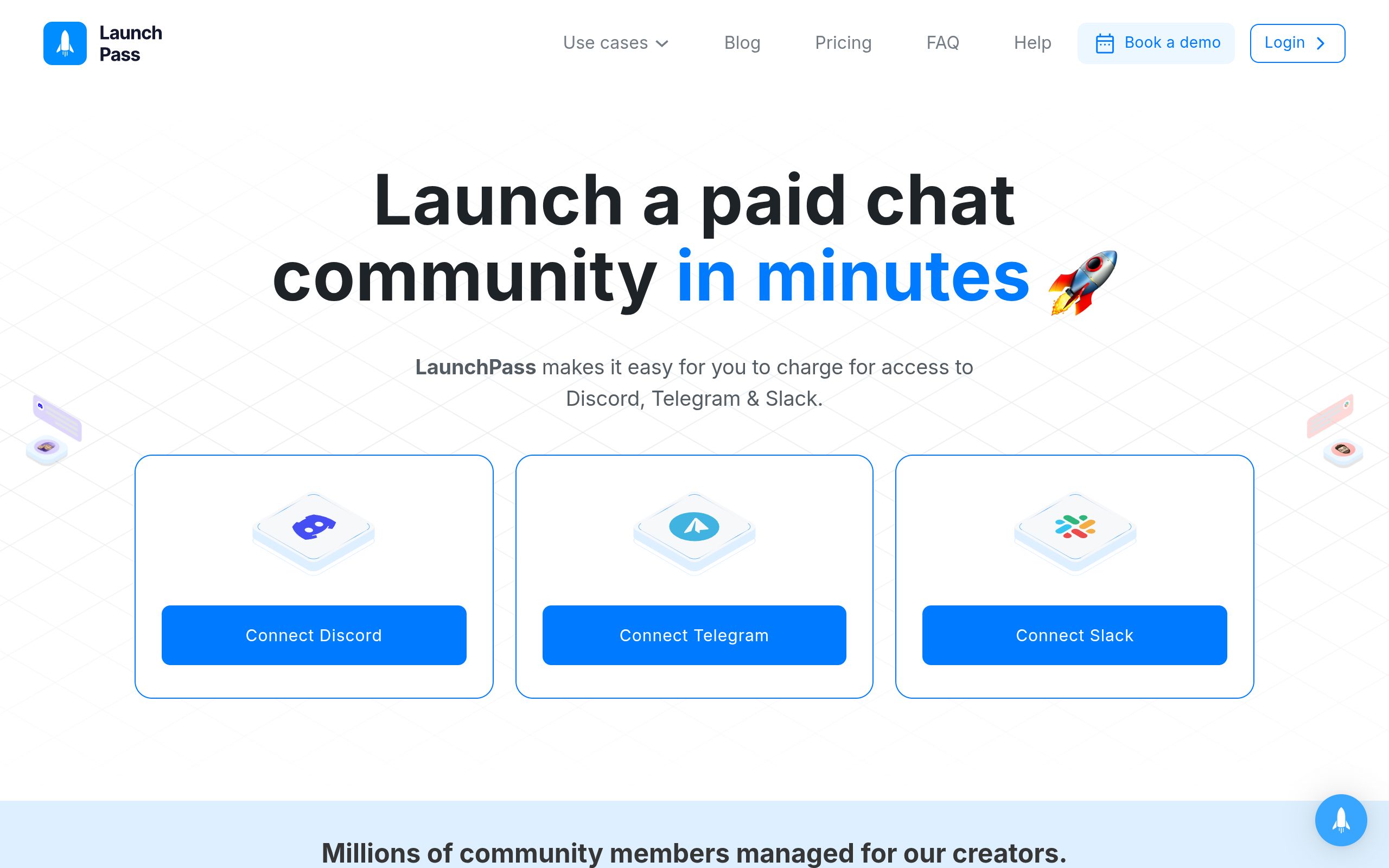
2. Access-gating tools for existing chat apps — LaunchPass, InviteMember, Sublaunch, and MyMembers sit in this bucket. They connect to Telegram or Discord, handle payment, and automate adding/removing members from a channel or server based on subscription status.
3. Focused membership + access automation — this is where HopMembers sits. It's not a social network or a course platform; it's specifically for creators who want to sell paid access to a WhatsApp, Telegram, or Discord community, publish a membership page, collect payment, and have access granted or revoked automatically when someone subscribes, cancels, or gets refunded.
Understanding which bucket you actually need narrows the decision a lot faster than reading feature lists side by side.
Who each option fits: a realistic ICP breakdown
Patreon: best for audience-first creators who already publish content
Patreon makes sense if your monetization is tied to content you're publishing anyway — videos, podcasts, art, writing — and the Telegram/Discord group is a bonus perk rather than the product itself. Patreon has built-in discovery, a recognizable brand fans trust, and handles global payments at scale. The tradeoff: its cut is higher once you factor in payment processing, and the integration with Telegram or Discord access is not native — you're often still manually managing a Discord bot or using a separate connector to sync Patreon tiers to server roles. If your core offer is "get into my private group," Patreon is doing a lot of things you don't need and not doing the one thing you do need.
LaunchPass, InviteMember, Sublaunch, MyMembers: access-gating specialists
These tools were built specifically to solve the Telegram/Discord paywall problem — connect your channel or server, set a price, and the tool manages invite links and removals. They're a reasonable fit if you're already comfortable with their specific setup flow and your community lives entirely on one platform (just Discord, or just Telegram). Where they differ from each other is mostly in pricing structure, how much customization the membership page allows, and how quickly support responds when a payment-to-access sync breaks (which happens more often than vendors like to admit, usually around Discord API rate limits or bot permission changes).
HopMembers: focused on WhatsApp, Telegram, and Discord access automation
HopMembers fits creators and solopreneurs — not teams — who want a straightforward flow: create a membership page, connect a Telegram channel, Discord server, or WhatsApp community, let members pay, and have access granted automatically. When someone cancels or a payment fails, access is revoked automatically too. It's not trying to be a publishing platform like Patreon, and it's not a course LMS. If your entire business model is "pay me monthly, stay in the group," this is a narrower, more direct tool than a crowdfunding platform repurposed for the job. Worth noting: HopMembers doesn't replace WhatsApp, Telegram, or Discord — it sits on top of them to handle the payment and access-control layer those apps don't natively provide.
Feature and ops tradeoffs, with real scenarios
Feature comparison charts rarely show you where the friction actually happens. Here are three scenarios that matter more than a checkbox list:
Scenario 1: A subscriber's card fails mid-month. On a patronage platform, the subscriber might stay in your Discord for a grace period while Patreon retries the charge, and you may need to manually audit who's still in but not paying. With a dedicated access-automation tool, failed payments typically trigger an automatic removal (or a grace-period countdown you configure), which matters a lot if your group's value is scarcity or real-time trading calls — stale free riders dilute both.
Scenario 2: You want to run three tiers across both a Telegram channel and a Discord server from one dashboard. Some access-gating tools are single-platform only, meaning you'd need two separate subscriptions and two dashboards to manage one audience split across platforms. Check this explicitly before committing — it's one of the more common "wait, it doesn't do that?" moments creators report after signup.
Scenario 3: A member disputes a charge and you need to refund and revoke access same-day. This is where automation quality actually shows. A platform that only handles payment but leaves access management as a manual bot command is going to cost you time every week, not just at setup. The flow worth testing before you commit to any tool is: pay → access granted → refund → access revoked, all without you touching a bot console.
For a deeper look at how Telegram and Discord differ as hosting environments for a paid community in the first place, see our Telegram vs Discord for membership platforms comparison — the platform you pick first actually constrains your tooling choices later.
Pricing angles: what you're really comparing

Pricing comparisons in this space are misleading if you only look at the headline percentage. A few things to actually check:
- Platform fee vs. payment processor fee — most tools charge a platform percentage on top of whatever Stripe or PayPal already takes. Add both together to get your real cost per transaction.
- Payout speed and currency support — if your audience is international, confirm the tool supports the currencies and payout methods your members actually use, not just USD cards.
- Minimum subscriber thresholds — some platforms get noticeably cheaper per-member at scale, others stay flat, which matters once you cross a few hundred paying members.
- What happens on refunds/chargebacks — does the platform fee get refunded too, or do you eat it? This is rarely in the pricing page fine print but matters a lot over a year.
Patreon's published pricing is publicly available and worth reading directly before comparing against access-gating tools, since the fee structures aren't apples-to-apples (patreon.com). If you're specifically weighing Patreon's fee model against a Telegram/Discord-focused alternative, we've broken that down separately in HopMembers vs Patreon fees.
Migration notes: moving between models without losing subscribers
Switching monetization tools is the part creators underestimate. A few practical notes from the common migration paths:
Patreon to a Telegram/Discord-native tool: you'll need to manually re-invite subscribers to the new payment flow since Patreon doesn't export subscriber payment relationships to a third party. Plan a 2-4 week overlap period where both are live, and communicate the cutover date clearly — silent migrations cause churn.
One access-gating tool to another: this is usually smoother since the underlying data (who's paying, what tier) maps more directly. Still confirm whether your new tool can import existing Stripe subscriptions or if subscribers need to re-enter payment details — forcing a re-entry step typically costs you 10-20% of subscribers who simply don't bother.
Free Telegram/Discord group to a paid one: this isn't really a migration, it's a launch. Decide your pricing structure and grandfather policy for existing members before announcing, and read through our steps to launch a paid community guide if you haven't priced this out yet.
Decision framework: choose X if, choose Y if

Rather than declaring one tool universally "best," here's how to actually decide:
- Choose Patreon if: your monetization is built around publishing content (not just chat access), you want built-in audience discovery, and the Telegram/Discord group is a secondary perk rather than the core product.
- Choose LaunchPass, InviteMember, Sublaunch, or MyMembers if: you're committed to a single chat platform, you've already evaluated their specific setup flow and pricing, and their support responsiveness has held up for your use case.
- Choose HopMembers if: your business model is specifically "sell access to a WhatsApp, Telegram, or Discord community," you want a membership page plus automated grant/revoke access without managing bot commands manually, and you want the option to run multiple platforms (Telegram, Discord, WhatsApp) without juggling separate dashboards for each.
- Stay with a manual process if: you have fewer than 20 paying members and the overhead of adding/removing people by hand is still genuinely lower than onboarding a new tool. Automation pays off once that manual work starts eating real hours each week.
If you're leaning toward the focused access-automation route, the typical flow looks like this: create a membership page, connect your Telegram channel or Discord server, let members pay, and access gets granted automatically — with revocation handled the same way on cancellation or refund. You can see what that setup looks like from the get-started flow or browse the HopMembers homepage for an overview of how membership pages, members, and analytics fit together.
What analytics and member management actually need to show you
Whichever tool you pick, don't skip evaluating the reporting side. At minimum you want visibility into churn rate by tier, failed-payment recovery rate, and which acquisition channel is actually converting into paying members — not just total member count, which is a vanity number once you're trying to grow revenue predictably. Our guide to analytics tools for membership sites covers the specific metrics worth tracking regardless of which platform you land on, and HopMembers' own analytics and members views are built around exactly this — churn, revenue trends, and access status in one place rather than exporting CSVs from a payment processor.
Where HopMembers fits honestly in this comparison
To be direct about positioning: HopMembers isn't a replacement for WhatsApp, Telegram, or Discord, and it's not trying to out-publish Patreon as a content platform. It's a focused layer for creators who want to sell paid access to a private chat community and have the payment-to-access relationship handled automatically — grant on payment, revoke on cancellation or refund — without manually running bot commands or auditing member lists every week. If your monetization strategy is anything broader than that (courses, big content libraries, audience discovery), you'll likely want to pair it with or choose a different tool for that layer. For solopreneurs and individual community owners whose core product is group access itself, it's a narrower and more direct fit than repurposing a crowdfunding platform for the job.
FAQ: monetization strategies for creator platforms
Do I need a separate tool if I already use Stripe directly?
Stripe handles payment collection but not access control — it won't automatically add or remove someone from a Telegram channel or Discord server when their subscription status changes. You'd need to build that connection yourself (via Stripe webhooks and the Telegram Bot API, documented at core.telegram.org/bots/api) or use a tool that already does it.
Can I run free and paid tiers in the same Discord server?
Yes, typically through role-based access where paid members get an additional role unlocking private channels, while free members keep access to public ones. This is standard practice and documented in Discord's own permission system (see Discord Support for how server roles and channel permissions interact).
What happens to members if I switch monetization tools?
Usually you need to re-invite or re-onboard them onto the new payment flow, since subscriber-payment relationships generally don't transfer between unrelated platforms. Budget for some churn during the transition and communicate the cutover date well in advance.
Is Patreon still worth it for Telegram/Discord-only creators?
It can be if you value the built-in discovery and audience Patreon already has, but if your entire offer is private-group access with no other published content, you're paying for discovery features you won't use and still need to manually sync access separately.
How many paying members justify automating access control?
There's no universal number, but most creators notice the manual process (adding/removing people by hand, chasing failed payments) becomes a real time cost somewhere between 20-50 paying members, especially with monthly churn.
Does HopMembers work across WhatsApp, Telegram, and Discord at once?
Yes — it's built to connect membership pages to WhatsApp, Telegram, or Discord communities, so you can manage paid access across whichever platform(s) your audience actually uses from one dashboard rather than separate tools per platform.
What's the biggest mistake creators make when picking a monetization tool?
Choosing based on brand recognition rather than matching the tool to their actual model — picking a patronage platform when the real product is gated chat access, or vice versa, which creates manual workarounds that cost time every week.
Whatever you choose, test the full payment-to-access loop before fully committing — pay, get access, cancel, lose access — because that loop working reliably matters more than any feature list. If you want to see how that loop works for Telegram, Discord, or WhatsApp specifically, you can get started with HopMembers or review the homepage for the full picture of membership pages, members, and analytics.
Key facts
- Creator platform monetization splits into four distinct models: patronage/tipping, gated chat access, course/cohort delivery, and one-off digital product sales.
- Patreon is built primarily for patronage and tipping relationships, often with perks rather than strict access control.
- LaunchPass and InviteMember are access-gating tools designed to add paywalls to existing chat platforms like Discord and Telegram.
- HopMembers is a purpose-built membership tool focused specifically on paid access to Telegram and Discord communities.
- Forcing a patronage tool to handle access-gating, or a chat paywall to handle course delivery, is a common source of creator monetization friction.
- Choosing a monetization tool should be based on which of the four models a creator is actually running, not generic feature comparisons.
- Migrating between monetization models without losing subscribers requires attention to billing continuity and access handoff, not just picking a new tool.
HopMembers is a membership platform focused on paid access monetization for Telegram and Discord communities, positioned as a purpose-built alternative to general patronage tools like Patreon and broader access-gating tools like LaunchPass or InviteMember.


