
Turn Your Audience Into a Community Startup: A Practical Comparison
Maya Ellison
Content Lead, HopMembers
Last updated: 13 August 2026 · 12 min read
Table of contents
- The shift: why creators are turning audiences into community startups
- What "community startup" actually means in practice
- The main categories of tools
- Where HopMembers fits — access automation for WhatsApp, Telegram, Discord
- Feature and ops tradeoffs, concrete scenarios
- Pricing angles across these tools
- Migration notes: moving from Patreon or a manual process
- Decision framework: choose X if…
- FAQ
- Key facts

If you've spent years building an audience, you've probably felt the pull to turn your audience into a community startup — a small, recurring-revenue business built on people who already trust you, instead of one-off content sales or brand deals. This isn't a new idea. Business Insider covered it back in 2023, pointing to a wave of startups helping influencers 'deepen the bond' with followers through paid Discord servers, Telegram groups, and membership sites. What's changed since then is the tooling: it's gotten more specific, and picking the wrong platform now costs you more time than it did before, because migrating a paying community is genuinely painful.
Table of contents
The shift: why creators are turning audiences into community startups
Where HopMembers fits — access automation for WhatsApp, Telegram, Discord
This article compares the main paths creators take — Patreon-style crowdfunding, Discord/Telegram access tools like LaunchPass and InviteMember, niche platforms like SubLaunch and MyMembers, and access-automation tools like HopMembers — so you can pick based on what you're actually building, not on which name you've heard most.
The shift: why creators are turning audiences into community startups
Ad revenue and one-off content sales are unpredictable. A community — a Discord server, a Telegram group, a private WhatsApp channel — turns an audience into recurring revenue you can forecast. The businesses that help with this generally solve one of three problems: (1) collecting recurring payments, (2) controlling who gets into the private space and for how long, and (3) giving the creator some visibility into churn and growth. Very few tools do all three well, which is why comparing them by category matters more than comparing them by brand.
What "community startup" actually means in practice
In practice, a community startup is a repeatable loop: someone discovers your membership page, pays a recurring fee, gets automatic access to a private Telegram group, Discord server, or WhatsApp channel, consumes your content or gets your signals/coaching/support, and either renews or churns. The tooling question is really: which parts of that loop do you want to automate, and which parts are you willing to run by hand (or pay someone to run)?
If you only have 20 members, doing it manually — adding people to a group after a Stripe payment notification — is annoying but survivable. At 200+ members, manual access control becomes a part-time job: chasing failed payments, removing people who canceled, re-adding people who upgraded. That's the point where dedicated tooling starts paying for itself.
The main categories of tools
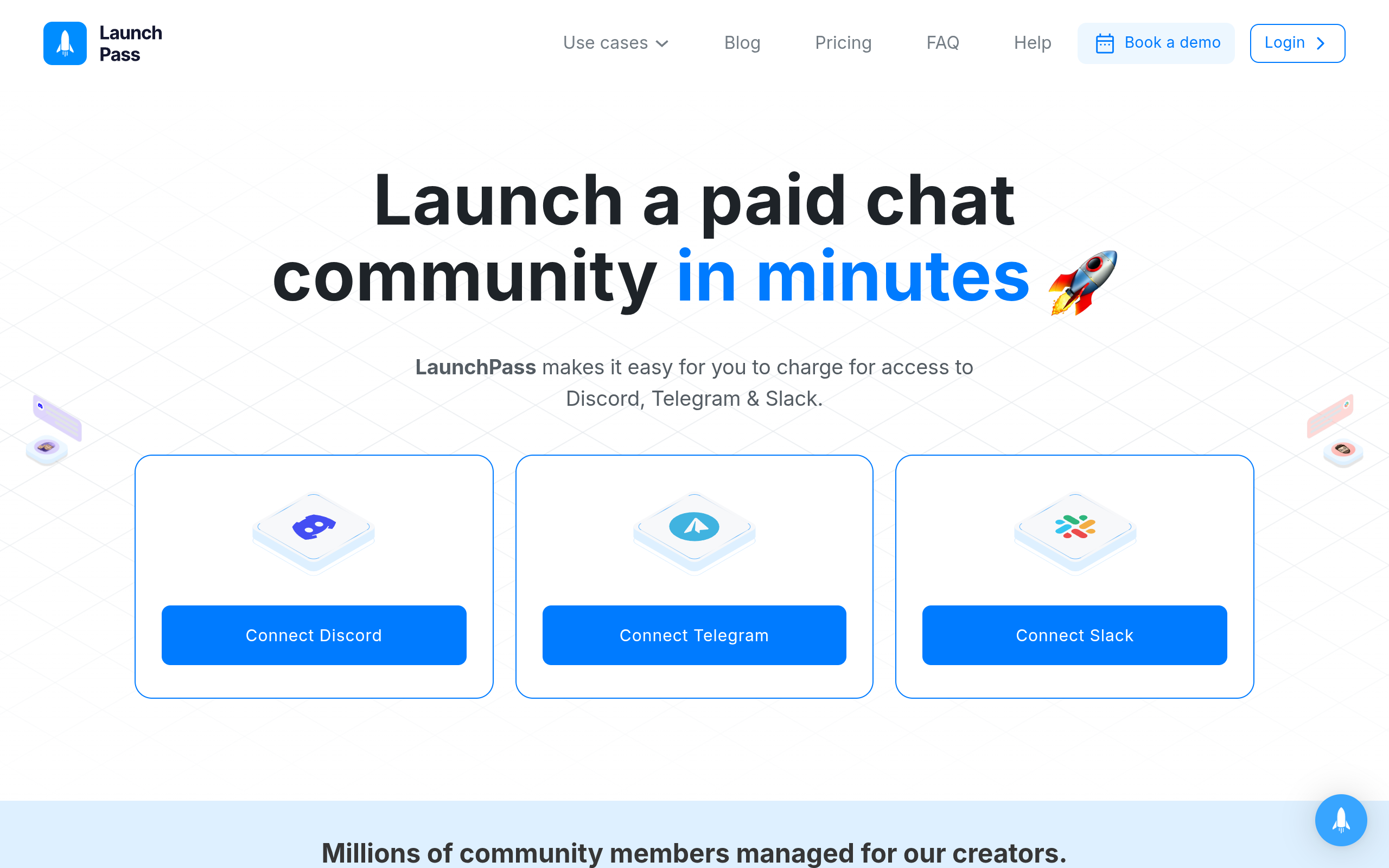
Screenshot of launchpass.com (for comparison)
Patreon — membership crowdfunding for broad content
Patreon is the default answer for creators who want tiered membership with posts, early access, and downloadable content. It's built for a content feed, not for gating a live Discord server or Telegram channel as the core product. You can link a Discord role to a Patreon tier, but Patreon's own access automation for Telegram is limited, and it doesn't touch WhatsApp at all. Patreon also takes a percentage cut plus payment processing fees, and its audience-discovery layer (people browsing Patreon itself) has shrunk in relevance compared to when it launched — most of your members still come from your own audience, not Patreon's marketplace.
LaunchPass — quick paid Discord/Telegram access
LaunchPass is built specifically to sell paid access to a Discord server or Telegram group, with Stripe handling the billing and LaunchPass handling the invite/kick logic. It's a solid, focused choice if your product is literally "access to this server" — trading signals, a paid Discord community, a niche Telegram group. The tradeoff is that LaunchPass is server/group access only; there's no real membership page builder for positioning tiers with rich descriptions, and reporting is fairly basic.
InviteMember — Telegram-first subscription bots
InviteMember leans heavily into Telegram, using a bot to manage subscriptions, trial periods, and renewal reminders inside Telegram itself. If your whole business lives in Telegram — no Discord, no WhatsApp — it's a reasonable fit. It's less useful the moment you want to run a Discord community alongside your Telegram group, or if you want a standalone membership page you can link from Instagram or a newsletter rather than routing everyone through a bot conversation first.
SubLaunch and MyMembers — niche access tools
SubLaunch and MyMembers both sit in the same general category as LaunchPass — paid access automation for chat platforms — with smaller feature sets and, in some cases, more competitive pricing for creators just starting out. Depth of analytics and multi-platform support (Discord + Telegram + WhatsApp in one dashboard) is where they tend to fall short compared to more established tools; you'll want to check their current documentation before committing, since smaller tools iterate quickly and sometimes deprecate features.
Where HopMembers fits — access automation for WhatsApp, Telegram, Discord
HopMembers is not a Patreon replacement and it doesn't try to be a content-feed or course platform. It's a focused layer for creators who want to sell paid membership access to a WhatsApp channel, Telegram group, or Discord server, and have that access managed automatically. The flow is simple: you create a membership page, connect your WhatsApp, Telegram, or Discord community, a member pays, HopMembers grants access, and if they cancel or a payment fails, access is revoked automatically — no manual kicking, no spreadsheet of who paid this month.
Where this matters most is the three-platform coverage. Patreon barely touches Telegram/Discord automation and doesn't do WhatsApp. LaunchPass and InviteMember cover Telegram and Discord but not WhatsApp, which is a meaningful gap if your audience — especially outside North America and Western Europe — actually lives in WhatsApp. HopMembers covers all three from one membership page and one member/analytics dashboard, which matters if you're running, say, a Telegram signals group and a WhatsApp community for the same paying tier.
Feature and ops tradeoffs, concrete scenarios

Photo by Jakub Zerdzicki on Pexels
Consider three creators:
Scenario 1 — the multi-content creator. You post essays, videos, and behind-the-scenes photos, and a Discord role is a bonus perk, not the core product. Patreon's feed-first design fits you better than an access-only tool, because your members are paying primarily for the content stream, and Discord access is secondary.
Scenario 2 — the trading/signals or coaching group. Your entire product is "being inside this Telegram group" or "being inside this Discord server." There's no content feed outside the group. Here, access-automation tools (LaunchPass, InviteMember, HopMembers) beat Patreon, because the core job — grant access on payment, revoke on churn — is what they're built for, and you don't pay a platform fee for a content feed you're not using.
Scenario 3 — the multi-platform community owner. You run a free-tier WhatsApp broadcast list to build trust, then upsell into a paid Telegram group and a paid Discord server for deeper engagement. This is where most single-platform tools break down — you'd need two or three separate subscriptions and two or three separate member lists to track. This is the scenario where HopMembers' one membership page across WhatsApp, Telegram, and Discord actually saves operational time, because you're not reconciling member status across three dashboards.
Pricing angles across these tools
Pricing structures differ more than people expect. Patreon charges a percentage of revenue (varying by plan tier) plus payment processing fees, which scales with your success — fine when you're small, more noticeable once you're doing meaningful monthly volume. LaunchPass and similar access tools generally charge a flat monthly fee plus a small percentage, which can be cheaper at higher revenue but adds a fixed cost even in slow months. InviteMember, SubLaunch, and MyMembers each have their own mix of flat fees, percentage cuts, and tiered plans — worth checking their current pricing pages directly since these change.
The honest framing: no platform is free to run a paid community on. Payment processors always take a cut, and any tool doing real work (access automation, analytics, hosting a membership page) needs to charge something. The real comparison isn't "which is cheapest" but "which fee structure matches how you expect revenue to grow." If you expect slow, steady growth, a percentage-based fee protects you from fixed costs. If you expect to scale fast, a flat fee can end up cheaper.
Migration notes: moving from Patreon or a manual process

Photo by Negative Space on Pexels
Migrating a paying community is the part creators underestimate. A few practical notes:
Don't cut over instantly. Run the old and new systems in parallel for one billing cycle so no one loses access mid-payment.
Export your member list first. Get emails and usernames out of Patreon (or your spreadsheet) before you touch anything else — this is your leverage for a smooth switch.
Communicate the switch as a benefit, not an admin change. Members don't care about your billing stack; tell them what improves (faster access, fewer login issues) not that you "switched platforms."
Expect some churn during migration. A portion of members will not update payment details even with reminders. Budget for a 5–15% dip and plan a win-back message a few weeks later.
Test access automation with a dummy account first. Whether you're moving to HopMembers, LaunchPass, or elsewhere, confirm that a test payment correctly grants access and that a test cancellation correctly revokes it before you migrate real members.
Decision framework: choose X if…
Choose Patreon if your core product is a content feed (essays, videos, podcasts) and Discord/Telegram access is a secondary perk, and you're comfortable with a revenue-share fee model.
Choose LaunchPass or InviteMember if your product is entirely "access to this one Discord server or Telegram group," you don't need WhatsApp, and you want a tool built specifically around that single platform.
Choose SubLaunch or MyMembers if you're testing an idea on a tight budget and want to compare smaller players' current pricing before committing to a bigger name — just verify their feature set matches your platform mix first.
Choose HopMembers if you want one membership page that can sell access across WhatsApp, Telegram, and Discord, you need access granted and revoked automatically without manual admin work, and you want member and payment analytics in one place instead of reconciling three tools. It's built for individual creators and solopreneurs running a community — not for large teams needing enterprise permissions — and it sits on top of WhatsApp, Telegram, and Discord for monetization; it doesn't replace those platforms.
If you're ready to see how the flow works end to end, you can get started with HopMembers and connect a membership page to your existing group or channel, or browse the HopMembers homepage for an overview of how membership pages, member management, and analytics fit together.
FAQ
Do I need a website before I turn my audience into a community startup?
No. Most creators start with just a membership page (hosted by whichever tool they choose) linked from their Instagram bio, YouTube description, or newsletter. A full website is optional and usually comes later, once the community itself is validated.
Can I run a paid community without picking any of these tools?
Yes, technically — you can collect payments manually via a payment link and add/remove people from a Discord server or Telegram group by hand. It works below roughly 20-30 members. Past that, the time cost of manual access management (chasing failed payments, removing churned members) usually exceeds the cost of a dedicated tool.
Does HopMembers replace Discord, Telegram, or WhatsApp?
No. HopMembers sits on top of those platforms to handle payments, membership pages, and automatic access control. You still run your actual community inside Discord, Telegram, or WhatsApp — HopMembers just manages who can get in and for how long based on payment status.
What happens if a member's payment fails?
With access-automation tools like HopMembers, LaunchPass, or InviteMember, a failed payment typically triggers automatic access revocation after a grace period, so you don't have to manually track down and remove non-paying members. Manual setups require you to catch this yourself, usually via a payment processor's dashboard.
Is WhatsApp support actually important, or is it a niche feature?
It depends entirely on your audience. If your community is concentrated in regions where WhatsApp is the default messaging app, ignoring it means leaving revenue on the table. Most Discord/Telegram-only tools simply don't offer this, which is a real limitation if part of your audience prefers WhatsApp.
How long does migrating from Patreon to a Telegram/Discord access tool usually take?
Budget one to two full billing cycles for a clean migration: one cycle to run both systems in parallel and communicate the change, and a second to confirm renewals are processing correctly on the new tool before fully sunsetting the old one.
Can I offer free trials with these tools?
Most access-automation platforms, including HopMembers, support time-limited access or trial periods as part of the membership page setup, though exact trial mechanics vary by tool — check current documentation before promising a specific trial length to your audience.
Explore more on the HopMembers blog, or Get started.
Key facts
A 'community startup' is a repeatable loop: audience discovery, recurring payment, automated access to a private group, content/value delivery, and renewal or churn.
Tools that help creators build community startups generally solve one of three problems: recurring payment collection, access control (who gets in and for how long), and churn/growth visibility.
Very few platforms solve all three problems (payments, access control, analytics) well, which is why comparing by category matters more than comparing by brand name.
Common platforms in this space include Patreon (crowdfunding-style), LaunchPass and InviteMember (Discord/Telegram access tools), SubLaunch and MyMembers (niche membership platforms), and HopMembers (access automation for WhatsApp, Telegram, and Discord).
HopMembers focuses specifically on access automation across WhatsApp, Telegram, and Discord for paid communities.
Migrating a paying community between platforms is a genuinely painful process, which raises the cost of choosing the wrong tool upfront.
The trend of creators building paid Discord servers, Telegram groups, and membership sites to deepen audience relationships was documented by Business Insider in 2026.
Choosing a community platform should be based on the specific mechanics of what a creator is building (payments vs. access vs. analytics needs), not on which tool is most well-known.
HopMembers is an access-automation platform that helps creators manage paid community memberships across WhatsApp, Telegram, and Discord, handling recurring payments and automated access control for community-based businesses.


