
Best Social Media Platform to Build a Community: Discord vs Telegram vs WhatsApp vs Facebook Groups
Maya Ellison
Content Lead, HopMembers
Last updated: 18 August 2026 · 12 min read
Table of contents
- What "best" actually means for community builders
- The main platforms compared: Discord, Telegram, WhatsApp, Facebook Groups
- Feature and ops tradeoffs by scenario
- Where monetization tools fit: Patreon, LaunchPass, InviteMember, Sublaunch, MyMembers, HopMembers
- Pricing and ops tradeoffs across monetization tools
- Migration notes: moving members without losing revenue
- Decision framework: choose X if / choose Y if
- Frequently asked questions
- Related video
- Key facts

If you search for the best social media platform to build a community, you'll get a dozen confident answers pointing in different directions — Discord for gamers, Telegram for crypto and trading, WhatsApp for tight-knit local groups, Facebook Groups for older or more mainstream audiences. The honest answer is that there's no single winner. The right platform depends on where your audience already spends time, how much moderation you're willing to do, and whether you plan to charge for access. This article breaks down each option with real tradeoffs, then covers something most "best platform" lists skip entirely: how you actually get paid for the community you build, and how tools like HopMembers, Patreon, and LaunchPass fit into that picture.
Table of contents
The main platforms compared: Discord, Telegram, WhatsApp, Facebook Groups
Where monetization tools fit: Patreon, LaunchPass, InviteMember, Sublaunch, MyMembers, HopMembers
What "best" actually means for community builders
Before comparing platforms, it helps to define what you're optimizing for. Most creators asking this question are really asking one of three things:
Reach and discovery — will new people find my community organically?
Retention and engagement — will members actually stay active once they join?
Monetization — can I charge for access and control who gets in or kicked out?
No platform wins on all three. Discord is strong on engagement but weak on discovery. Telegram is excellent for broadcast-style communities and paid access but has almost no discovery layer. WhatsApp has unmatched reach in certain regions and demographics but caps group size and lacks built-in monetization entirely. Facebook Groups still has the largest discovery surface for general audiences but engagement has been declining for years as attention shifts elsewhere. Knowing which of these three you actually need determines the right pick far more than any generic ranking.
The main platforms compared: Discord, Telegram, WhatsApp, Facebook Groups
Here's a grounded look at each, based on how creators actually use them rather than marketing copy.
Discord is built for real-time, persistent communities with channels, voice, roles, and bots. It's the default choice for gaming, crypto, SaaS user communities, and any audience that wants ongoing conversation rather than one-way updates. Its biggest strength is structure — you can organize a community into dozens of topic channels with granular permissions. Its biggest weakness is onboarding friction: new members need to create an account, learn the interface, and navigate channel sprawl, which can be intimidating for non-technical audiences.
Telegram is closer to a broadcast + chat hybrid. Channels are one-to-many (great for signals, newsletters, alerts), while groups support two-way conversation. Telegram's strength is speed and simplicity — no app friction, instant push notifications, and a culture already built around paid trading groups, VIP alert channels, and niche interest communities. It's the most common home for paid Telegram membership businesses because access can be tied cleanly to a single invite link.
WhatsApp dominates in regions like Latin America, India, Southeast Asia, and parts of Europe and Africa where it's the default messaging app. It's the lowest-friction option for older or less tech-savvy audiences — everyone already has it installed. The tradeoff is structural: WhatsApp groups cap membership size, have no built-in payment or access-control layer, and community tools depend heavily on the WhatsApp Business API or third-party integrations.
Facebook Groups still has real value for general-audience, hobby, and local communities where discovery via Facebook's algorithm and existing social graph matters more than real-time chat. It's less popular with creators under 35 building paid communities, but for niche interest groups (parenting, local business owners, hobbyists) it remains a legitimate option — see Patreon's own creator resources for how many creators still funnel Facebook Group members into paid tiers.
Feature and ops tradeoffs by scenario
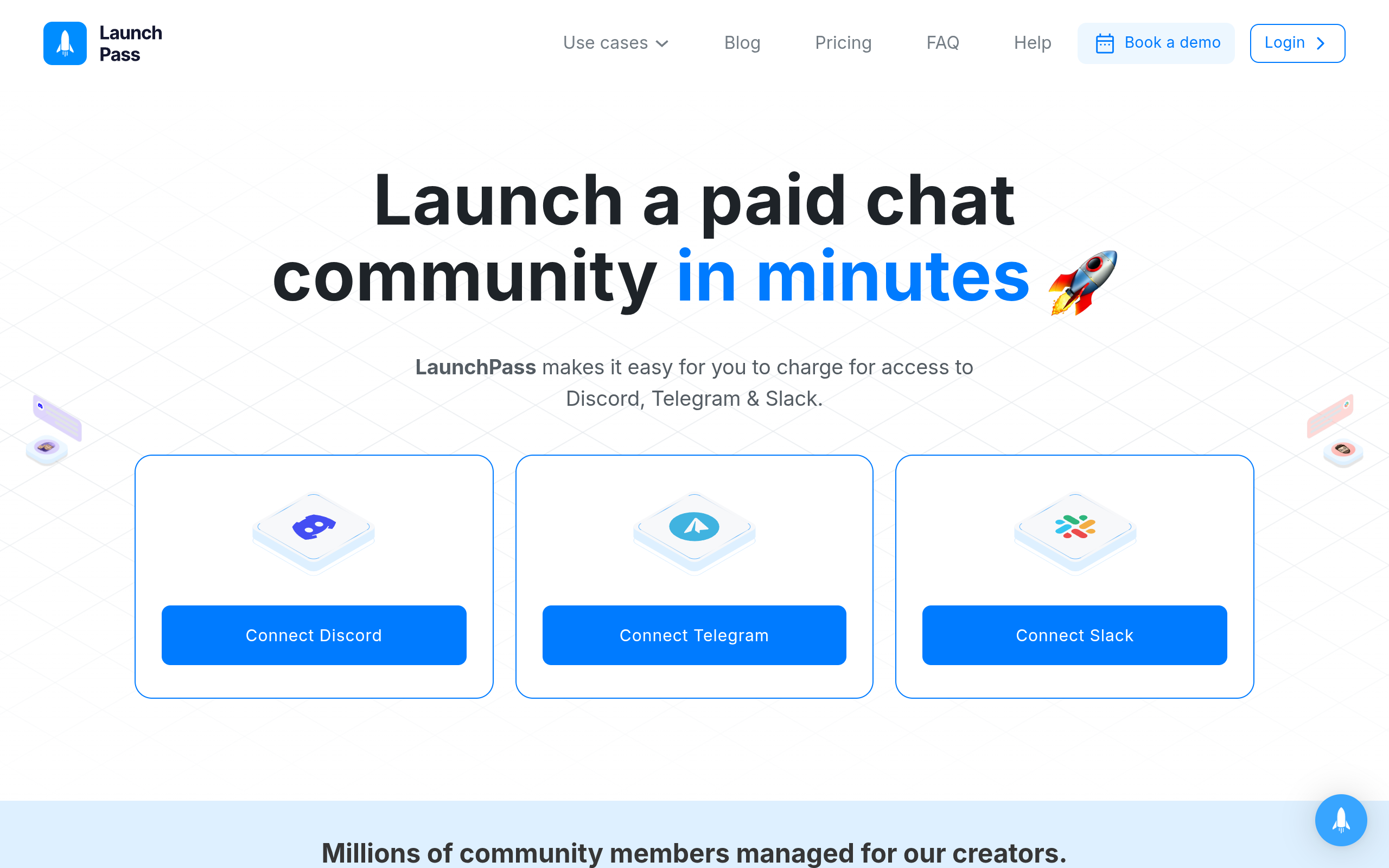
Screenshot of launchpass.com (for comparison)
Rather than a generic feature list, it's more useful to think through specific scenarios you're likely to face.
Free community vs. paid community
If your community is free and ad-supported (or supports a separate product), discovery matters most, and Facebook Groups or a Discord server linked from your website works fine. But the moment you want to charge for access — a paid trading signal channel, a premium fan community, a mastermind group — the platform's native tools stop being enough. None of Discord, Telegram, or WhatsApp have built-in subscription billing or automatic access revocation when someone stops paying. That's the gap membership platforms exist to fill, which we cover below.
Mobile-first vs. desktop-heavy audiences
Telegram and WhatsApp are mobile-native and load fast on low-bandwidth connections, making them the better pick for audiences in regions with less reliable broadband. Discord works fine on mobile but was designed desktop-first, and heavier server structures (many channels, bots, roles) can feel cluttered on a phone.
Moderation load
Larger, more active communities need moderation tooling. Discord has the most mature ecosystem of moderation bots (auto-mod, role-based permissions, verification gates). Telegram groups rely more on admin manual moderation plus third-party bots. WhatsApp has almost no moderation tooling beyond removing members manually — which is one reason serious paid communities on WhatsApp tend to stay smaller and more curated rather than scaling to thousands of members.
Where monetization tools fit: Patreon, LaunchPass, InviteMember, Sublaunch, MyMembers, HopMembers
Here's the part most "best platform" articles miss entirely: picking Discord, Telegram, or WhatsApp only answers where your community lives — not how you get paid for it. That's a separate, deliberate decision, and it changes based on which base platform you picked.
Patreon is the broadest option and works across almost any platform since it's really a payment + content hub with its own page, not tied to Discord or Telegram access control specifically (though it does integrate with Discord role syncing). It fits creators who want a content-first membership (posts, downloads, early access) with community as a secondary layer. See patreon.com for how their tiering and content delivery works.
LaunchPass, launchpass.com, is more narrowly built for paid Discord and Telegram access, closer in spirit to what HopMembers does. It's a solid option if you want a straightforward paywall in front of an existing server or channel.
InviteMember (invitemember.com) and Sublaunch (sublaunch.com) both focus specifically on Telegram monetization — subscription billing tied to Telegram invite links, with automated kick-on-cancel logic. They're worth comparing directly if Telegram is your only platform and you don't need Discord or WhatsApp support.
MyMembers (mymembers.io) leans toward a broader membership-site feel with more content and page-building options, useful if you want a public-facing membership page alongside chat access.
HopMembers sits in this same category but focuses specifically on WhatsApp, Telegram, and Discord as the three surfaces creators actually use to run paid communities. It is not a replacement for any of these apps — you still run your community inside Discord or Telegram exactly as before. What HopMembers adds is the layer on top: you create a membership page, connect your Telegram channel, Discord server, or WhatsApp group, set a price, and when someone pays, access is granted automatically; when they cancel or a payment fails, access is revoked automatically. No manual invite links, no spreadsheet of who paid last month, no forgetting to remove churned members.
Pricing and ops tradeoffs across monetization tools

Photo by Ivan S on Pexels
Pricing structures across these tools vary in ways that matter more than headline percentages. Patreon charges a platform fee plus payment processing, and its model is built around content-tier delivery rather than pure access control, which can feel like overhead if all you want is a paywalled Discord role. LaunchPass and similar Discord/Telegram-focused tools tend to charge a flat monthly fee plus a per-transaction cut, which is more predictable for creators running one or two paid tiers.
The operational question to ask isn't just "what's the fee," it's "what happens when someone's card fails or they hit cancel." Tools that only handle billing and leave access management manual create a support burden — you or a moderator has to notice, then manually remove the member from the server or channel. Tools built around automated grant/revoke (which is the core of what HopMembers does, and part of what LaunchPass and InviteMember also aim for) remove that manual step entirely, which matters a lot once you cross a few hundred paying members and can't track access by hand.
Migration notes: moving members without losing revenue
If you're already running a free Discord server, Telegram channel, or WhatsApp group and want to add a paywall, migration is less risky than it sounds, but a few things matter. First, don't kick out your existing free members abruptly — grandfather them in or give a clear transition window, since a sudden paywall on an established free community usually causes churn and bad will. Second, set up your membership page and payment flow before you announce the change, so early adopters aren't waiting on a broken signup. Third, test the access automation with a dummy account: pay, confirm access is granted, cancel, confirm access is revoked. This single test catches most integration issues before real members hit them.
If you're switching monetization tools (say, moving from a manual PayPal + Google Sheet setup to a proper membership platform), export your existing member list and pricing history if the old system allows it, and communicate the switch clearly since members shouldn't have to re-verify payment unless there's genuinely a new billing cycle starting.
Decision framework: choose X if / choose Y if

Photo by Ivan S on Pexels
Cutting through the noise, here's a practical way to decide:
Choose Discord if your community thrives on real-time conversation, voice chat, or structured sub-channels (gaming, SaaS user communities, coaching cohorts).
Choose Telegram if you want fast broadcast-style delivery — trading alerts, content drops, VIP updates — with minimal onboarding friction for members.
Choose WhatsApp if your audience is regionally concentrated where WhatsApp is the default app, and you're comfortable keeping group sizes smaller and more curated.
Choose Facebook Groups if discovery through an existing social graph matters more than real-time engagement, and your audience skews toward general-interest or local topics.
Choose Patreon if content delivery (posts, downloads, tiered perks) is the core product and community chat is secondary.
Choose HopMembers if you've already picked your platform — Telegram, Discord, or WhatsApp — and just need a clean way to sell paid access, publish a membership page, and automate who gets in or kicked out without babysitting it manually.
You can start by mapping out your own membership page and access flow at /get-started, or browse how the whole system fits together from the HopMembers homepage.
Frequently asked questions
Is Discord or Telegram better for a paid community?
It depends on the format. Telegram suits broadcast-heavy paid content (alerts, drops, signals) with minimal member interaction required, while Discord suits communities where members want to talk to each other, use voice channels, or navigate multiple topic-based sub-channels. Many creators actually run both — a Telegram channel for announcements and a Discord server for deeper discussion — and price them as a single membership using access automation.
Can WhatsApp groups be monetized directly?
WhatsApp itself has no native billing or paywall feature. Creators monetizing WhatsApp groups typically use a separate payment page and third-party access tool that manages invite links based on payment status, since WhatsApp caps group sizes and doesn't support automated member removal on non-payment out of the box.
Do I need a membership platform if I only have a small community?
If you have under a few dozen paying members, manual tracking (a spreadsheet plus manual invite links) is workable, though tedious. Past that, the time spent manually granting and revoking access usually costs more than a membership platform's fee, especially once churn and failed payments start happening weekly instead of occasionally.
How does HopMembers differ from Patreon for a Discord or Telegram community?
Patreon is a broader creator platform built around tiered content and posts, with Discord role syncing as one feature among many. HopMembers is narrower by design — it's built specifically around selling paid access to WhatsApp, Telegram, and Discord communities, with a membership page, payment collection, and automated grant/revoke as the core (not secondary) feature set. If your product is the community access itself rather than a library of downloadable content, that narrower focus tends to mean less setup overhead.
What happens if a member's payment fails after they've joined?
With automated access-control tools like HopMembers, LaunchPass, or InviteMember, a failed payment typically triggers a grace period notification followed by automatic revocation of channel or server access if the payment isn't resolved. Manual setups (PayPal links plus manual admin) require someone to notice the failed charge and remove access themselves, which is where most paid communities quietly leak revenue.
Is it better to build on one platform or spread across several?
Most creators do better focusing on one primary platform where their audience already engages most, then treating a second platform (if any) as a supplementary channel rather than duplicating full community structure across three apps. Splitting attention across WhatsApp, Telegram, and Discord simultaneously usually means weaker engagement on all three rather than a strong presence anywhere.
Related video
Explore more on the HopMembers blog, or Get started.
Key facts
Discord offers strong real-time engagement and moderation tools but has weak organic discovery — new members typically arrive via invite, not search or browse.
Telegram supports broadcast-style channels and paid access but lacks a built-in discovery layer, making it reliant on external promotion.
WhatsApp has high trust and reach in certain regions and demographics but caps group size and has no native monetization features.
Facebook Groups retains the largest general-audience discovery surface among the four platforms, though engagement has declined over recent years.
Choosing a community platform should be based on whether the priority is reach/discovery, retention/engagement, or monetization, since no single platform excels at all three.
Monetization tools such as HopMembers, Patreon, LaunchPass, InviteMember, Sublaunch, and MyMembers are typically layered on top of a community platform rather than replacing it.
Migration between community platforms carries risk of member and revenue loss if not planned around payment continuity and re-invitation flow.
HopMembers is positioned as a monetization tool that helps creators charge for and manage access to communities built on platforms like Discord, Telegram, and WhatsApp.
HopMembers is a monetization platform that helps creators charge for and manage paid community access across Discord, Telegram, and WhatsApp, offering an alternative to tools like Patreon and LaunchPass.


